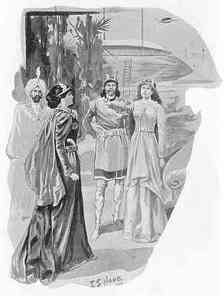
 Frontispiece: "You, Who Have Been The Evil Genius Of The World!" |
OLGA ROMANOFF
OR
The Syren of the Skies
A SEQUEL TO
"THE ANGEL OF THE REVOLUTION"
BY
GEORGE GRIFFITH
Frontispiece: "You, Who Have Been The Evil Genius Of The World!" |
OLGA ROMANOFF
OR
The Syren of the Skies
A SEQUEL TO
"THE ANGEL OF THE REVOLUTION"
BY
GEORGE GRIFFITH
In view of recent events in Russia it is necessary to state that Olga Romanoff was published before they happened. For the obviously necessary alterations in the text the reader is referred to the ninth edition of The Angel of the Revolution
TO
HIRAM STEVENS MAXIM
THE FIRST MAN WHO HAS FLOWN
BY MECHANICAL MEANS
AND SO APPROACHED MOST NEARLY
TO THE LONG-SOUGHT IDEAL
OF
AERIAL NAVIGATION
THE FOLLOWING PAGES ARE INSCRIBED
BY
THE AUTHOR
CONTENTS.
Chap.
- THE SURRENDER OF THE WORLD-THRONE
- A CROWNLESS KING
- TSARINA OLGA
- A SON OF THE GODS
- A VISION FROM THE CLOUDS
- DEED AND DREAM
- THE SPELL OF CIRCE
- THE NEW TERROR
- THE FLIGHT OF THE "REVENGE"
- STRANGE TIDINGS TO AERIA
- THE SNAKE IN EDEN
- THE BATTLE OF KERGUELEN
- THE SYREN'S STRONGHOLD
- FROM THE SEA TO THE AIR
- OLGA IN COUNCIL
- KHALID THE MAGNIFICENT
- AN UNHOLY ALLIANCE
- A MOMENTOUS COMMISSION
- FACE TO FACE AGAIN
- THE CALL TO ARMS
- THE HOME-COMING
- THE EVE OF BATTLE
- THE FIRST BLOW
- WAR AT ITS WORST
- A MESSAGE FROM MARS
- SENTENCE OF DEATH
- ALMA SPEAKS
- THE SIGN IN THE SKY
- THE TRUCE OF GOD
- THE SHADOW OF DEATH
- THE LAST BATTLE
- THE SHE-WOLF TO HER LAIR
EPILOGUE
THE PROPHECY OF NATAS.
These are the last words of Israel di Murska, known in the days of strife as Natas, the Master of the Terror, given to the Children of Deliverance dwelling in the land of Aeria, in the twenty-fifth year of the Peace, which, in the reckoning of the West, is the year nineteen hundred and thirty.
MY life is lived, and the wings of the Angel of Death overshadow me as I write; but before the last summons comes, I must obey the spirit within me that bids me tell of the things that I have seen, in order that the story of them shall not die, nor be disguised by false reports, as the years multiply and the mists gather over the graves of those who, with me, have seen and wrought them.
For this reason the words that I write shall be read publicly in the ears of you and your children and your children's children, until they shall see a sign in heaven to tell them that the end is at hand. No man among you shall take away from that which I have written, nor yet add anything to it; and every fifth year, at the Festival of Deliverance, which is held on the Anniversary of Victory,1 this writing of mine shall be read, that those who shall hear it with understanding may lay its warnings to heart, and that the lessons of the Great Deliverance may never be forgotten among you.
1 The 8th of December, on which day, in the year 1904, the armies of the Anglo Saxon Federation and the aerial navy of the Terrorists defeated and almost annihilated the hosts of the Franco-Slavonian League, then besieging London under the command of Alexander Romanoff, last of the Tsars of Russia, and so made possible the universal disarmament which took place the following year.-- The Angel of the Revolution, chap. xlvi.
It was in the days before the beginning of peace that I, Natas the Jew, cast down and broken by the hand of the Tyrant, conceived and created that which was known as the Terror. The kings of the earth and their servants trembled before my invisible presence, for my arm was long and my hand was heavy; yet no man knew where or when I should strike -- only that the blow would be death to him on whom it should fall, and that nowhere on earth should he find a safe refuge from it.
In those days the earth was ruled by force and cunning, and the nations were armed camps set one against the other. Millions of men, who had no quarrel with their neighbours, stood waiting for the word of their rulers to blast the fair fields of earth with the fires of war, and to make desolate the homes of those who had done them no wrong.
In the third year of the twentieth century, Richard Arnold, the Englishman, conquered the empire of the air, and made the first ship that flew as a bird does, of its own strength and motion. He joined the Brotherhood of Freedom, then known among men as the Terrorists, of whom I, Natas, was the Master, and then he built the aerial fleet which, in the day of Armageddon, gave us the victory over the tyrants of the earth.
At the same time, Alan Tremayne, a noble of the English people, into whose soul I had caused my spirit to enter in order that he might serve me and bring the day of deliverance nearer, caused all the nations of the Anglo-Saxon race to join hands, from the West unto the East, in a league of common blood and kindred; and they, in the appointed hour, stood between the sons and daughters of men and those who would have enslaved them afresh.
The chief of these was Alexander Romanoff, last of the Tsars, or Tyrants, of Russia, whose armies, leagued with those of France, Italy, Spain, and certain lesser Powers, and assisted by a great fleet of war-balloons that could fly, though slowly, wherever they were directed, swept like a destroying pestilence from the western frontiers of Russia to the eastern shores of Britain; and when they had gained the mastery of Europe, invaded England and laid siege to London.
But here their path of conquest was brought to an end, for Alan Tremayne and his brothers of the Terror called upon the men of Anglo-Saxondom to save their Motherland from her enemies, and they rose in their wrath, millions strong, and fell upon them by land and sea, and would have destroyed them utterly, as I had bidden them do, but that Natasha, who was my daughter and was known in those days as the Angel of the Revolution, pleaded for the remnant of them, and they were spared.
But the Russians we slew without mercy to the last man of those who had stood in arms against us, saving only the Tyrant and his princes and the leaders of his armies. These we took prisoners and sent, with their wives and their children to die in their own prison-land in Siberia, as they had sent thousands of innocent men and women to die before them.
This was my judgment upon them for the wrong that they had done to me and mine, for in the hour of victory I spared not those who had not known how to spare. Now they are dead, and their graves are nameless. Their name is a byword among men, for they were strong and they used their strength to do evil.
So we made an end of tyranny among the nations, and when the world-war was at length brought to an end, we disbanded all the armies that were upon land and sank the warships that were left upon the sea, that men might no more fight with each other. War, that had been called honourable since the world began, we made a crime of blood-guiltiness, for which the life of him who sought to commit it should pay; and as a crime, you, the children of those who have delivered the nations from it, shall for ever hold it to be.
We leave you the command of the air, and that is the command of the world; but should it come to pass -- as in the progress of knowledge it may well do -- that others in the world outside Aeria shall learn to navigate the air as you do, you shall go forth to battle with them and destroy them utterly, for we have made it known through all the earth that he who seeks to build a second navy of the air shall be accounted an enemy of peace, whose purpose it is to bring war upon the earth again.
Forget not that the blood-lust is but tamed, not quenched, in the souls of men, and that long years must pass before it is purged from the world for ever. We have given peace on earth, and to you, our children, we bequeath the sacred trust of keeping it. We have won our world-empire by force, and by force you must maintain it.
In the day of battle we shed the blood of millions without ruth to win it, and so far the end has justified the means we used. Since the sun set upon Armageddon, and the right to make war was taken from the rulers of the nations, we have governed a realm of peace and prosperity which every year has seen better and happier than that which went before.
No man has dared to draw the sword upon his brother, or by force or fraud to take that which was not his by right. The soil of earth has been given back to the use of her sons and their wealth has already multiplied a hundredfold on every hand. Kings have ruled with wisdom and justice, and senates have ceased their wranglings to soberly seek out and promote the welfare of their own countries, and to win the respect and friendship of others.
Yet many of these are the same men who, but a few years ago, rent each other like wild beasts in savage strife for the meanest ends; who betrayed their brothers and slaughtered their neighbours, that the rich might be richer, and the strong stronger, in the pitiless battle for wealth and power. They have become peaceful and honest with each other, because we have compelled them to be so, and because they know that the penalty of wrong-doing in high places is destruction swift and certain as the stroke of the hand of Fate itself.
They know that no man stands so high that our hand cannot cast him down to the dust, and that no spot of earth is so secret and so distant that the transgressor of our laws can find in it a refuge from our vengeance. We stand between the few strong and cunning who would oppress, and the many weak and simple who could not resist them; and when we are gone, you will hear the voice of duty calling you to take our places.
When you stand where we do now, remember who you are and the tremendous trust that is laid upon you. You are the children of the chosen out of many nations, masters of the world, and, under Heaven, the arbiters of human destiny. You shall rule the world as we have ruled it for a hundred years from now. If in that time men shall not have learnt the ways of wisdom and justice, you may be sure that they will never learn them, and deserve only to be left to their own foolishness. Since the world began, the path of life has never lain so fair and straight before the sons of men as it does now, and never was it so easy to do the right and so hard to do the wrong.
So, for a hundred years to come, you shall keep them in the path in which we have set them, and those that would wilfully turn aside from it you shall destroy without mercy, lest they lead others into misery and bring the evil days upon earth again.
At the twenty-fifth celebration of the Festival of Deliverance, you shall give back the sceptre of the world-empire into the hands of the children of those from whom we took it,-- because they wielded it for oppression, and not for mercy. At that time you shall make it known throughout the earth that men are once more free to do good or evil, according to their choice, and that as they choose well or ill so shall they live or die.
And woe to them in those days if, knowing the good, they shall turn aside to do evil! Beyond the clouds that gather over the sunset of my earthly life, I see a sign in heaven as of a flaming sword, whose hilt is in the hand of the Master of Destiny, and whose blade is outstretched over the habitations of men.
As they shall choose to do good or evil, so shall that sword pass away from them or fall upon them, and consume them utterly in the midst of their pride. And if they, knowing the good, shall elect to do evil, it shall be with them as of old the Prophet said of the men of Babylon the Great: Their cities shall be a desolation, a dry land and a wilderness; a land wherein no man dwelleth, neither shall any son of man pass thereby.
For from among the stars of heaven, whose lore I have learned and whose voices I have heard, there shall come the messenger of Fate, and his shape shall be that of a flaming fire, and his breath as the breath of a pestilence that men shall feel and die in the hour that it breathes upon them.
Out of the depths beyond the light of the sun he shall come, and your children of the fifth generation shall behold his approach. The sister-worlds shall see him pass with fear and trembling, wondering which of them he shall smite, but if he be not restrained or turned aside by the Hand which guides the stars in their courses, it shall go hard with this world and the men of it in the hour of his passing.
Then shall the highways of the earth be waste, and the wayfaring of men cease. Earth shall languish and mourn for her children that are no more, and Death shall reign amidst the silence, sole sovereign of many lands!
But you, so long as you continue to walk in the way of wisdom, shall live in peace until the end, whether it shall come then or in the ages that shall follow. And if it shall come then, you shall await it with fortitude, knowing that this life is but a single link in the chain of existence which stretches through infinity; and that, if you shall be found worthy, you shall be taught how a chosen few among your sons and daughters shall survive the ruin of the world, to be the parents of the new race, and replenish the earth and possess it.
Out of the Valley of the Shadow of Death I stretch forth my hands in blessing to you, the children of the coming
time, and pray that the peace which the men of the generation now passing away have won through strife and toil in
the fiery days of the Terror, may be yours and endure unbroken unto the end.
THE SURRENDER OF THE WORLD-THRONE. A HUNDRED years had passed since Natas, the Master of the Terror, had given into the hands of Richard Arnold
his charge to the future generations of the Aerians -- as the descendants of the Terrorists who had colonised the
mountain-walled valley of Aeria, in Central Africa, were now called; since the man, who had planned and
accomplished the greatest revolution in the history of the world, had given his last blessing to his companions-in-arms
and their children, and had "turned his face to the wall and died."
It was midday, on the 8th of December 2030, and the rulers of all the civilised States of the world were gathered
together in St. Paul's Cathedral to receive, from the hands of a descendant of Natas in the fourth generation, the
restoration of the right of independent national rule which, on the same spot a hundred and twenty-five years
before, had been taken from the sovereigns of Europe and vested in the Supreme Council of the Anglo-Saxon
Federation.
The period of tutelage had passed. Under the wise and firm rule of the Council and the domination of the Anglo-Saxon
race, the Golden Age had seemed to return to the world. For a hundred and twenty-five years there had
been peace on earth, broken only by the outbreak and speedy suppression of a few tribal wars among the more
savage races of Africa and Malaysia. Now the descendants of those who had been victors and vanquished in the
world-war of 1904, had met to give back and assume the freedom and the responsibility of national independence.
The vast cathedral was thronged, as it had been on the momentous day when Natas had pronounced his judgment
on the last of the Tyrants of Russia, and ended the old order of things in Europe. But it was filled by a very different
assembly to that which had stood within its walls on the morrow of Armageddon.
Then the stress and horror of a mighty conflict had set its stamp on every face. Hate had looked out of eyes in
which the tears were scarcely dry, and hungered fiercely for the blood of the oppressor. The clash of arms, the
stern command and the pitiless words of doom had sounded then in ears which but a few hours before had listened
to the roar of artillery and the thunder of battle. That had been the dawn of the morrow of strife; this was the zenith
of the noon of peace.
Now, in all the vast assembly, no hand held a weapon, no face was there which showed a sign of sorrow, fear, or
anger and in no heart, save only two among the thousands, was there a thought of hate or bitterness.
For three days past the Festival of Deliverance had been celebrated all over the civilised world, and now, in the
centre of the city which had come to be the capital, not only of the vast domains of Anglo-Saxondom, but of the
whole world, a solemn act of renunciation was to be performed, upon the issues of which the fate of all humanity
would hang; for the members of the Supreme Council had come through the skies from their seat of empire in
Aeria to abdicate the world-throne in obedience to the command of the dead Master, from whom their ancestors
had derived it.
At a table, drawn across the front of the chancel, sat the President and the twelve men who with him had up to this
hour shared the empire of the human race. Below the steps on the floor of the cathedral, sat, in a wide semicircle,
the rulers of the kingdoms and republics of the earth assembled to hear the last word of their over-lords, and to
receive from them the power and responsibility of maintaining or forfeiting, as the event should prove, the blessings which had
multiplied under the sovereignty of the Aerians.
The President of the Council was the direct descendant not only of Alan Tremayne, its first President, but also of
Richard Arnold and Natasha; for their eldest son, born in the first year of the Peace, had married the only daughter
of Tremayne, and their first-born son had been his father's father.
Although the average physique of civilised man had immensely improved under the new order of things, the
Aerians, descendants of the pick of the nations of Europe, were as far superior to the rest of the assembly as the
latter would have been to the men and women of the nineteenth century; but even amongst the members of the
Council, the splendid stature and regal dignity of Alan Arnold, the President, stamped him as a born ruler of men,
whose title rested upon something higher than election or inheritance.
At the last stroke of twelve, the President rose in his place, and, in the midst of an almost breathless silence, read
the message of Natas to the great congregation. This done, he laid the parchment down on the table and, beginning
from the outbreak of the world-war, rapidly and lucidly sketched out the vast and beneficent changes in the
government of society that its issues had made possible.
He traced the marvellous development of the new civilisation, which, in four generations, had raised men from a
state of half-barbarous strife and brutality to one of universal peace and prosperity; from inhuman and unsparing
competition to friendly co-operation in public, and generous rivalry in private concerns, from horrible contrasts of
wealth and misery to a social state in which the removal of all unnatural disabilities in the race of life had made them
impossible.
He showed how, in the evil times which, as all men hoped, had been left behind for ever, the strong and the
unscrupulous ruthlessly oppressed the weak and swindled the honest and the straightforward. Now dishonesty was
dishonourable in fact as well as in name; the game of life was played fairly, and its prizes fell to all who could win
them, by native genius or earnest endeavour.
There were no inequalities, save those which Nature herself had imposed upon all men from the beginning of time.
There were no tyrants and no slaves. That which a man's labour of hand or brain had won was his, and no man
might take toll of it. All useful work was held in honour, and there was no other road to fame or fortune save that of
profitable service to humanity.
"This," said the President in conclusion, "is the splendid heritage that we of the Supreme Council, which is now to
cease to exist as such, have received from our forefathers, who won it for us and for you on the field of the world's
Armageddon. We have preserved their traditions intact, and obeyed their commands to the letter; and now the hour
has come for us, in obedience to the last of those commands, to resign our authority and to hand over that heritage
to you, the rulers of the civilised world, to hold in trust for the peoples over whom you have been appointed to
reign.
"When I have done speaking I shall no longer be President of the Senate, which for a hundred and twenty-five
years has ruled the world from pole to pole and east to west. You and your parliaments are henceforth free to rule
as you will. We shall take no further part in the control of human affairs outside our domain, saving only in one
concern.
"In the days when our command was established, the only possible basis of all rule was force, and our supremacy
was based on the force that we could bring to bear upon those who might have ventured to oppose us or revolted
against our rule. We commanded, and we will still command, the air, and I should not be doing my duty, either to
my own people or to you, if I did not tell you that the Aerians not as the world-rulers that they have been, but as the
citizens of an independent State, mean to keep that power in their own hands at all costs.
"The empire of earth and sea, saving only the valley of Aeria, is yours to do with as you will. The empire of the air is ours,-- the heritage that we have received from the genius of that ancestor of mine who first conquered it.
"That we have not used it in the past to oppress you is the most perfect guarantee that we shall not do so in the
future, but let all the nations of the earth clearly understand, that we shall accept any attempt to dispute it with us as
a declaration of war upon us, and that those who make that attempt will either have to exterminate us or be
exterminated themselves. This is not a threat, but a solemn warning; and the responsibility of once more bringing
the curse of war and all its attendant desolation upon the earth, will lie heavily upon those who neglect it.
"A few more needful words and I have done. The message of the Master, which I have read to you, contains a
prophecy, as to the fulfilment of which neither I nor any man here may speak with certainty. It may be that he, with
clearer eyes than ours, saw some tremendous catastrophe impending over the world, a catastrophe which no
human means could avert, and beneath which human strength and genius could only bow with resignation.
"By what spirit he was inspired when he uttered the prophecy, it is not for us to say. But before you put it aside as
an old man's dream, let me ask you to remember, that he who uttered it was a man who was able to plan the
destruction of one civilisation, and to prepare the way for another and a better.
"Such a man, standing midway between the twin mysteries of life and death, might well see that which is hidden
from our grosser sight. But whether the prophecy itself shall prove true or false, it shall be well for you and for your
children's children if you and they shall receive the lesson that it teaches as true.
"If, in the days that are to come, the world shall be overwhelmed with a desolation that none shall escape, will it not
be better that the end shall come and find men doing good rather than evil? As you now set the peoples whom you
govern in the right or the wrong path, so shall they walk.
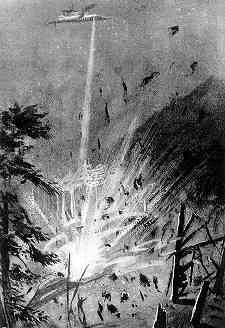 "Not A Vestige Of Our Air-Ship Or Her Creators Remained" |
"Two days before she was ready to take the air, one of his men deserted. The traitor was never seen again, but the next night a Terrorist vessel descended from the clouds, and in a few minutes not a vestige of our air-ship or her creators remained. Only a blackened waste in the midst of the forest was left to show the scene of their labours. Within forty-eight hours, it was known all over the civilised world that Vladimir Romanoff and his associates had been killed by order of the Supreme Council, for endeavouring to build an air-ship in defiance of its commands.
"Such are the enemies against whom you will have to contend. They are still virtually the masters of the world, and the task before you is to wrest that mastery from them. It is no light task, but it is not impossible; for these Aerians are, after all, but men and women as you are, and what they have done, other men and women can surely do.
"The Great Secret cannot always remain theirs alone. While they actively controlled the nations, nothing could be done against them, for their hand was everywhere and their eyes saw everything. But now they have abdicated the throne of the world, and left the nations to rule themselves as they can. For a time things will go on in their present grooves, but that will not be for long.
"I, who am their bitterest enemy on earth, am forced to confess that the Terrorists have proved themselves to be the wisest as well as the strongest of despots. Under their rule the world has become a paradise -- for the canaille and the multitude. But they have curbed the mob as well as the king, and abolished the demagogue as well as the despot. Now the strong hand is lifted and the bridle loosed; and before many years have passed, the brute strength of the multitude will have begun to assert itself.
"The so-called kings of the earth, who rule now in a mockery of royalty, will speedily find that the real kings of the old days ruled because, in the last resource, they had armies and navies at their command and could enforce obedience. These are but the puppets of the popular will, and now that the moral and physical support of the Supreme Council and its aerial fleet is taken from them, they will see democracy run rampant, and, having no strength to stem the tide, they will have to float with it or be submerged by it.
"In another generation the voice of the majority, the blind, brute force of numbers, will rule everything on earth. What government there may be, will be a mere matter of counting heads. Individual freedom will by swift degrees vanish from the earth, and human society will become a huge machine grinding all men down to the same level until the monotony of life becomes unendurable.
"Hitherto all democracies in the history of the world have been ended by military despotisms, but now military despotism has been made impossible, and so democracy will run riot, until it plunges the world into social chaos.
"This may come in your time or in your children's, but it is the opportunity for which you must work and wait. Even now you will find in every nation, thousands of men and women who are chafing against the limitations imposed on individual aspirations and ambition; and as the rule of democracy spreads and becomes heavier, the number of these will increase, until at last revolt will become possible, nay, inevitable.
"Of this revolt you must make yourselves the guiding-spirits. The work will be long and arduous, but you have all your lives before you, and the reward of success will be glorious beyond all description.
"Not only will you restore the House of Romanoff to its ancient glories in yourselves and your children, but you will enthrone it in an even higher place than that which your ancestor had almost won for it, when these thrice-accursed Terrorists turned the tide of battle against him on the threshold of the conquest of the world.
"Do not shrink from the task, or despair because you are now only two against the world. Think of Natas and the mighty work that he did, and remember that he was once only one against the world which in the day of battle he fought and conquered.
"Above all things, never let your eyes wander from the land of the Aerians. That once conquered and the world is yours to do with as you will. To do that, you must first conquer the air as they have done. Aeria itself, by all reports, is such a paradise as the sun nowhere else shines upon. Some day, whether by force or cunning, it may be yours; and when it is, the world also will be yours to be your footstool and your plaything, and all the peoples of the earth shall be your servants to do your bidding.
"Yes, I can see, through the mists of the coming years and beyond the grave that opens at my feet, aerial navies, flying the Eagle of Russia and scaling the mighty battlements of Aeria, hurling their lightnings far and wide in the work of vengeance long delayed! Behind the battle, I see darkness that my weak eyes cannot pierce, but yours shall see clearly where mine are clouded with the falling mists of death.
"The shadows are closing round me, and the sands in the glass are almost run out. Yet one thing remains to be done. Since Alexander Romanoff died at the mines of Kara, no Tsar of Russia has been crowned. Now I, Paul Romanoff, his rightful heir, will crown myself after the fashion of my ancestors, and then I will crown you, the daughter of my murdered son, and you will place the diadem on your husband's brow when God has made you one!"
So saying, the old man rose from his seat, with his face flushed and his eyes aglow with the light of ecstasy. Olga and Serge rose to their feet, half in fear and half in wonder, as they looked upon his transfigured countenance.
He lifted the Imperial crown from the table, and then, drawing himself up to the full height of his majestic stature, raised it high above his head, and lowered it slowly down towards his brow.
The jewelled circlet of gold had almost touched the silver of his snowy hair when the light suddenly died out of his eyes, leaving the glaze of death behind it. He gasped once for breath, and then his mighty form shrank together and pitched forward in a huddled heap at their feet, flinging the crown with a dull crash to the floor, and sending it rolling away into a corner of the room.
"God grant that may not be an omen, Olga!" said Serge, covering his eyes with his hands to shut out the sudden horror of the sight.
"Omen or not, I will do his bidding to the end," said the girl slowly and solemnly. Then her pent-up passion of grief
burst forth in a long, wailing cry, and she flung herself down on the prostrate form of the only friend she had ever
known and loved, and laid her cheek upon his, and let the welling tears run from her eyes over those that had for
ever ceased to weep.
TSARINA OLGA. THREE days after his death, the body of Paul Romanoff was reduced to ashes in the Highgate Crematorium, a
magnificent building, in the sombre yet splendid architecture of ancient Egypt, which stood in the midst of what had
once been Highgate Cemetery, and what was now a beautiful garden, shaded by noble trees, and in summer
ablaze with myriads of flowers.
Not a grave or a headstone was to be seen, for burial in the earth had been abolished throughout the civilised world
for nearly a century. In the vast galleries of the central building, thousands of urns, containing the ashes of the
dead, reposed in niches inscribed with the name and date of death, but these mostly belonged to the poorer
classes, for the wealthy as a rule devoted a chamber in their own houses to this purpose.
The body was registered in the great Book of the Dead at the Crematorium as that of Paul Ivanitch, and the only
two mourners signed their names, "Serge Ivanitch and Olga Ivanitch, grand-children of the deceased." The reason
for this was, that for more than a century the name of Romanoff had been proscribed in all the nations of Europe. It
was believed that the Vladimir Romanoff who had been executed by the Supreme Council, for attempting to solve
the forbidden problem, was the last of his race, and Paul had taken great pains not to disturb this belief.
Long before his son had met with his end, he had called himself Paul Ivanitch, and settled in London and practised
his profession as a sculptor, in which he had won both fame and fortune. Olga had lived with him since her father's
death, and Serge, who at the time the narrative opens had just completed his studies at the Art University of Rome,
had passed as her brother.
They took the urn containing the ashes of the old man back with them to the house, which now belonged, with all its
contents, to Olga and Serge. On the morning after his death, a notice, accompanied by an abstract of his will, had
been inserted in The Official Gazette, the journal devoted exclusively to matters of law and government.
Paul Romanoff had, however, left two wills behind him, one which had to be made public in compliance with the law,
and one which was intended only for the eyes of Olga and Serge. This second will reposed, with the crown of
Russia, in the secret recess in the wall of the octagonal chamber; and the instructions endorsed upon it stated that
it was to be opened by Serge in the presence of Olga, after they had brought his ashes back to the house and had
been legally confirmed in their possession of his property.
Consequently, on the evening of the 11th, the two shut themselves into the room, and Olga, who since her
grandfather's death had worn the key of the recess on a chain round her neck, unlocked the secret door and gave
the will to Serge. As she did so, a sudden fancy seized her. She took the crown from its resting-place, and,
standing in front of a long mirror which occupied one of the eight sides of the room from roof to floor, poised it
above the lustrous coils of her hair with both hands, and said, half to Serge and half to herself--
"What age could not accomplish, youth shall do! By my own right, and with my own hands, I am crowned Tsarina
Empress of the Russias in Europe and Asia. As the great Catherine was, so will I be -- and more, for I will be
Mistress of the West and the East. I will have kings for my vassals and
senates for my servants, and I will rule as no other woman has ruled before me since Semiramis!"
As she uttered the daring words, whose fulfilment seemed beyond the dreams of the wildest imagination, she placed
the crown upon her brow and stood, clothed in imperial purple from head to foot, the very incarnation of loveliness
and royal majesty. Serge looked up as she spoke, and gazed for a moment entranced upon her. Then he threw
himself upon his knees before her, and, raising the hem of her robe to his lips, said in a voice half choked with love
and passion--
"And I, who am also of the imperial blood, will be the first to salute you Tsarina and mistress! You have taken me as
your lover, let me also be the first of your subjects. I will serve you as woman never was served before. You shall be
my mistress -- my goddess, and your words shall be my laws before all other laws. If you bid me do evil, it shall be
to me as good, and I will do it. I will kill or leave alive according to your pleasure, and I will hold my own life as
cheap as any other in your service; for I love you, and my life is yours!"
Olga looked down upon him with the light of triumph in her eyes. No woman ever breathed to whom such words
would not have been sweet; but to her they were doubly sweet, because they were a spontaneous tribute to the
power of her beauty and the strength of her royal nature, and an earnest of her future sway over other men.
More than this, too, they had been won without an effort, from the lips of the man whom she had always been taught
to look upon as higher than other men, in virtue of his descent from her own ancestry, and the blood-right that he
shared with her to that throne which it was to be their joint life-task to re-establish.
If she did not love him, it was rather because ambition and the inborn lust of power engrossed her whole being,
than from any lack of worthiness on his part. Of all the men she had ever seen, none compared with him in strength
and manliness save one -- and he, bitter beyond expression as the thought was to her, was so far above her as she
was now, that he seemed to belong to another world and to another order of beings.
As their eyes met, a thrill that was almost akin to love passed through her soul, and, acting on the impulse of the
moment, she took the crown from her own head and held it above his as he knelt at her feet, and said--
"Not as my subject or my servant, but as my co-ruler and helpmate, you shall keep that oath of yours, Serge
Nicholaivitch. We have exchanged our vows, and in a few days I shall be your wife. We will wed as equals; and so
now I crown you, as it is my right to do. Rise, my lord the Tsar, and take your crown!"
Serge put up his hands and took the crown from hers at the moment that she placed it on his brow. He rose to his
feet, holding it on his head as he said solemnly--
"So be it, and may the God of our fathers help me to wear it worthily with you, and to restore to it the glory that has
been taken from it by our enemies!"
Then he laid it reverently down on the table and turned to Olga, who was still standing before the mirror looking at
her own lovely image, as though in a dream of future glory. He took her unresisting in his arms, and kissed her
passionately again and again, bringing the bright blood to her cheeks and the light of a kindred passion to her
eyes, and murmuring between the kisses--
"But you, darling, are worth all the crowns of earth, and I am still your slave, because your beauty and your
sweetness make me so."
"Then slave you shall be!" she said, giving him back kiss for kiss, well knowing that with every pressure of her
intoxicating lips she riveted the chains of his bondage closer upon his soul.
To an outside observer, what had taken place would have seemed but little better than boy-and-girl's play, the
phantasy of two young and ardent souls dreaming a romantic and impossible dream of power and glory that had
vanished, never to be brought back again. And yet, if such a one had been
able to look forward though more than a single lustrum, he would have seen that, in the mysterious revolutions of
human affairs, it is usually the seemingly impossible that becomes possible, and the most unexpected that comes to
pass.
The secret will of Paul Romanoff, to the study of which the two lovers addressed themselves when they awoke from
the dream of love and empire into which Olga's phantasy had plunged them both, would, if it had been made public,
have given a by no means indefinite shape to such vague dreams of world-revolution as were inspired in thoughtful
minds, even in the thirty-first year of the twenty-first century.
It was a voluminous document of many pages, embodying the result of nearly eighty years of tireless scheming and
patient research in the field of science as well as in that of politics. Paul Romanoff had lived his life with but one
object, and that was, to prepare the way for the accomplishment of a revolution which should culminate in the
subversion of the state of society inaugurated by the Terrorists, and the re-establishment, at any rate in the east of
Europe, of autocratic rule in the person of a scion of the House of Romanoff. All that he had been able to do
towards the attainment of this seemingly impossible project was crystallised in the document bequeathed to Olga
and Serge.
It was divided into three sections. The first of these was mostly of a personal nature, and contained details which it
would serve no purpose of use or interest to reproduce here. It will therefore suffice to say, that it contained a list of
the names and addresses of four hundred men and women scattered throughout Europe and America, each of
whom was the descendant of some prince or noble, some great landowner or millionaire, who had suffered
degradation or ruin at the hands of the Terrorists during the reorganisation of society, after the final triumph of the
Anglo-Saxon Federation in 1904.
The second section of the will was of a purely scientific and technical character. It was a theoretical arsenal of
weapons for the arming of those who, if they were to succeed at all, could only do so by bringing back that which it
had cost such an awful expenditure of blood and suffering to banish from the earth in the days of the Terror. The
designs of Paul Romanoff, and the vast aspirations of those to whom he had bequeathed the crown of the great
Catherine, could have but one result if they ever passed from the realm of fancy to that of deeds.
If the clock was to be put back, only the armed hand could do it, and that hand must be so armed that it could strike
at first secretly, and yet with paralysing effect. The few would have to array themselves against the many, and if
they triumphed, it would have to be by the possession of some such means of terrorism and irresistible destruction
as those who had accomplished the revolution of 1904 had wielded in their aerial fleet.
By far the most important part of this section of the will consisted of plans and diagrams of various descriptions of
airships and submarine vessels, accompanied by minute directions for building and working them. Most of these
were from the hand of Vladimir Romanoff, Olga's father; but of infinitely more importance even than all these was a
detailed description, on the last page but two of the section, of the solution of a problem which had been attempted
in the last decade of the nineteenth century, but which was still unsolved so far as the world at large was
concerned.
This was the direct transformation of the solar energy locked up in coal into electrical energy, without loss either by
waste or transference. How vast and yet easily controlled a power this would be in the hands of those who were
able to wield it, may be guessed from the fact that, in the present day, less than ten per cent. of the latent energy of
coal is developed as electrical power even in the most perfect systems of conversion.
All the rest is wasted between the furnace of the steam-engine and the dynamo. It was to electrical power, obtained
direct from coal and petroleum, that Vladimir Romanoff trusted
for the motive force of his air-ships and submarine vessels, and which he had already employed with experimental
success as regards the former, when his career was cut short by the swift and pitiless execution of the sentence of
the Supreme Council.
The remainder of this section was occupied by a list of chemical formulæ for the most powerful explosives then
known to science, and minute instructions for their preparation. At the bottom of the page which contained these,
there was a little strip of parchment, fastened by one end to the binding of the other sheets, and covered with very
small writing.
Olga's eyes, wandering down over the maze of figures which crowded the page, reached it before Serge's did. One
quick glance told her that it was something very different to the rest. She laid one hand carelessly over it, and with
the other softly caressed Serge's crisp, golden curls. As he looked round in response to the caress, their eyes met,
and she said in her sweet, low, witching voice--
"Dearest, I have a favour to ask of you."
"Not a favour to ask, but a command to give, you mean. Speak, and you are obeyed. Have I not sworn obedience?"
he replied, laying his hand upon her shoulder and drawing her lovely face closer to his as he spoke.
"No, it is only a favour," she said, with such a smile as Antony might have seen on the lips of Cleopatra. "I want you
to leave me alone for a little time -- for half an hour -- and then come back and finish reading this with me. You
know my brain is not as strong as yours, and I feel a little bewildered with all the wonderful things that there are in
this legacy of my father's father.
"Before we go any further, I should like, to read it all through again by myself, so as to understand it thoroughly. So
suppose you go to your smoking-room for a little, and leave me to do so. I shall not take very long, and then we will
go over the rest together."
"But we have only a couple more pages to read, sweet one, and then I will go over it all again with you, and explain
anything that you have not understood."
As he spoke, Serge's eyes never wavered for a moment from hers. Could he but have broken their spell, he might
have seen that she was hiding something from him under her little, white hand and shapely arm. She brought her
red, smiling lips still nearer to his as she almost whispered in reply--
"Well, it is only a girl's whim, after all, but still I am a girl. Come, now, I will give you a kiss for twenty minutes'
solitude, and when you come back, and we have finished our task, you shall have as many more as you like."
The sweet, tempting lips came closer still, and the witching spell of her great dusky eyes grew stronger as she
spoke. How was he to know what was hanging in the balance in that fateful moment? He was but a hot-blooded
youth of twenty, and he worshipped this lovely, girlish temptress, who had not yet seen seventeen summers, with an
adoration that blinded him to all else but her and her intoxicating beauty.
He drew her yielding form to him until he could feel her heart beating against his, and as their lips met, the
promised kiss came from hers to his. He returned it threefold, and then his arm slipped from her shoulder to her
waist, and he lifted her like a child from her chair, and carried her, half laughing and half protesting, to the door,
claimed and took another kiss before he released her, and then put her down and left her alone without another
word.
"Alas, poor Serge!" she said, as the door closed behind him; "you are not the first man who has lost the empire of
the world for a woman's kiss. Before, I saw that you were my equal and helpmate, now you and all other men -- yes,
not even excepting he who seems so far above me now -- shall be my slaves and do my bidding, so blindly that they
shall not even know they are doing it.
"Yes, the weapons of war are worth much, but what are they in comparison with the souls of the men who will have to use them!"
In half an hour Serge came back to finish the reading of
the will with her. The little slip of paper had been removed so skilfully that it would have been impossible for him to
have even guessed that it had ever been attached to the parchment or that it was now lying hidden in the bosom of
the girl who would have killed him without the slightest scruple to gain the unsuspected possession of it.
A SON OF THE GODS. ON the day but one following the reading of Paul Romanoff's secret will, Olga and Serge set out for St. Petersburg,
to convey his ashes to their last resting-place in the Cathedral of SS. Peter and Paul in the Fortress of
Petropaulovski, where reposed the dust of the Tyrants of Russia, from Peter the Great to Alexander II. of Russia,
now only remembered as the chief characters in the dark tragedy of the days before the Revolution.
The intense love of the Russians for their country had survived the tremendous change that had passed over the
face of society, and it was still the custom to bring the ashes of those who claimed noble descent and deposit them
in one of their national churches, even when they had died in distant countries.
The station from which they started was a splendid structure of marble, glass, and aluminium steel, standing in the
midst of a vast, abundantly-wooded garden, which occupied the region that had once been made hideous by the
slums and sweating-dens of Southwark. The ground floor was occupied by waiting-rooms, dining-saloons,
conservatories, and winter-gardens, for the convenience and enjoyment of travellers; and from these lifts rose to the
upper storey, where the platforms and lines lay under an immense crystal arch.
Twelve lines ran out of the station, divided into three sets
of four each. Of these, the centre set was entirely devoted to continental traffic, and the lines of this system
stretched without a break from London to Pekin.
The cars ran suspended on a single rail upheld by light, graceful arches of a practically unbreakable alloy of
aluminium, steel, and zinc, while about a fifth of their weight was borne by another single insulating rail of forged
glass,-- the rediscovery of the lost art of making which had opened up immense possibilities to the engineers of the
twenty-first century.
Along this lower line the train ran, not on wheels, but on lubricated bearings, which glided over it with no more
friction than that of a steel skate on ice. On the upper rail ran double-flanged wheels with ball-bearings, and this line
also conducted the electric current from which the motive-power was derived.
The two inner lines of each set were devoted to long-distance, express traffic, and the two outer to intermediate
transit, corresponding to the ordinary trains of the present day. Thus, for example, the train by which Olga and
Serge were about to travel, stopped only at Brussels, Berlin, Königsberg, Moscow, Nijni Novgorod, Tomsk,
Tobolsk, Irkutsk, and Pekin, which was reached by a line running through the Salenga valley and across the great
desert of Shamoo, while from Irkutsk another branch of the line ran north-eastward via Yakutsk to the East Cape,
where the Behring Bridge united the systems of the Old World and the New.
The usual speed of the expresses was a hundred and fifty miles an hour, rising to two hundred on the long runs;
and that of the ordinary trains, from a hundred to a hundred and fifty. Higher speeds could of course be attained on
emergencies, but these had been found to be quite sufficient for all practical purposes.
The cars were not unlike the Pullmans of the present day, save that they were wider and roomier, and were built not
of wood and iron, but of aluminium and forged glass. Their interiors were, of course, absolutely impervious to wind
and dust, even at the highest speed of the train, although a perfect system of ventilation kept their atmosphere
perfectly fresh.
The long-distance trains were fitted up exactly as moving hotels, and the traveller, from London to Pekin or
Montreal, was not under the slightest necessity of leaving the train, unless he chose to do so, from end to end of the
journey.
One more advantage of railway travelling in the twenty-first century may be mentioned here. It was entirely free,
both for passengers and baggage. Easy and rapid transit being considered an absolute necessity of a high state of
civilisation, just as armies and navies had once been thought to be, every self-supporting person paid a small
travelling tax, in return for which he or she was entitled to the freedom of all the lines in the area of the Federation.
In addition to this tax, the municipality of every city or town through which the lines passed, set apart a portion of
their rent-tax for the maintenance of the railways, in return for the advantages they derived from them.
Under this reasonable condition of affairs, therefore, all that an intending traveller had to do was to signify the date
of his departure and his destination to the superintendent of the nearest station, and send his heavier baggage on
in advance by one of the trains devoted to the carriage of freight. A place was then allotted to him, and all he had to
do was to go and take possession of it.
The Continental Station was comfortably full of passengers when Olga and Serge reached it, about fifteen minutes
before the departure of the Eastern express; for people were leaving the Capital of the World in thousands just then,
to spend Christmas and New Year with friends in the other cities of Europe, and especially to attend the great
Winter Festival that was held every year in St. Petersburg in celebration of the anniversary of Russian freedom.
Ten minutes before the express started, they ascended in one of the lifts to the platform, and went to find their
seats. As they walked along the train, Olga suddenly stopped and said, almost with a gasp--
"Look, Serge! There are two Aerians, and one of them is"--
"Who?" said Serge, almost roughly. "I didn't know you had any acquaintances among the Masters of the World."
The son of the Romanoffs hated the very name of the Aerians, so bitterly that even the mere suspicion that his
idolised betrothed should have so much as spoken to one of them was enough to rouse his anger.
"No, I haven't," she replied quietly, ignoring the sudden change in his manner; "but both you and I have very good
reason for wishing to make their distinguished acquaintance. I recognise one of these because he sat beside Alan
Arnold, the President of the Council, in St. Paul's, when they were foolish enough to relinquish the throne of the
world in obedience to an old man's whim.
"The taller of the two standing there by the pillar is the younger counterpart of the President, and if his looks don't
belie him, he can be no one but the son of Alan Arnold, and therefore the future ruler of Aeria, and the present or
future possessor of the Great Secret. Do you see now why it is necessary that we should-- well, I will say, make
friends of those two handsome lads?"
Olga spoke rapidly and in Russian, a tongue then scarcely ever heard and very little understood even among
educated people, who, whatever their nationality, made English their language of general intercourse. The words
"handsome lads" had grated harshly upon Serge's ears, but he saw the force of Olga's question at once, and strove
hard to stifle the waking demon of jealousy that had been roused more by her tone and the quick bright flush on her
cheek than by her words, as he answered--
"Forgive me, darling, for speaking roughly! Their hundred years of peace have not tamed my Russian blood
enough to let me look upon my enemies without anger. Of course, you are right; and if they are going by the
express, as they seem to be, we should be friendly enough by the time we reach Königsberg."
"I am glad you agree with me," said Olga, "for the destinies of the world may turn on the events of the next few
hours. Ah, the Fates are kind! Look! There is Alderman1 Heatherstone talking to them. I suppose he
has come to see them off; for no doubt they have been the guests of the City during the Festival. Come, he will very
soon make us known to each other."
A couple of minutes later the Alderman, who had been an old friend of Paul Ivanitch, the famous sculptor, had
cordially greeted them and introduced them to the two Aerians, whose names he gave as Alan Arnoldson, the son
of the President of the late Supreme Council, and Alexis Masarov, a descendant of the Alexis Mazanoff who had
played such a conspicuous part in the war of the Terror. They were just starting on the tour of the world, and were
bound for St. Petersburg to witness the Winter Festival.
Olga had been more than justified in speaking of them as she had done. Both in face and form, they were the very
ideal of youthful manhood. Both of them stood over six feet in the long, soft, white leather boots which rose above
their knees meeting their close-fitting, grey tunics of silk-embroidered cloth, confined at the waist by belts curiously
fashioned of flat links of several different metals, and fastened in front by heavy buckles of gold studded with great,
flashing gems.
From their broad shoulders hung travelling-cloaks of fine, blue cloth, lined with silver fur and kept in place across
the breast by silver chains and clasps of a strange, blue metal whose lustre seemed to come from within like that of
a diamond or a sapphire.
On their heads they wore no other covering than their own thick, curling hair, which they wore somewhat in the
picturesque style of the fourteenth century, and a plain, broad band of the gleaming blue metal, from which rose
above the temples a pair of marvellously-chased, golden wings about four inches high -- the insignia of the Empire
of the Air, and the sign which distinguished the Aerians from all the other peoples of the earth.
As Olga shook hands with Alan, she looked up into his dark-blue eyes, with a glance such as he had never received
from a woman before -- a glance in which he seemed instinctively to read at once love and hate, frank admiration
and equally undisguised defiance. Their eyes held each other for a moment of mutual fascination which neither
could resist, and then the dark-fringed lids fell over hers, and a faint flush rose to her cheeks as she replied to his
words of salutation--
"Surely the pleasure will rather be on our side, with travelling companions from the other world! For my own part, I
seem to remind myself somewhat of one of the daughters of men whom the Sons of the Gods"--
She stopped short in the middle of her daring speech, and looked up at him again as much as to say--
"So much for the present. Let the Fates finish it!" and then, appearing to correct himself, she went on, with a half-
saucy, half-deprecating smile on her dangerously-mobile lips--
" You know what I mean; not exactly that, but something of the sort."
"More true, I fancy, of the daughter of men than of the supposed Sons of the Gods," retorted Alan, with a laugh,
half startled by her words, and wholly charmed by the indescribable fascination of the way in which she said them;
"for the daughters of men were so fair that the Sons of the Gods lost heaven itself for their sakes."
"Even so!" said Olga, looking him full in the eyes, and at that moment the signal sounded for them to take their
places in the cars.
A couple of minutes after they had taken their seats, the train drew out of the station with an imperceptible, gliding
motion, so smooth and frictionless that it seemed rather as though the people standing on the platform were sliding
backwards than that the train was moving forward. The speed increased rapidly, but so evenly that, almost before
they were well aware of it, the passengers were flying over the snow-covered landscape, under the bright, heatless
sun and pale, steel-blue sky of a perfect winter's morning, at a hundred miles an hour, the speed ever increasing as
they sped onward.
The line followed the general direction of the present route to Dover, which was reached in about half an hour.
Without pausing for a moment in its rapid flight, the express swept out from the land over the Channel Bridge, which
spanned the Straits from Dover to Calais at a height of 200 feet above the water.
Travelling at a speed of three miles a minute, seven minutes sufficed for the express to leap, as it were, from land to
land. As they swept along in mid-air over the waves, Olga pointed down to them and said to Alan, who was sitting in
the armchair next her own--
"Imagine the time when people had to take a couple of hours getting across here in a little, dirty, smoky steamboat,
mingling their sorrows and their sea-sickness in one common misery! I really think this Channel Bridge is worthy
even of your admiration. Come now, you have not admired anything yet"--
"Pardon me," said Alan, with a look and a laugh that set Serge's teeth gritting against each other, and brought the
ready blood to Olga's cheeks; "on the contrary, I have been absorbed in admiration ever since we started."
"But not apparently of our engineering triumphs," replied Olga frankly, taking the compliment to herself, and
seeming in no way displeased with it. "It would seem that the polite art of flattery is studied to some purpose in
Aeria."
"There you are quite wrong," returned Alan, still speaking in the same half-jocular, half-serious vein. "Before all
things, we Aerians are taught to tell the absolute truth under all circumstance, no matter whether it pleases or
offends; so, you see, what is usually known as flattery could hardly be one of our arts, since, as often as not, it is a
lie told in the guise of truth, for the sake of serving some hidden and perhaps dishonest end."
The blow so unconsciously delivered struck straight home, and the flush died from Olga's cheek, leaving her for the
moment so white that her companion anxiously asked if she was unwell.
"No," she said, recovering her self-possession under the impulse of sudden anger at the weakness she had
betrayed. "It is nothing. This is the first time for a year or so that I have travelled by one of these very fast trains,
and the speed made me a little giddy just for the instant. I am quite well, really, so please go on.
"You know, that wonderful fairyland of yours is a subject of everlasting interest and curiosity to us poor outsiders
who are denied a glimpse of its glories, and it is so very rarely that one of us enjoys the privilege that is mine just
now, that I hope you will indulge my feminine curiosity as far as your good nature is able to temper your reserve."
As she uttered her request, Alan's smiling face suddenly became grave almost to sternness. The laughing light died
out of his eyes, and she saw them darken in a fashion that at once convinced her that she had begun by making a
serious mistake.
He looked up at her, with a shadow in his eyes and a slight frown on his brow. He spoke slowly and steadily, but
with a manifest reluctance which he seemed to take little or no trouble to conceal.
"I am sorry that you have asked me to talk on what is a forbidden subject to every Aerian, save when he is speaking
with one of his own nation. I see you have been looking at these two golden wings on the band round my head. I will
tell you what they mean, and then you will understand why I cannot say all that I know you would like me to say.
"They are to us what the toga virilis was to the Romans of old, the insignia of manhood and responsibility. When a
youth of Aeria reaches the age of twenty he is entitled to wear these wings as a sign that he is invested with all the
rights and duties of a citizen of the nation which has conquered and commands the Empire of the Air.
"One of these duties is, that in all the more serious relations of life he shall remain apart from all the peoples of the
world save his own, and shall say nothing that will do anything to lift the veil which it has pleased our forefathers in
their wisdom to draw round the realm of Aeria. Before we assume the citizenship of which these wings are the
symbol we never visit the outside world save to make air voyages, for the purpose of learning the physical facts of
the earth's shape and the geography of land and sea.
"Immediately after we have assumed it we do as Alexis and I are now doing -- travel for a year or so through the
different countries of the outside world, in order to get our knowledge of men and things as they exist beyond the
limits of our own country.
"The fact that we do so,-- under a pledge solemnly and publicly given, of never revealing anything which could lead
even to a possibility of other peoples of the earth overtaking us in the progress which we have made in the arts and
sciences,-- is my excuse for refusing to tell you what your very natural curiosity has asked."
Olga saw instantly that she had struck a false note, and was not slow to make good her mistake. She laid her hand
upon his arm, with that pretty gesture which Serge knew so well, and watched now with much bitter feelings, and
said, in a tone that betrayed no trace of the consuming passion within her--
"Forgive me! Of course, you will see that I did not know I was trenching on forbidden grounds. I can well
understand why such secrets as yours must be, should be kept. You have been masters of the world for more than
a century, and even now, although you have formally abdicated the throne of the world, it would be absurd to deny
that you still hold the destinies of humanity in your hands.
"The secrets which guard so tremendous a power as that may well be religiously kept and held more sacred than
anything else on earth. Still, you have mistaken me if you thought I asked for any of these. All I really wanted was,
that you should tell me something that would give me just a glimpse of what human life is like in that enchanted land of
yours"--
Alan laid his hands upon hers, which was still resting upon his arm, and interrupted her even more earnestly than before.
"Even that I cannot tell you. With us, the man who gives a pledge and breaks it, even in the spirit though not in the
letter, is not considered worthy to live, and therefore I must be silent."
Instead of answering with her lips, Olga turned her hand palm upwards, and clasped his with a pressure which he
returned before he very well knew what he was doing; and while the magic of her clasp was still stealing along his
nerves, Serge broke in, with a harsh ring in his voice--
"But pardon me for interrupting what seems a very pleasant conversation with my-- my sister, I should like to ask,
with all due deference to the infinitely superior wisdom of the rulers of Aeria, whether it is not rather a risky thing for
you to travel thus about the world, possessing secrets which any man or woman would almost be willing to die even
to know for a few minutes, when, after all, you are but human even as the rest of humanity are?
"You, for instance, are only two among millions; how would you protect yourselves against the superior force of
numbers? Supposing you were taken unawares under circumstances which make your superior knowledge
unavailing, You know, human nature is the same yesterday to-day, and to-morrow, despite the superficial varnish of
civilisation.
"The passions of men are only curbed, not dead. There may be men on earth to-day who, to gain such knowledge
as you possess, would even resort to the tortures used by the Inquisition in the sixteenth century. Suppose you
found yourself in the power of such men as that, what then? Would you still preserve your secret intact, do you
think?"
Alan heard him to the end without moving a muscle of his face, and without even withdrawing his hand from Olga's
clasp. But at the last sentence he snatched it suddenly away, half-turned in his seat, and faced him. Then, looking
him straight in the eyes, he said in a tone as cold and measured as might have been used by a judge sentencing a
criminal to death--
"We do not fear anything of the sort, simply because each one of us holds the power of life and death in his hands.
If you laid a hand on me now in anger, or with an intent to do me harm, you would be struck dead before you could
raise a finger in your own defence.
"Do you think that we, who are as far in advance of you as you are in advance of the men of a hundred years ago,
would trust ourselves amongst those who might be our enemies were we not amply protected against you? Tell me,
have you ever read a book, written nearly two hundred years ago in the Victorian Age, called The Coming Race?"
"Yes," said Serge, thinking, as he spoke, of the possibilities contained in the secret will of Paul Romanoff, "I have
read it, and so has Olga. What of it?"
"Well," said Alan quietly, without moving his eyes from those of Serge. "I had better tell you at once that we have
realised, to all intents and purposes, the dream that Lytton dreamt when he wrote that book. I can tell you so much
without breaking the pledge of which I have spoken. All that the Vril-Ya did in his dream we have accomplished in
reality, and more than that.
"Our empire is not bounded by the roofs of subterranean caverns, but only by the limits of the planet's atmosphere.
We can soar beyond the clouds and dive beneath the seas. We have realised what he called the Vril force as a
sober, scientific fact; and if I thought that you, for instance, were my enemy, I could strike you dead without so
much as laying a hand on you. And if a dozen like you tried to overcome me by superior brute force, they would
all meet with the same fate.
"I'm afraid this sounds somewhat like boasting," he continued
in a more gentle tone, and dropping his eyes to the floor of the car, "but the turn the conversation has taken
obliged me to say what I have done. Suppose we give it another turn and change the subject. We have
unintentionally got upon rather uncomfortable ground."
Serge and Olga were not slow to take the pointed hint, and of the talk drifted into general and more harmless
channels.
A VISION FROM THE CLOUDS. AT Königsberg, which was reached in nine hours after leaving London, that is to say, soon after seven o'clock
in the evening, the Eastern express divided: five of the cars went northward to St. Petersburg, carrying those
passengers who were going to participate in the Winter Festival, while the other five which made up the train went
on to Moscow and the East.
During the twenty minutes' stop at Berlin, Olga had found an opportunity of having a few words in private with
Serge, and had succeeded in persuading him, much against his will, of the necessity of postponing their marriage,
and therefore their visit to Moscow, for the execution of a daring and suddenly-conceived plan which she had
thought out, but which she had then no time to explain to him.
Serge, though very loath to postpone even for a day or two the consummation of his hopes and the hour which
should make Olga irrevocably his, so far as human laws could bind her to him, was so far under the domination of
her imperious will that, as soon as he saw that she had determined to have her own way, he yielded with the best
grace he could.
Olga chided him gently and yet earnestly for his outbreak of temper towards Alan, and told him plainly that, where
such tremendous issues were concerned as those which were involved in the struggle which sooner or later they
must wage with the Aerians, no personal considerations whatever could be permitted
a moment's serious thought. If she could sacrifice her own feelings, and disguise her hatred of the tyrants of the
world under the mask of friendliness, for the sake of the ends to which both their lives were devoted, surely he, if he
were at all worthy of her love, could so far trust her as to restrain the unreasoning jealousy of which he had already
been guilty.
Either, she told him, he must trust to her absolutely for the present, or he must take the management of affairs into
his own hands; and, as she said in conclusion, he must find some influence stronger than hers in their dealings
with him who would one day be the ruler of Aeria, and, therefore, the real master of the world, should it ever be
possible to dispute the empire of Earth with the Aerians.
From the influence which she exercised over himself, Serge knew only too well that he could not hope to rival her in
this regard where a man was concerned, and so he perforce agreed to her proposal, and for the present left the
conduct of affairs in her hands.
A telephonic message was therefore sent from Königsberg to the friends who expected them at Vorobiévô,
near Moscow, to tell them of the change in their plans; and when the train once more glided out over the frozen
plains of the North, the four were once more seated together in the brilliantly-lighted car, which flashed like a
meteor through the gathering darkness of the winter's night.
About half an hour after they had passed what had once been the jealously-guarded Russian frontier, a dazzling
gleam of light suddenly blazed down from the black darkness overhead, and Olga, who was sitting by one of the
windows of the car, bent forward and said--
"Look there! What is that? There is a bright light shining down out of the clouds on the train."
Alan saw the flash across the window, and, without even troubling to look up at its source, said--
"Oh, I suppose that'll be the air-ship that was ordered to meet us at St. Petersburg. You know, we usually have one
of them in attendance, when we trust ourselves alone among our possible enemies of the outer world."
The last sentence was spoken with a quiet irony, which brought home both to Olga and Serge the not very pleasant
conviction that their previous conversation had by no means been forgotten. Serge, perhaps fearing to give
utterance to his thoughts, remained silent, but Olga looked at Alan with a half-saucy smile, and said almost
mockingly--
"Your Majesties of Aeria may well esteem yourselves impregnable, while you have such a bodyguard as that at your
beck and call. I suppose that air-ship would not have the slightest difficulty in blowing this train, and all it contains,
off the face of the earth at a moment's notice, if it had orders to do so?"
"Not the slightest," said Alan quietly. "But in proof of the fact that it has no such hostile intentions, you shall, if you
please, take a voyage beyond the clouds in it the day after tomorrow, from St. Petersburg."
"What!" said Olga, her cheeks flushing and her eyes lighting up at the very idea of such an experience. "Do you
really mean to say that you would permit a daughter of the earth, as I am told you call the women who have not the
good fortune to be born in Aeria, to go on board one of those wonderful airships of yours, and taste the forbidden
delights of spurning the earth and sharing, even for an hour, your Empire of the Air?"
"Why not?" replied Alan, with a laugh. "What harm would be done by taking you for a trip beyond the clouds? We
are not so selfish as all that; and if the novel experience would give you any pleasure, we have a perfect right to ask
you to enjoy it. Will you come?"
"Surely there is scarcely any need for me to say 'yes.' Why, do you know, I believe I would give five years of my
life for as many hours on board that air-ship of yours," said Olga; "and if you will do as you say, you will make me
your debtor for ever. Indeed, how could a poor earth-dweller such as I am repay a favour like that."
"Ah, if only you were an Aerian, I should not have much
difficulty in telling you how you could do that," retorted Alan with almost boyish candour. "As it is, I am afraid I
must be satisfied for my reward with the pleasure of knowing that I have given you a pleasurable experience."
"Your Majesty has put that so prettily, that it almost atones for the sense of hopeless inferiority which, I need hardly
tell you, is just a trifle bitter to my feminine pride," said Olga, in the same half-bantering tone she had used all along,
Before a reply had risen to Alan's lips, the conversation was interrupted by the air-ship suddenly swooping down
from the clouds to the level of the windows of the train, which was now flying along over a wide, treeless plain at a
speed of fully two hundred miles an hour.
As the search-lights of the aerial vessel flashed along the windows of the cars, the blinds, which had been drawn
down at nightfall, were sprung up again by the passengers, who were all eager to get a glimpse of one of the
marvellous vessels which so rarely came within close view of the dwellers upon earth.
The air-ship, on which all eyes were now bent with such intense curiosity, was a beautifully-proportioned vessel
built chiefly of some unknown metal, which shone with a brilliant pale-blue lustre. Her hull was about two hundred
feet from stem to stern, not counting a long, ramlike projection which stretched some twenty-five feet in front of the
stem, with its point level with the keel, or rather, with the three keels,-- the centre one shallow and the two others
very deep,-- which were obviously shaped so as to enable the craft either to stand upright on land or to sail upon
the water if desired.
From each of her sides spread out two great wings, not unlike palm-leaves in shape, measuring some hundred feet
from point to point, and about twice the width of the vessel's deck which was, as nearly as could be judged, twenty
feet amidships.
These wings were made of some white lustrous material, which shone with a somewhat more metallic sheen than
silk would have done, and were divided into a vast number of sections by transverse ribs. These sections vibrated
and undulated rhythmically from front to rear with enormous rapidity, and evidently not only sustained the vessel in
the air, but also aided in her propulsion.
Three seemingly solid discs, which glittered brilliantly in the light from the train, marked the positions of the air-ship's
propellers, of which one revolved on a shaft in a straight line with the centre of the deck, while the shafts of
the other two were inclined outwards at a slight angle from the middle line. From the deck rose three slender, raking
masts, apparently placed there for ornament rather than use, unless indeed they were employed for signalling
purposes.
The whole deck was covered completely from end to end by a curved roof of glass, and formed a spacious
chamber pervaded by a soft, diffused light, the origin of which was invisible, and which showed about half a dozen
figures clad in the graceful costume of the Aerians, and all wearing the headdress with golden wings. From under
the domed, crystal roof projected ten long, slender guns,-- two over the bows, two over the stern, and three over
each side, at equal intervals.
Such was the wonderful craft which swept down from the darkness of the wintry sky, in full view of the passengers
in the cars, and lighted up the snowy landscape for three or four miles ahead and astern with the dazzling rays of
her two searchlights.
Although, as has been said, the express was moving at quite two hundred miles an hour, the air-ship swept up
alongside it with as much apparent ease as though it had been stationary. Amid the murmurs of irrepressible
admiration which greeted it from the passengers, it glided smoothly nearer and nearer, until the side of one of its
wings was within ten feet of the car windows.
Alan and Alexis stood up and saluted their comrades on the deck, then a few rapid, unintelligible signals made with
the hand passed between them, a parting salute was waved from the airship to the express; and then, with a speed
that seemed to rival that of the lightning-bolt, the cruiser of the air darted forward and upward, and in ten seconds
was lost beyond the clouds.
"Well, now that you have seen one of our aerial fleet at
close quarters," said Alan, turning to Olga and Serge, "what do you think of her?"
"A miracle!" they both exclaimed in one breath; and then Olga went on, her voice trembling with an irresistible
agitation--
"I can hardly believe that such a marvel is the creation of merely human genius. There is something appalling in the
very idea of the awful power lying in the hands of those who can create and command such a vessel as that. You
Aerians may well look down on us poor earth-dwellers, for truly you have made yourselves as gods."
She spoke earnestly, and for once with absolute honesty, for the vision of the air-ship had awed her completely for
the time being. Alan appeared for the moment as a god in her eyes, until she saw his lips curve in a very human
smile, and heard his voice say, without the slightest assumption of superiority in its tone--
"No, not as gods; but only as men who have developed under the most favourable circumstances possible, and who
have known how to make the best of their advantages."
1The good old word had now regained its ancient and uncorrupted meaning.
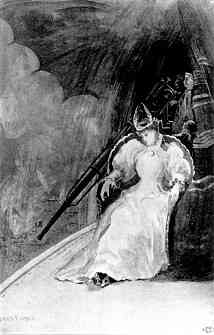 "As She Gazed Upon It, The Fires Died Away" |
She looked down with fierce exultation upon the scene of carnage and destruction; and as she gazed upon it, the fires died away, the roar of the explosions began to sound like echoes in the distance, and when the landscape of her dreamland took definite shape again, the air-ship was hovering, over a vast, oval valley, walled in by mighty mountain masses, surmounted by towering peaks, on some of which crests of everlasting snow and ice shone undissolved in the rays of the tropical sun.
The valley itself was of such incomparable and fairy-like beauty, that it seemed to belong rather to the realm of imagination than to the world of reality. A great lake lay in the centre, its emerald shores lined with groves of palms and orange-trees, and fringed with verdant islets spangled with many coloured flowers.
On the northern shore of the lake lay a splendid city of marble palaces, surrounded by shady gardens, and divided from each other by broad, straight streets, smooth as ivory and spotless as snow, and lined with double rows of wide-spreading trees, which cast a pleasant shade along their sides
In the midst of a vast square, in the centre of the city, rose an immense building of marble of perfect whiteness surmounted by a great golden dome, which in turn was crowned by the silver shape of a woman with great spreading wings, which blazed and scintillated in the sunlight as though they had been fashioned of sheets of crystal, pure and translucent as diamonds.
All over the valley, villas and palaces of marble were scattered in cool ravines and on shaded, wooded slopes; and as far as her eye could reach, vast expanses of garden and emerald pastures, and golden corn fields stretched away over hill and vale, until the most remote were met by the cool, dark forests which clothed the middle slopes of the all-encircling mountains, and themselves gave place higher up to dark, frowning precipices, vast walls of living rock, rising thousands of feet sheer upwards, and ending in the mighty peaks which stood like eternal sentinels guarding this enchanted realm.
If she had had her will, she would have gazed for ever upon this delightful scene; but the spirit of the dream was not to be controlled, and it faded from her sight just as the picture of death and desolation had done. As it faded away, Alan, who had now come back to her side, laid his hand upon her shoulder and, looking at her with mournful eyes, said wearily--
"That was your first and last glimpse of heaven. Now comes the judgment!"
As he spoke, the air-ship soared upwards again, and was instantly enveloped in a cloud of impenetrable darkness. She sped on and on in utter silence through the gloom, which was so dense that it seemed to cast the rays of the ship's electric lights back upon her as she floated amidst it. Presently the deathlike silence was broken by a low, weird sound, that seemed like a wail of universal agony rising up from the earth beneath.
Then, far ahead and high up in the sky, appeared a faint light, which grew and brightened until the darkness melted away before it; and Olga saw the air-ship floating near enough to the earth for her to see that all its vegetation was withered and yellow, and the beds of its streams almost dry, with only little, thin rivulets trickling sluggishly along them.
Millions of people seemed wandering listlessly and aimlessly about the streets of the cities and the parched fields of the open country, ever and anon stretching their hands as though in appeal up to the dark, moonless sky, in which the fearful shape of light and fiery mist was growing every moment brighter and vaster.
It grew and grew until it arched half the horizon with its tremendous curve; and then out of the midst of it came a huge, dazzling globe of fire, from the rim of which shot forth great flames of every colour, some of which seemed to descend to the surface of the earth like long fiery tongues that licked up the seething lakes in wreathing clouds of steam, which hissed and roared as they rose like ascending cataracts.
She looked down between them at the earth. The myriads of figures were there still, but now they lay prone and lifeless on the ground, as though the last agony of mankind were past. The light of the blazing globe grew more and more dazzling, and the heat more and more intense. The speed of the air-ship slackened visibly, although the wings and propellers were working at their utmost speed, and it was falling rapidly, as though there was no longer any air to support it.
She gasped for breath in the choking, burning atmosphere of the deck chamber, and then a swift, vivid wave of light seemed to sweep through her brain, and she woke with a choking gasp of terror, with the chimes of her watch ringing sweetly in her ears, telling her that the vision had been but a dream of a night had passed.
Wide awake in an instant, she got out of bed and turned on the electric lamp. As the room had been perfectly warmed all night by the electric conduction-stoves, which were then in almost universal use, she only stopped to throw a fur-lined cloak round her shoulders before she went to remove the cap of the crucible.
She peered anxiously into the vessel, and saw about two fluid ounces of a dark, glittering liquid, from the surface of which the light of the lamp was reflected as though from a mirror. With hands that trembled slightly, in spite of the great effort she made to keep her nerves in check, she poured the precious fluid into one of the glass measures that she had used the night before.
Seen through the glass, its colour was a deep, brilliant blue and, like the white liquid first prepared, shone as though with an inherent, light-giving power of its own. She held it up admiringly to the light, and said to herself, with the same cruel smile that had curved her lips when she had contemplated the other fluid--
"How beautiful it is! It might be made of sapphires dissolved in some potent essence. In reality, it is an elixir capable of dissolving the souls of men. Ah, my proud Masters of the World, we shall soon see how much your boasted powers avail you against this and a woman's wit and hatred!
"And you, my splendid Alan, before to-morrow night you shall be at my feet! Two drops of this, and that proud, strong soul of yours shall melt away like a snowflake under warm rain, and you shall be my slave and do my bidding, and never know that you are not as free as you are now.
"The days have gone by when men sought the Elixir of Life, but Paul Romanoff sought and found the Elixir of Death,-- death of the body or of the soul, as the possessor of it shall will; and he is gone, and I, alone of all the children of men, possess it!"1
1Such a poison as this is no figment of the imagination. It has been known to Oriental adepts in poisoning for many centuries, and the Borghias were certainly familiar with it. A kindred drug was used by the Russian agents who kidnapped the late Prince Alexander of Bulgaria, though in his case the injury was permanent. It reduced him from one of the most able and daring princes in Europe to a mental and moral cripple, who was perfectly content to live in the obscurity to which his enemies had consigned him.
She set the measure down on the table, and took out of her valise a similar little flask to the one which held the white liquid. In this she carefully poured the contents of the measure, screwed the cap on as before, and hung it with the other on the chain round her neck. Then, woman-like, she turned to the mirror, threw back her cloak a little, and gazed at the reflection of the two flasks, which shone like two great gems upon her white skin.
"There is such a necklace as woman never wore before, since woman first delighted in gems,-- a necklace that all the jewels in the world could not buy. How pretty they look!"
So saying, she turned away from the mirror and carefully put away all traces of the work she had been engaged in, then she threw off her cloak and turned the lamp out and got into bed again, to wait until the attendant called her at eight o'clock as she had directed.
She did not go to sleep again, but lay with wide-open eyes looking at the darkness, and conjuring out of it visions of love and war, and the world-wide empire which she believed to be now almost within her grasp. In all these visions, two figures stood out prominently -- those of Serge and Alan, her lover that had been and the lover that was to be,-- if only the elixir did its work as its discoverer had said it would.
As such thoughts as these passed through her brain, a new and perhaps a nobler conception of her mission of revenge took possession of her. In the past, Natasha had won the love of the man whose genius had made possible, nay, irresistible, the triumph of that revolution which had subverted the throne of her ancestors, and sent the last of the Tsars of Russia to die like a felon in chains amidst the snows of Siberia.
What more magnificent vengeance could she, the last surviving daughter of the Romanoffs, win than the enslavement of the man descended not only from Natasha and Richard Arnold, but also from that Alan Tremayne whose name he bore, and who, as first President of the Anglo-Saxon Federation, had ensured the victory of the Western races over the Eastern?
The empire of freedom and peace, which Richard Arnold had won for Natasha's sake, this son of the line of Natas should convert, at her bidding, into an empire such as she longed to rule over, an empire in which men should be her slaves and women her handmaidens. For her sake the wave of Destiny should flow back again; she would be the Semiramis of a new despotism.
What was the freedom or the happiness of the mass of mankind to her? If she could raise herself above them, and put her foot upon their necks, why should she not do so? By force the leaders of the Terror had overthrown the despotisms of the Old World; why should not she employ the self-same force to seat herself, with the man she loved in spite of all her hereditary hatred, upon the throne of the world, and reign with him in that glorious land whose beauties had been revealed to her in the vision which surely had been something more than a dream?
Thus thinking and dreaming, and illumining the darkness with her own visions of glories to come, she lay in a kind of ecstasy, until a knock at the door warned her that the time for dreaming had passed and the hour for action had arrived.
A brief half-hour sufficed for her toilet, and she entered the room of the hotel, in which Serge was awaiting her, dressed to perfection in her plain, clinging robe of royal purple, and self-composed as though she had passed the night in the most innocent and dreamless of slumbers. She submitted to his greeting kiss with as good a grace as possible, and yet with an inward shrinking which almost amounted to loathing, born of the visions which were still floating in her mind.
She shuddered almost invisibly as he released her from his embrace, and then the bright blood rose to her cheeks, and a sudden light shone in her eyes, as the thought possessed her, that not many hours would pass before a far nobler lover would take her in his arms, and would press sweeter kisses upon her lips,-- the lips which had sworn fealty and devotion to the enemies of his race.
Serge, with the true egotism of the lover, took the blush to himself, and said, with a laugh of boyish frankness--
"Travelling and Russian air seem to agree with your Majesty. Evidently you have slept well your first night on Russian soil. I was half afraid that what happened yesterday, and your conversation with that golden-winged braggart from Aeria, would have sufficiently disturbed you to give you a more or less sleepless night, but you look as fresh and as lovely as though you had slept in the most perfect peace at home."
The anger that these unthinking words awoke in her soul, brought back the bright flush to Olga's cheeks and the light into her eyes, and again Serge mistook the sign, as indeed he might well have done; and so he entirely mistook the meaning of her words when she replied, with a laugh, of the true significance of which he had not the remotest conception--
"On the contrary, how was it possible that I could have anything but the sweetest sleep and the most pleasant dreams, after such a delightful journey and the making of such pleasant acquaintances? Do you not think the Fates have favoured us beyond our wildest expectations, in thus bringing our enemies so unconsciously across our path at the very outset of our campaign against them?
"But really, these Aerians are delightful fellows. No, don't frown at me like that, because you know as well as I do, that in that chivalrous good-nature of theirs lies our best hope of success."
As she spoke she went up to him, and laid her two hands upon his shoulder, and went on looking up into his eyes with a seductive softness in hers.
"I am afraid I made you terribly jealous yesterday; but really, Serge, you must remember that in diplomacy, and diplomacy alone, lies our only chance of advantage in the circumstances which the kindly Fates appear to have specially created for our benefit.
"The time for you to act will come later on, and when it comes, I know you will acquit yourself like the true Romanoff that you are; but for the present -- well, you know these Aerians are men, and where diplomacy alone is in the question it is better that a woman should deal with them. You will trust me for the present,-- won't you, Serge?"
For all answer, he took her face between his hands, put her head back, and kissed her, saying as he released her--
"Yes, darling; I will trust you not only now, but for ever. You are wiser than I am in these things. Do as you please; I will obey."
As he spoke, the door opened, and an attendant came in with two little cups of coffee on a silver salver. He placed it on the table, told them that breakfast would be ready for them in the morning-room in ten minutes, and retired. As they sipped their coffee, Olga said to Serge--
"Now, we shall meet our enemies at breakfast, and I want you to be a great deal more cordial and friendly than you were yesterday. Our own feelings concern ourselves alone, but in our outward conduct we owe something to the sacred cause which we both have at heart. You can imagine how great a sacrifice I am making in my relations with those whom I have been taught to hate from my cradle.
"I can see as well as you do, perhaps better, that this future ruler of Aeria admires me in his own boyish way. If I can bring myself to appear complaisant, surely it is not too much to ask you to look upon it with indifference, or even with interest,-- a brotherly interest, you know; for you must remember that he knows me only as your sister.
"Now, I want you to ask them to come and have breakfast with us at our table, and to exert yourself to appear agreeable to them, even as I shall; and above all things, promise me that you will fall in with any suggestions that I may make as regards our trip in this wonderful air-ship which we are to make to-morrow.
"There is no time now to explain to you what I mean, but I swear to you, by the blood that flows in both our veins, that if I can only carry through, without any let or hindrance, the plans that I have already formed -- that before forty-eight hours have passed that air-ship shall no longer be under Alan Arnoldson's command."
He looked at her for a moment with almost incredulous admiration. She returned his inquiring glance with a steady, unwavering gaze, which made suspicion impossible. All his life he had grown up to look upon her as sharing with him the one hope that was left of restoring the ancient fortunes of their family. More than this they had been lovers ever since either of them knew the meaning of love.
How then could he have dreamt that behind so fair an appearance lay as dark and treacherous a design as the brain of an ambitious woman had ever conceived? Intoxicated by her beauty and the memory of his lifelong love, he took a couple of steps towards her, took her unresisting into his arms again, and said passionately--
"Give me another kiss, darling, and on your lips I will swear to trust you always and do your bidding even to the death."
She returned his kiss with a passion so admirably simulated that his resolve was thrice strengthened by it, and then she released herself gently from his embrace, saying--
"Even so, unto the death if needs be,-- as I shall serve our sacred cause to the end, cost what it may! Come, it is
time that we went down to breakfast."
THE SPELL OF CIRCE. BREAKFAST passed off very pleasantly, and by the time it was over Serge was upon much better terms with the
two Aerians than he had been on the previous day. He had taken Olga's warning and appeal to heart, and he had
done so all the more easily for the reason that he felt somewhat ashamed of himself for the ill-temper and bad
manners of which he had been guilty, and which their two new acquaintances had repaid with such dignified
courtesy and good humour.
His frankly-expressed apology was accepted with such perfect good nature, unmixed with even a suspicion of
condescension, that he felt at ease with them at once, and even began to regret that his destiny made it impossible
for him to be their friend instead of their enemy.
The discussion of their plans for the day occupied the rest of the meal. They had a whole twenty-four hours before
them, for the Ithuriel would not be back from San Francisco, where she was going when she passed the train, until
ten o'clock on the following morning, so it was arranged that they would begin the day with a sleigh drive -- a luxury
which not even Aeria could afford,-- then the two Aerians were to see the sights of the city under the guidance of
Olga and Serge, and perform the chief of the duties that brought them to St. Petersburg.
After luncheon they were to have a couple of hours on the ice in the park, into which the Yusupoff Gardens of the
nineteenth century had been expanded, after which they would see the ice palaces illuminated at dusk, then dine,
and finish the day at the opera. When the air-ship arrived, a rapid flight was to be taken across Europe over the
Alps and back to Moscow, across Italy, Greece, and the Black Sea, which would enable Alan and Alexis to deposit
their guests with their Moscow friends soon after nightfall.
The sleigh drive took the form of a race, on the plain stretching towards Lake Ladoga, between the two troikas
driven by Serge and Olga, who had so managed matters that she had Alan for a companion, and who, not a little to
Serge's disgust, won it, after a desperate struggle, by a head. The race was a revelation to the two Aerians, and
when Alan handed Olga out of the sleigh after they had trotted quietly back to the city, the interest which she had
excited in him during the railway journey had already begun to deepen into a sentiment much more pleasing and
dangerous.
The rest of the morning was devoted to driving about the city, and to paying a visit to the ancient fortress of Peter
and Paul, which alone of all the fortress prisons of Russia had been preserved intact as a fitting monument of fallen
despotism and a warning to all future generations. Once at least in his life every man in Aeria visited this fortress,
as good Moslems visit Mecca, and this was the duty which Alan and Alexis were now performing.
In one of the horrible dungeons deep down in the foundations of the fortress, under the waters of the Neva, they
were shown a massive gold plate riveted on to the rough, damp, stone wall. Its surface was kept brightly polished,
and it looked strangely incongruous with the gloom and squalor of the cell. On it stood an inscription in platinum
letters let into the gold:
"In this cell Israel d'Murska, afterwards known as Natas, the Master of the Terror, was imprisoned in the year 1881,
previous to his exile to Siberia by order of Alexander Romanoff the last of the Tyrants of Russia."
With feelings wide asunder as love and hate, or gratitude and revenge, the descendant of Natas and the daughter
of the Romanoffs stood in front of this memorial plate, and read the simple and yet pregnant words. Alan and Alexis
both bent their heads as if in reverence for a moment, but Olga and Serge gazed at it with heads erect and eyes
glowing with the fires of anger, in a silence that was broken by Alan saying--
"Liberty surely never had a stranger temple than this, and yet this dungeon is to us what the Tomb of the Prophet is
to the Moslems. I wonder what the Last of the Tsars would have thought if he could have foreseen even a little part
of all that sprang from the tragedy that was begun in this dismal cell?"
"He would have killed him," said Olga, carried away for the moment by an irrepressible burst of passion, "and then
there would have been no Natas, no Terror, and no Terrorist air-fleet, and Alexander Romanoff would have died
master of the world instead of a chained felon in Siberia! Your ancestor, Richard Arnold, would have starved in his
garret, or killed himself in despair, as many other geniuses did before him, and"--
"And the world would have remained the slave-market of tyrants and the shambles of murderous men. Let us thank
God that Natas lived to do his work!" said Alan in a tone of solemn reverence, wondering not a little at Olga's strange
outburst, and yet not having the remotest idea of its true cause.
Neither Olga nor Serge could reply to this speech. They would have bitten their tongues through rather than say
"Amen" to it, and anything else they dare not have said. After a moment more of somewhat constrained silence,
Olga turned towards the door and said--
"Come! Let us go, the air of this place poisons me!"
When they got on the ice after lunch, Olga was not a little astonished to find that, perfect as she and Serge were in
skating, the two Aerians were little inferior to them, despite the fact that they had just left their tropical home for the
first time.
"How is this?" said Olga to Alan, as, hand in hand, they went sweeping over the ice in long, easy curves. "I suppose
you manufacture your ice for skating purposes in Aeria?"
"No," he said. "Some of our mountains rise above the snow-line, and in their upper valleys they have little lakes, so,
when we want a skating surface, we just pump the water up and flood them and let it freeze. Besides this -- I don't
think there is any harm in my telling you that we have a sort of wheel-skate which runs quite as easily as steel does
on ice."
"Ah," said Olga, possessed by a sudden thought. "Then I suppose that is why the streets of your splendid city are
so broad, and white, and smooth?"
Quietly as the words were spoken, Alan's hand tightened upon hers as he heard them with a grip that almost made
her cry out with pain. It was some moments before he recovered from his astonishment sufficiently to ask her the
meaning of her unexpected and amazing question. She greeted his question with a saucy smile and a mocking,
upward glance, and said quietly--
"Simply because I have seen them!"
It was a bow drawn at a venture. She had suddenly determined to test the truth of her vision and hazard a
description from it of the unknown land.
"You have seen them?" cried Alan, now more amazed than ever. "But, pardon me, even at the risk of contradicting
you I must tell you that that is impossible. No one not a born Aerian has set eyes on Aeria for more than a hundred
years."
"So you think perhaps," she said in the same quiet, half-mocking tone. "Well now, listen and tell me whether this
description is entirely incorrect. If it is correct you need say nothing, if it is not you can tell me so."
And then she began, while he listened in a silence of utter stupefaction, and described the valley and city of Aeria
as she had seen them in her dream-vision. When she had finished he was silent for several moments, and then
said in a voice that told her that she had really seen it as though with the eyes of flesh--
"What are you ? A sorceress, or-- No, you cannot be an Aerian girl in disguise, for none ever leaves the country till
she is married."
"Then as I cannot be the latter," said Olga, "you must, I suppose, consider me the former. Now I shall take my
revenge for your reticence in the train yesterday, and tell you no more. We are quits to that extent at least, and now
we will go back to my brother, if you please."
With this Alan was forced to be content. Indeed, he could not have pursued the subject without breaking his oath,
and so a few minutes later it came about that Olga and Serge were skating together in an unfrequented part of the
lake, and here Olga took an opportunity that she might not have again of telling him as much as she thought fit for
him to know of her plans for capturing the air-ship on the following day.
"I needn't tell you," said she, "that this air-ship is worth everything to us, and that therefore we must be ready to go
to any extremities to get possession of it. It is the first step to the command of the world, for you heard Alan say to-day
that she is the swiftest vessel in the whole Aerian fleet."
"But to do that we must first overcome the crew," said Serge, looking anxiously about to see if there was anyone
within earshot. "How are we going to do that -- two of us against ten or a dozen, armed with powers we know
nothing about?"
"We must find means to drug them -- to poison them, if necessary, during to-morrow's voyage," came the reply, in
a whisper that made his heart stand still for the moment with utter horror.
"Good God! is that really necessary? It seems a horrible thing to do, when they are trusting us and taking us as
their guests," he said in a low, trembling tone.
"Yes," she replied, with a well simulated shudder; "it is horrible, I know, but it is necessary. Remember that we
have solemnly sworn war to the knife against this people, and that, armed as they are, all open assault is
impossible; therefore they must be struck in secret, or not at all.
"Now listen. I have brought with me a flask which my grandfather gave me a day or two before he died. It contains
enough of a tasteless, powerful narcotic to send twenty people to sleep so that nothing will wake them for several
hours. I will give you half of this to-night and keep half myself, and one of us must find an opportunity to get the
crew to take it in their wine, or whatever they may drink, for they are sure to have one or two meals while we are on
board.
"To-night I will send instructions in cypher to the Lossenskis in Vorobièvô to tell them that as many as possible of
the Friends must be ready for action by eight to-morrow night, and must wait, if necessary, night after night till we
come. If all goes well we shall select the new crew of the Ithuriel from them before we see two more sunrises. In
fact, by the time we return from our voyage we must have absolute control of the vessel.
"Such an opportunity as this will never offer itself again, and I, for my part, am determined to risk anything, not
excepting life itself, to take the best advantage of it. It would be madness to allow any scruples to stand in our way
when the Empire of the Air is almost within our grasp."
"And none shall, so far as I am concerned," replied Serge in a low, steady voice that showed that his horror at the
deed they contemplated had succumbed, at least for the moment, to the tremendous temptation offered by the
prospect of success.
"Spoken like a true Romanoff!" said Olga, looking up at him with a sweet smile of approval. "As the deed is so shall
the reward be. Now we must get back to our friends. We will find a means to get an hour together before to-night to
arrange matters further, and we will have Alan and Alexis to supper with us after the opera, and then I will begin my
share of the work. Once the air-ship is ours, we can hide her in one of the ravines of the Caucasus, hold a council
of war in the villa at Vorobièvô, and set about the work of the Revolution in regular fashion."
The rest of the day was spent in accordance with the plans already agreed on. Olga and Serge had tea together in
their private room before going to the theatre, and put the finishing touches to their plans for the momentous venture
of the following day; and Alan and Alexis, all unsuspecting, accepted
their invitation to supper after their return from the opera-house.
The seemingly innocent and pleasant little supper, which passed off so merrily in the private sitting-room occupied
by Olga and Serge, had but one incident which calls for description here, and even that was unnoticed not only by
the two guests, but by Serge himself.
Just before midnight, Olga proposed that, in accordance with the ancient custom of Russia, they should drink a
glass of punch, brewed in the Russian style; and as she volunteered to brew it herself, it is needless to say that the
invitation was at once accepted.
The apparatus stood upon a little table in one corner of the room. For a single minute her back was turned to the
three sitting at the table in the centre; her share in the conversation was not interrupted for an instant, and no one
saw a couple of drops of sparkling, blue liquid fall into each of three of the glasses from the little flask that she held
concealed in the palm of her hand, and when she turned round with the little silver tray on which the glasses stood,
the flask was resting at the bottom of her dress-pocket.
She handed a glass to each of them, and then took her own up from the side-table where she had left it. She went
to her place, and, holding her glass up, said simply--
"Here's to that which each of us has nearest at heart!" and drank.
All followed suit, and as the clock chimed twelve a few minutes later, the two Aerians took their leave, and left Olga
and Serge alone.
"You said you would begin your share of the work to-night," said he, as soon as they were alone. "Have you done so?"
"If you do your work to-morrow as successfully as I have done mine to-night," replied Olga, looking steadily into his
eyes as she spoke, "the Empire of the Air will no longer be theirs."
Serge returned her glance in silence. He wanted to speak, but some superior power seemed to have laid a spell
upon his will, and as long as Olga's burning eyes were fixed on his, his tongue was paralysed, nay, more than this,
his mind even refused to shape the sentences that he would have liked to speak. Olga held him mute before her for
several minutes, and then she said quietly, still keeping her eyes fixed on his--
"Now speak, and tell me what you would do if I told you that I preferred Alan as a lover to you, and that I would
rather a thousand times be his slave and plaything than your wife."
"I should say that you are the mistress of my destiny, that I have no law but your will, and that it is for you to give
me joy or pain, as seems good to you."
Serge spoke the unnatural words in a calm, passionless tone, rather as though he were speaking in a sort of
hypnotic trance than in full command of his senses. A strange, subtle influence had been stealing through his veins
and over his nerves ever since he had drunk the liquor which Olga had prepared.
He seemed perfectly incapable of resisting any suggestion that might have been made to him. His will was
paralysed, but even the consciousness of this fact was fading from his mind. All his passions were absolutely in
abeyance. Even his love for Olga failed to inspire him with any jealous resentrnent of words which half an hour
before would have goaded him to frenzy. He heard them as though they concerned someone else.
The ruin of his life's hopes, which they implied so distinctly, had no meaning for him; so far as his volition was
concerned he was an automaton, ready to obey without question the dictates of her imperious will.
"That will do," said Olga, in the tone of a mistress addressing a servant. "Now go to bed and sleep well, and
remember the work that lies before you to-morrow."
"I will," said Serge, and without another word, without attempting to take his customary good-night kiss, he walked
out of the room, leaving her to the enjoyment of her victory and the contemplation of triumphs that now seemed
almost certain to her.
Punctual to its appointed time, the air-ship appeared in mid-air over the city a few minutes before ten the next
morning. It sank slowly and gracefully to within a hundred feet of the ground over the garden of the hotel in which
the two Aerians and their new friends were staying.
Signals were rapidly exchanged as before between Alan and one of the crew standing on the afterpart of the deck.
Then it sank down on to one of the snow-covered lawns of the garden, a door opened in the glass covering of the
deck, a short, light, folding ladder with hand-rails dropped out of it to the ground, and Alan, springing up three or
four of the steps, held out his hand to Olga, saying--
"Come along! we shall have a crowd round us in another minute."
This was true, for the appearance of the air-ship had already attracted hundreds of people in the streets, and many
of them had already made their way into the gardens of the hotel in order to get a closer view of her.
Olga, feeling not a little like a queen ascending a throne, ran lightly up the steps, followed by Serge and Alexis. The
moment they got on to the deck the ladder was drawn up, the glass door slid noiselessly to, and Alan at once
presented them to his friends on deck.
While the introductions were taking place, the wings of the air-ship began to vibrate and undulate with a wavy
motion from forward aft, at first slowly, and then more and more swiftly, her propeller whirled round, and the
wonderful craft rose without a jar or a tremor from the earth. Then the propellers began to revolve faster and faster,
and she shot forward and upward over the trees amid the admiring murmurs of the crowds in the streets about the
hotel. But little did those light-hearted sightseers dream, any more than did the captain and crew of the Ithuriel, that
this aerial pleasure-cruise was destined to mark the beginning of a tragedy that would involve the whole of civilised
humanity in a catastrophe so colossal that the like of it had never been seen or even dreamt of on earth before.
From the wit of a woman and the weakness of a man were now to be evolved the elements of destruction that ere
long should lay the world in ruins.
THE NEW TERROR. FIVE years had passed since the Ithuriel had vanished like a cloud from the sky, leaving, so far as the air-ship itself
was concerned, no more trace than if she had soared into space beyond the sphere of the earth's attraction and
departed to another planet.
All the rest of the winter of She had been traced to St. Petersburg and Vorobièvô, but there, like the phantom craft of the Flying Dutchman,
she had melted into thin air so far as any result of the search could show. But when the snows thawed on the
mountains of Norway, and the bodies of eight Aerians who had formed her crew on her last fatal voyage were
discovered by a couple of foresters in a melting snowdrift on the very spot on which Vladimir Romanoff had been
killed with his companions by order of the Supreme Council, a thrill both of horror and excitement ran through the
whole civilised world.
That their death was intimately connected with the disappearance of the air-ship was instantly plain to everyone,
and the only inference which could be drawn from such a
conclusion was that at last some power, silent, mysterious, and intangible, had come into existence prepared to
dispute the empire of the world with the Aerians, and, more than this, had already struck them a deadly blow which
it was utterly beyond their power to return.
The effects of this discovery were exactly what Olga had anticipated. From the first time since their ancestors had
conquered the earth and made war impossible, the supreme authority of the Aerians was called into question. It
was quite beyond their power to conceal the fact that their flagship had either deserted or been captured, incredible
as either alternative seemed. The Central Council therefore wisely accepted the situation, and immediately after the
discovery of the bodies the President published a full account of her last voyage, as far as was known, in the
columns of The European Review, the leading newspaper of the day in the Old World.
The only clue to the fate of the air-ship seemed to lie in the fact that at St. Petersburg a youth and young girl with
whom Alan and Alexis had made friends on their journey from London had gone on board the Ithuriel for a trip to
the clouds. But this led to nothing. Who was to recognise the daughter of the Tsar and the last male scion of the
House of Romanoff in Olga and Serge Ivanitch, who had never been known as anything but the orphan
grandchildren of Paul Ivanitch, the sculptor.
More than this, even to entertain for a moment the supposition that this boy and girl -- for they were known to be
little more -- could by any possible means have overcome the ten Aerians, armed as they were with their terrible
death-power, and then have vanished into space with the air-ship would have been to shatter the supremacy of the
Aerians at a blow.
Even as it was, the wildest and most dangerous rumours began to fly from lip to lip and nation to nation all round the
world, and for the first time since the days of the Terror the "Earth Folk" began to think of the Aerians rather as men
like themselves than as the superior race which they had hitherto regarded them.
The President of Aeria at once issued a proclamation asking, in the interests of peace and public security, for the
assistance of all the civilised peoples of the earth in his efforts to discover the lost air-ship, and also conditionally
declaring a war of extermination on any Power or nation which either concealed the whereabouts of the Ithuriel or
gave any assistance to those who might be in possession of her. This proclamation was published simultaneously in
all the newspapers of the world, and produced a most profound sensation wherever it was read.
The terrible magic of the ominous word "war" roused at once the deathless spirit of combativeness that had lain
dormant for all these years. It was impossible not to recognise the fact that this mysterious power, which had come
unseen into existence and had snatched the finest vessel in the Aerian navy from the possession of the Council with
such daring and skill that not a trace of her was to be found, could have but one object in view, and that was to
dispute the Empire of the Air with the descendants of the Terrorists.
This could mean nothing else than the outbreak, sooner or later, of a strife that would be a veritable battle of the
gods, a struggle which would shake the world and convulse human society throughout its whole extent. The general
sense of peace and security in which men had lived for four generations was shattered at a stroke by the universal
apprehension of the blow that all men felt to be inevitable, but which would be struck no man knew when or how.
A year passed, and nothing happened. The world went on its way in peace, the Aerian patrols circled the earth with
a moving girdle of aerial cruisers, ready to give instantaneous warning of the first reappearance of the lost Ithuriel;
but nothing was discovered. If she still existed, she was so skilfully concealed as to be practically beyond the reach
of human search.
Then without the slightest warning, while Anglo-Saxondom
was in the midst of the hundred and thirtieth celebration of the Festival of Deliverance, the civilised world was
started out of the sense of security into which it had once more begun to fall by the publication, in The European
Review, of the following piece of intelligence--
A MYSTERY OF THE SEA.
It is our duty to chronicle the astounding and disquieting fact that the three transports, Massilia, Ceres, and
Astræa, belonging respectively to the Eastern, Southern, and Western Services, have disappeared.
The first left New York for Southampton four days ago, and should have arrived yesterday. The Central Atlantic
signalling station reported her "All well" at midday on Tuesday, and this is the last news that has been heard of her.
The second was reported from Cape Verd Station on her voyage from Cape Town to Marseilles, and there all trace
of her is lost, as she never reached the Canary Station. The third was last heard of from Station No. 2 in the Indian
Ocean, which is situated at the intersection of the 80th meridian of east longitude with the 20th parallel of south
latitude, she was on her way from Melbourne to Alexandria, and should have touched at Aden two days ago.
The disappearance of these three magnificent vessels, filled as they were with passengers and loaded with cargoes
of enormous value both in money and material, can only be described as a calamity of world-wide importance.
Unhappily, too, the mystery which surrounds their fate invests it with a sinister aspect which it is impossible to
ignore.
That their loss is the result of accident or shipwreck it is almost impossible to believe. They represented the latest
triumphs of modern shipbuilding. All were over forty thousand tons in measurement, and had engines capable of
driving them at a speed of fifty nautical miles an hour through the water.
For fifty years no ocean transport has suffered shipwreck or even serious injury, so completely has modern
engineering skill triumphed over the now conquered elements. Added to this, no storms of even ordinary violence
have occurred along their routes. After passing the stations at which they were last reported, they vanished, and
that is all that is known about them.
The President of Aeria has desired us to state that he has ordered his submarine squadrons stationed at Zanzibar,
Ascension, and Fayal, to explore the ocean beds along the routes pursued by the transports. Until we receive news
of the result of their investigation it will be well to refrain from further comment on this mysterious misfortune which
has suddenly and unexpectedly fallen upon the world, and in doing so we shall only express the fervent desire of all
civilised men and women when we express the hope that this calamity, grievous as it is, may not be the precursor
of even greater misfortunes to come. It would be almost impossible for us of the present day to form any adequate estimate of the thrill of horror and
consternation which this brief and temperately-worded narration of the mysterious loss of the three transports sent
through the world of the twenty-first Century. Not only was it the first event of the kind that had occurred within the
memory of living men, but, saving the loss of the Ithuriel, it was the first dark cloud that had appeared in the clear
heaven of peace and prosperity for more than a hundred and twenty years.
But terrible as was the state of excitement and anxiety into which it threw the nations of the world, it gave place to a
still deeper horror and bewilderment when day after day passed and no tidings were received of the three
submarine squadrons, consisting of three vessels each, which had been sent to inquire into the fate of the
transports. They dived beneath the waves of the Indian Ocean and the Atlantic, and that was the last that was ever
seen of them.
Month after month went by, every week bringing news of some fresh calamity at sea -- of the disappearance of
transport after transport along the great routes of ocean travel, of squadron after squadron of submarine cruisers
which plunged into the abysses of the sea to discover and attack the mysterious enemy of mankind that lay hidden
in the depths, and which never reappeared on the surface. Whether they were captured or destroyed it was
impossible to say, simply because no member of their crews ever returned to tell the tale.
Whatever doubt there had been as to the existence or hostile nature of this ocean terror that was paralysing the
trade of the world was speedily set at rest by a discovery made in the spring of the year 2032 by a party of divers
who descended to repair a fault in one of the Atlantic cables about two hundred miles west of Ireland.
There, lying in the Atlantic ooze, they found the shattered fragments of the Sirius, a transport which had
disappeared about a month before. The great hull of the splendid vessel had been torn asunder by some explosive
of tremendous power, and, more than this, her hold had been rifled of all its treasure and the most valuable portions
of its cargo. After this there no longer remained any doubt that the depths of
the ocean were the hunting-ground of some foe of society, one at least of whose objects was plunder.
The President and Council of Aeria found themselves at last confronted and baffled by an enemy who could neither
be seen nor reached in his hiding-place, wherever it might be, beneath the surface of the waters. Thousands of
lives had been sacrificed, and treasure in millions had been lost by the end of the first year of what men had now
come to call the New Terror.
New fleets of submarine cruisers were built and held in readiness in all the great ports of the world, and these
scoured the ocean depths in all directions with no further result than the swift and silent annihilation of vessel after
vessel by some power which struck irresistibly out of the darkness and then vanished the moment that the blow had
been delivered.
As yet, however, no enemy appeared on land or in the air, nor were any tidings heard of the lost Ithuriel, or her
captain and lieutenant. The Aerians had replaced her with ten almost identical vessels and had raised the strength
of their navy to two hundred and fifty vessels, one hundred of which were kept in readiness in Aeria, while the other
hundred and fifty were distributed in small squadrons at twenty-four stations, half of which were in the Western
hemisphere and half in the Eastern.
The submarine warfare had now practically ceased. Nearly two hundred vessels belonging to Aeria, Britain, and
America, had been captured or destroyed by an enemy which at the period at which this portion of the narrative
opens was as supreme throughout the realm of the waters as the Aerians were in the air. To the menace of the air-ships
this hidden foe replied by severing all the oceanic cables and paralysing the communication of the world save
overland and through the air.
Thus, at the end of six years after the capture of the Ithuriel by Olga Romanoff more than half the work of those who
had brought peace on earth after the Armageddon of 1904 had been undone. All over the world, not even excepting
in Aeria, men lived in a state of constant anxiety and apprehension, not knowing where or how their invisible enemy
would strike them next.
The Masters of the World were supreme no longer, for a new power had arisen which, within the limits of the seas,
had proved itself stronger than they were. Communication between continent and continent had almost ceased,
save where the Aerian air-ships were employed. In six short years the peace of the world had been destroyed and
the stability of society shaken.
Among the nations of Anglo-Saxondom the change had manifested itself by a swift decadence into the worst forms
of unbridled democracy. Men's minds were unhinged, and the most extravagant opinions found acceptance.
Parliaments had already been made annual and were fast sinking into machines for registering the ever-changing
opinions of rival factions and their leaders. Sovereigns and presidents were little better than popular puppets
existing on sufferance. In short, all that Paul Romanoff had prophesied was coming to pass more rapidly than even
he had expected so far as the area of the Anglo-Saxon Federation was concerned.
In the Moslem Empire affairs were different, but no less threatening. The Sultan Khalid the Magnificent, as he was
justly styled by his admirers, saw clearly that the time must come when this mysterious enemy would emerge from
the waters and attempt the conquest of the land, and for three years past he had been manufacturing weapons and
forming armies against the day of battle which he considered inevitable, and which he longed for rather than
dreaded.
Thus, while Anglo-Saxondom was lapsing into the anarchy of unrestrained democracy, the Moslem monarch was
preparing to take advantage of the issue of events which, skilfully turned to account, might one day make him
master of the world.
Such was the condition of affairs throughout the world on the 1st of May 2036, and then the long-expected came in
strange and terrible shape. At midnight a blaze of light was seen far up in the sky over the city of Aeria. A moment
later something that must have been a small block of metal fell from a tremendous height in the square in the centre of
the city, and was shivered to fragments by the force of its fall.
On the splintered pavement where it fell was found a little roll of parchment addressed to the President. It was taken
to him, and he opened it and read these words:--
If you want your son Alan and his friend Alexis, go and look for them on an island which you will find near the
intersection of the 40th parallel of south latitude and the 120th meridian of west longitude in the South Pacific. They
have served my turn and I have done with them. Perhaps they will be able to tell you how I have conquered the
Empire of the Sea. Before long I shall have wrested the Empire of the Air from you as well.
OLGA ROMANOFF. THE FLIGHT OF THE "REVENGE". ASTOUNDING, almost stupefying, as were the tidings conveyed by this letter, which had dropped like a veritable
bolt from the blue, the challenge contained in the last sentence and the ominous name with which it was signed
were matters of infinitely greater and more instant importance.
Alan Arnold was the responsible President of Aeria first and a father afterwards. He lost not a moment in
speculating upon the strange fate of his son and first-born. The safety not only of Aeria, but of the world, demanded
his first attention, and he gave it.
Crushing the missive in his hand he took two swift strides to a telephone in the wall of the room in which he had
received the message from the skies and delivered several rapid orders through it. If they had been the words of a
demi-god instead of those of a man their effects could scarcely have been more instantaneous or marvellous.
DISAPPEARANCE OF THREE TRANSPORTS.To Alan Arnold, President of Aeria.
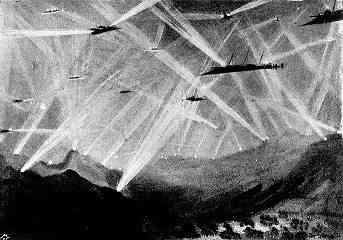 "Flinging Long Streams Of Radiance For Miles Into The Sky." |
On a hundred mountain-peaks all round the great valley of Aeria enormous lights blazed out simultaneously, flinging long streams of radiance, dazzling and intense, for miles into the sky towards all points of the compass, and at the same moment fifty air-ships soared up from their stations all round the mountains, flashing their search-lights ahead and astern in all directions.
It was a scene of unearthly wonder and magnificence, a scene such as could only have been made possible by the triumphant genius of a race of men, heirs of all the best that earth could give them, who had turned the favour of circumstance to the utmost advantage.
Three minutes sufficed for the aerial cruisers to clear the mountains, and as they did so the wide-sweeping rays of fifty search-lights, assisted by the blazing orbs which crowned every mountain-peak, illuminated the darkness for many miles outside the valley. In the midst of the sea of light thus projected through the semi-darkness of the starlit heavens the flying shape of an air-ship was detected speeding away to the south-eastward.
Instantly the prows of the whole squadron were turned towards her, and the first aerial race in the history of the world began. The pursuing air-ships spread themselves out in a huge semicircle, at the extremities of which were the two swiftest vessels in the fleet, almost exact counterparts of the lost Ithuriel. One of these bore the same name as the stolen flag-ship, and the other had been named the Ariel, after the first vessel built by Richard Arnold, the conqueror of the air, a hundred and thirty-two years before.
These two vessels carried ten guns each and were capable of a maximum speed of five hundred miles an hour, the highest velocity that it had so far been found possible to attain. The others were somewhat smaller craft, mounting eight guns each, and capable of a speed of about four hundred miles an hour. The chase, either because she could not travel faster or for some hidden reason, allowed the pursuing squadron to gain upon her until she was only some five miles ahead of its two foremost vessels, which were travelling at the highest speed attainable by the whole flotilla.
She showed no lights, and so in order to keep her in view it was necessary for her pursuers to keep their search-lights constantly sweeping the skies ahead of them, lest they should lose sight of her in the semi-darkness.
This placed the Aerian fleet at a serious disadvantage, which very soon became apparent, for before the pursuit had lasted an hour the chase opened fire with her stern guns and shell after shell charged with some terrific explosive began bursting along the line of the pursuing squadron, producing fearful concussions in the atmosphere, and causing the pursuers to rock and toss in the shaken air like ships on a stormy sea.
The Ithuriel and the Ariel, at the two extremities of the semicircle, replied with a rapid converging fire from their bow guns in the hope of reaching the now invisible chase. All the projectiles were, of course, time-shells, but the speed at which the vessels were travelling not only made the aim hopeless, but caused such an in-rush of air into the muzzles of the guns that the projectiles, checked in their course through the barrels, flew wild and exploded at random, often in dangerous proximity to the vessels themselves.
Hence, after about a dozen shots had been fired, the commanders of the two vessels found themselves compelled to cease firing, and to trust to speed alone to overtake the enemy. On the other hand, this disadvantage to them was all in favour of the chase, which was able to work her two stern guns without the slightest impediment. Before long she got the range of her pursuers, and at last a shell burst fairly under one of the smaller vessels. A brilliant flash of light, blue as the lightning-bolt, illuminated her for an instant, and in that instant her companions saw her stop and shiver like a stricken bird in mid-air, and then plunge downwards like a stone to the earth.
Olga Romanoff, standing on the deck of what had once been the Ithuriel, flag-ship of the Aerian fleet, and now renamed the Revenge, saw this catastrophe, as the others had done, through her night-glasses. She lowered them from her eyes, and said to a dark-eyed, black-haired young fellow, who was commanding the gun that had done the execution--
"Bravo, Boris Lossenski! Did you sight that gun?"
Boris drew himself up and saluted, saying--
"Yes, Majesty, I did."
"Then for that you shall be a Prince henceforth, and if you can bring another down you shall command an air-ship of your own when this fight is over."
Boris saluted again, and ordered the gun to be reloaded. Before it could be discharged a shell from the port gun, which had been fired as Olga spoke, struck another of the Aerian vessels square on the fore-quarter. The flash of the exploding projectile was almost instantaneously followed by the outburst of a vast dazzling mass of flame which illumined for the instant the whole scene of the aerial battle.
The air-ship with all its cargo of explosives blew up like one huge shell, and the frightful concussion of the atmosphere induced by the explosion hurled the two vessels that were close on either side of her like feathers into space, turning them completely over and flinging them to the earth six thousand feet below. A few moments later they struck the ground simultaneously, two great spouts of flame shot up from the spots where they struck, and when the darkness closed over them again four of the pursuing squadron had been annihilated.
"Better still, Levin Ostroff!" cried Olga, as she saw the awful effects of this last shot. "For that you too shall be a Prince of the Empire and command an air-ship on our next expedition. Now, Boris, let us see if you can beat that!"
"Yes, Majesty," said Boris again, knitting his brows and clenching his teeth in anger at his rival's superior success. He glanced along the line of the pursuers and saw four of the Aerian squadron flying close together. He brought the gun to bear upon the two inner ones, took careful aim, and despatched the projectile on its errand of destruction. The moment he had released it he said to the two men who were working under him--
"Load again, quickly!"
The command was instantly obeyed, and scarcely had the explosion of the first blazed out than a second shell was sent after it. The very firmament seemed split in twain by the frightful results of the two well-aimed shots, each of which had found its mark on the two inner vessels with fatal accuracy.
Great sheets of flame leapt out in all directions from the focus of the explosion, and in the midst of their dazzling radiance those on board the Revenge saw the two outside airships of the four roll over and dive head foremost into the dark abyss below them. They struck the earth as the others had done, and vanished into annihilation in the midst of the momentary mist of fire.
This last catastrophe made it plain to the commanders of the Ithuriel and the Ariel that to continue the chase under such conditions meant the destruction in detail of all the smaller ships of the squadron. Those on board the Revenge saw signals rapidly flash from one end of the line, and instantaneously answered from the other end.
"Ah!" said Olga. "My Lords of the Air seem to have had enough of it for the present. Look, the small fry are falling to the rear; our reception has been a little too hot for them. I wonder what they are going to do now. Cease firing, and let us watch them. You two gunners have done gloriously and earned quite enough laurels for your first battle."
It soon became evident that the Aerians had decided to send their smaller craft back. From the speed of the Revenge, and the terrible accuracy and destructiveness of her guns, the commanders of the squadron were now convinced that she was either the lost Ithuriel, or some vessel even superior to her, built upon the same plan.
This being so, to have continued the pursuit under such conditions with the smaller craft would simply have been to court destruction for them in detail. It was impossible for them to use their guns effectively at the speed at which they were travelling, while, as had been so terribly proved, the chase could use hers with perfect ease.
The flying fight could thus only result under present conditions in the ignominious defeat of the squadron by the single vessel as long as she was able to keep ahead. The only hope of success lay, therefore, in a trial of speed and manoeuvring skill between her and the Ithuriel and Ariel, so orders were flashed to the smaller vessels to return to Aeria with the mournful tidings of the destruction of eight of their number.
As they vanished into the darkness behind, Olga divined instantly the tactics that were to be adopted. She saw the converging search-lights of the two remaining air-ships begin to glow brighter and brighter in the rear of the Revenge, proving that they had increased their speed.
"So, it is going to be a race, is it!" she said, half to herself. "Well, we will see if we can lead them into the trap. How fast are we going, Boris?"
He went to the engine-room, and returned saying--
"Four hundred miles an hour, Majesty."
"Make it five," replied Olga.
He saluted, and transmitted the order to the engineer. The lights of the pursuers immediately began to recede again, then they seemed to stop.
"That will do!" said Olga. "They have reached the limit of their speed. Keep to the southward, and see that they come no nearer."
The three air-ships were, in fact, now travelling at their utmost speed. If anything, the advantage was slightly in favour of the Revenge, thanks to the high efficiency of the motive-power which had been applied to her in accordance with the directions left by Olga's father, and transmitted in the will of Paul Romanoff.
So all the rest of the night and on into the next day pursuers and pursued sped on with fearful velocity through the air. They passed over Africa and out above the ocean, and still on and on they swept until the Southern Sea was crossed and the mighty ice-barrier that fences in the South Pole gleamed out white upon the horizon.
This was passed, and still they rushed on over the dreary wastes of Antarctica. The pole was crossed along the 40th meridian, and then they swept northward until the smoke-cloud that crowned the crest of Mount Erebus rose above the snow-clouds that hid the earth. The Revenge headed straight towards this and swept over it, followed at a distance of about ten miles by her pursuers.
Then with a mighty upward sweep she leapt two thousand feet higher still, came to equilibrium, and discharged a shell downwards on to the ice. The explosion was answered by the rising of a flotilla of air-ships, which seemed to have sprung out of the bowels of the earth.
Thirty vessels as large as herself rose simultaneously through the clouds and spread themselves out in a wide circle round the two Aerian vessels, which thus found themselves surrounded by an overwhelming force and dominated by the Revenge floating far above them with her ten guns pointed down upon them.
To an observer so placed as to be able to command a view of the situation it would have seemed that nothing short of the surrender or annihilation of the Ithuriel and the Ariel could have been the outcome of it.
So evidently thought Olga and those in command of the Russian aerial fleet, for, although for one brief instant the two Aerian vessels lay at their mercy, they failed to take advantage of it, and in losing this one precious moment they reckoned without the superior skill and perfect control of their air-ships possessed by those of whom they thought to make an easy prey.
What really happened took place with such stupefying suddenness that they were taken completely off their guard. The Ithuriel and the Ariel lay end on to each other in the midst of the circle of their enemies. Each mounted ten guns, and of these every one was available. The crews of both vessels, trained by constant practice to the highest point of efficiency, knew exactly what to do without so much as an order being given.
Automatically the twenty guns were trained in the twinkling of an eye, each on a Russian vessel, and discharged simultaneously. A moment later the two vessels sank like stones through the thick clouds below them; and while the heavens above were shaken with the combined explosions of the twenty projectiles, each of which had found its mark with unerring accuracy, they had regained their equilibrium a thousand feet from the surface of the ice, and darted away full speed northward.
To such a fearful pitch of efficiency had their guns and projectiles been brought that, while the aim was unerring if once a fair sight was obtained, nothing shaped by human hands could withstand the impact of their shells without destruction. Twenty out of the thirty vessels of the Russian fleet collapsed, and, as it were, shrivelled up under the frightful energy of the Aerian projectiles. Twenty masses of flame blazed out over the grey surface of the cloud-sea, and in another moment the fragments of the vessels it had taken so many months of labour and such wondrous skill to construct were lying scattered far and wide over the snow and ice of the Antarctic desert.
The awful suddenness with which this destruction had been accomplished deprived Olga and her subordinates of all power of thought for the moment. They heard the roar of the explosions, and saw a mist of flame burst out round them as though all the fires of Mount Erebus had broken loose at once and then came the silence of speechless horror and stupefaction. It was more like the work of omnipotent fiends than of men. The bolts of heaven themselves could have done nothing like it.
Then the moment of the shock passed, and those who survived remembered what they ought never to have forgotten -- that, armed as they were with weapons which under favourable circumstances were absolutely irresistible, the first shot meant victory for those who fired it, and destruction for their enemies. Odds of mere numbers went for nothing, for each air-ship was equal to ten others provided she could send her ten projectiles home first, and this is just what had happened.
All this had passed in a twentieth of the time that it has taken to describe it, and by the time Olga and her subordinates grasped the extent of the calamity that had overtaken them the two Aerian vessels, darting through the air at five hundred miles an hour, had swept far out of range of their guns, and were moreover so hidden by the cloud-sea, that they had no idea which course they had taken.
Olga stamped her foot upon the deck, and, in a paroxysm of unrestrained passion, literally screamed with rage as she ordered the Revenge to sink below the clouds. Less than two minutes sufficed for the remains of the fleet, that had been thirty-one strong five minutes before and now only numbered eleven vessels, to sink through the clouds.
A rapid glance round showed them the Ithuriel and the Ariel, tiny specks far out over the waste of snow and ice, speeding away to the northward. To give chase was out of the question, for scarcely had they sighted them than they vanished as completely as though they had melted into the atmosphere; and so Olga signalled for her remaining vessels to proceed to their secret haven in the snowy solitudes of the South, while the Ithuriel and her consort sped onward on their homeward voyage, to carry the news of the terrible vengeance that they had taken for the destruction of the eight air-ships which had been annihilated by the guns of the Revenge.
Twenty hours sufficed for the two Aerian vessels to pass over a quarter of the earth's circumference, and carry their tidings of vengeance and victory to Aeria, and shortly after noon on the day but one after Olga had dropped her challenge from the skies, a meeting of the Ruling Council was held at the President's house in order to consider the startling and pregnant events which had taken place, and to determine the plan of the war which, after a hundred and thirty years of unquestioned supremacy, they were now called upon to wage not only for the mastery of the world, but for the very lives and liberties of the citizens of Aeria.
It had of course been impossible to conceal from the inhabitants of the valley the gravity of the startling events which had taken place in such rapid succession, nor did the President and Council consider any such concealment desirable. There were no demagogues and no politics in Aeria, and therefore there was no need for any State secrets save those which contained the essentials of aerial navigation.
There was also no fear of panic in a community which contained no ignorant or criminal classes, and so, while the Council was sitting, the strange tidings were promulgated throughout the length and breadth of the valley. Marvellous and disquieting as they were they yet gave rise to very few external signs of excitement. They were gravely, earnestly, and even anxiously discussed, for they brought with them a prophecy of calamities to come, the probability of whose realisation was too plain to be ignored.
But ever since the days of the Terror each generation of Aerians had been carefully trained to recognise the fact that the progress of science and the restlessness of human invention in the world outside their borders must, sooner or later, produce some challenge to their supremacy and some attempt to dispute with them the Empire of the Air. Now, after four generations -- in spite of all the elaborate precautions that had been taken, the stringent laws that had been enacted and more than once mercilessly enforced -- the crisis had come.
It was now impossible to doubt that by some means, which so far seemed almost superhuman, the flag-ship of their fleet had been stolen, and the son of the President kidnapped with his greatest friend. More than this, the news brought back by the Ithuriel and the Ariel proved beyond all doubt that means had been found to build a large fleet of aerial warships without even arousing the suspicions of the Council. And, worst and most sinister sign of all, there was also the fact, proved by Olga's letter to the President, that the moving spirit in this defiant revolt against the supremacy of Aeria was one who bore the ill-omened and still hated name of Romanoff.
As has been said, there was no panic that night in Aeria, but still many a man and woman anxiously asked, either aloud or in his or her own soul, whether in the mysterious revolution of human affairs it might not be about to come to pass that she who had wrought this apparent miracle might not yet be able to avenge the terrible fate of her ancestor, the Last of the Tsars. Then, with this thought came a universal revulsion of horror at the prospect of such a crime against humanity and a deep resolve to exact the penalty for it to the uttermost.
If war was to be brought once more upon the earth, those who brought it would find Aeria worthy of its splendid
traditions and ready, if necessary, to reconquer the earth as the founders of its empire had done in the
Armageddon of 1904. Fierce as that mighty struggle had been, its horrors would pale before those of a conflict in
which conquest would mean extermination, for if Aeria was forced once more to draw the sword it would not be
sheathed until there was peace again on earth, even if that peace were to be but the silence of universal desolation.
STRANGE TIDINGS TO AERIA. THE sitting of the Council lasted until nightfall, and just as the western mountains were throwing their huge
shadows over the lovely valley, two more air-ships passed between two of the southward peaks and alighted in the
great square in the centre of the city. They were the two vessels which had been sent to the island indicated in
Olga's letter to bring back the long-lost Alan and Alexis.
It would be vain to attempt to describe the feelings with which the President and the father of Alexis went, as
they thought, to receive their sons, but the air-ships had returned without them, and in their stead they brought a
written message which conveyed tidings no less strange and startling than those brought from Antarctica by the
Ithuriel and her consort.
It was a letter from Alan to his father, and as soon as he received it from the captain of one of the air-ships,
who had found it nailed to a tree on the island, he took his friend into his library, and there the two fathers read it
together.
After briefly but circumstantially recounting the capture of the flag-ship by Olga by means of her subtle drugs,
and showing how, by using the power they gave her, she had kept them in mental slavery for years, forcing them to
employ their skill and knowledge in aiding her to build her aerial and submarine fleets out of the spoils of the
destroyed ocean transports, from which the latter had taken an incalculable amount of treasure, Alan's letter
concluded thus:--
What the judgment of the Council would be upon us I don't know, but we are resolved that, whatever it might
have been, you and Alexis's father shall be spared the sorrow of pronouncing sentence upon your own sons. Some
day perhaps we may win at least the right to plead our cause before you. At present we have none, and until we
have won it you shall not see us again unless you capture us by force.
We were sent here in the Narwhal, the swiftest and most powerful vessel of the Russian submarine fleet. Only a
few days ago an accident revealed to Alexis for the first time during our long mental slavery the means which this
woman, who is as beautiful as an angel and as merciless as a fiend, had used to keep us in subjection. We
took the utmost care to give her no suspicion of his discovery, and although we drank no more of her poison we
acted exactly as though we were still under its influence.
In what could only have been mockery she gave us back our belts and coronets, bidding us wear them "when
we returned to our kingdom," as she put it. We shall never wear the winged circlets again till we have regained the
right to do so, but the belts and a couple of brace of magazine pistols which we took before we left her stronghold in
Antarctica stood us in good stead.
We have killed the crew of the Narwhal, and taken possession of her. She is far swifter and more powerful than
any vessel in our submarine navy, for she can be driven at a hundred and fifty miles an hour through the water,
and can destroy anything that floats in or on the sea with a blow of her ram, and, more than this, she carries a
torpedo battery which has an effective range of two miles and can strike and destroy anything within that distance
without giving the slightest warning of her presence.
There are fifty vessels of this type in the Russian fleet, but the Narwhal is at least thirty miles an hour faster than
any of them. An attack will probably be made by the Russians on our station at Kerguelen Island within a week by
submarine vessels and a small squadron of air-ships, and there we shall begin our operations against the enemy. If
you have any reply to make to this letter we will wait for it at sea off Kerguelen, and then begin the campaign we
have planned. We shall never rest until we have either destroyed the Russian fleet in detail or have died in the
attempt to do so.
If we ever return it will be to restore to you the supremacy of the sea, and then, and not till then, we will ask you
to pardon our fault and will willingly submit to such further conditions as you may see fit to impose upon us before
you give us back -- if ever you do -- the rights which we have lost.
With all love and duty to yourself, and loving remembrances to the dear ones in Aeria, your son
At the foot of the letter was a postscript signed by Alexis, indorsing all that Alan had said, save with regard to his
sole responsibility for the calamity that had ensued from the admission of Olga and Serge on board the Ithuriel.
The two fathers discussed the strange, and, to them, most affecting communication for nearly an hour in
private, and then another meeting of the Council was called to consider it and pronounce authoritatively upon it. The
President read the letter aloud in a voice which betrayed no trace of the deep emotion that moved his inmost being,
and then left the Council chamber with Maurice Masarov, so that their presence might not embarrass their
colleagues.
The simple, manly straightforwardness of Alan's letter appealed far more eloquently to the Council than excuses
or prayers for forgiveness would have done. It was plain, too, that after the first indiscretion of taking the strangers
on board the air-ship, no moral responsibility or blame could be laid on Alan and Alexis for what they had done
under the influence of a drug which had paralysed their moral sense.
The Council, therefore, not only accepted the conditions of the letter, but without a dissentient voice, agreed to
confer the first and second commands of the Aerian submarine fleets and stations for the time being upon Alan and
Alexis, with permission to call in the aid of the nearest aerial squadron when necessary. This decision was
despatched forthwith by an airship to Kerguelen, and within an hour all Aeria was talking of nothing, else than the
strange fate of the two youths who for five years had been mourned as dead.
Later on that evening, when the twin snow-clad peaks which towered high above the city of Aeria had lost the
pink afterglow of the departed sunlight, and were beginning to gleam with a whiter radiance in the level beams of the
newly-risen moon, a girl was standing on the spacious terrace of a marble villa which stood on the summit of a
rounded eminence a couple of miles from the western verge of the city.
She had just crossed the threshold of womanhood. The next sun that would rise would be that of her twentieth
birthday. Yet for two years she had worn the silver circle and crystal wings, for in Aeria a girl became of legal age
at eighteen, though she took no share in the civil life of the community until she was married, an event which, as a
rule, took place not long after she was invested with the symbol of citizenship.
It was an exceedingly rare event for an Aerian girl to reach the eve of her twentieth year unmarried, for the
sexes in the Central-African paradise were very evenly balanced, and, as was natural in a very high state of
civilisation, where families seldom exceeded three or four children, celibacy in either sex was looked upon as a
public misfortune and a private reproach.
But Alma Tremayne, the girl who was standing on the terrace of her father's house on this most eventful
evening, had become an exception to the rule through circumstances so sad and strange that her loneliness was an
honour rather than a reproach. There were many of the wearers of the golden wings who had sought long and
ardently to win her from the allegiance which forbade her to look with favouring eyes upon any of them.
She was beautiful in a land where all women were fair, a land where, under the most favourable conditions that
could be conceived, a race of almost more than human strength and beauty had been evolved, and she came of a
family scarcely second in honour even to that of the President, for she was the direct descendant in the fifth
generation of Alan Tremayne, first President of the Anglo-Saxon Federation, through his son Cyril born two years
after the daughter who had married the firstborn son of Natasha and Richard Arnold.
More than five years before she and Alan had plighted their boy-and-girl troth on the eve of his departure on
the fateful voyage from which he had never returned, and of which no tidings had reached Aeria until a few hours
before. To the simple vow which her girlish lips had then spoken she had remained steadfast even when, as the
years went by and still no tidings came of her lost lover, she, in common with her own kindred, had begun to mourn
him as dead.
It is true that she was in love rather with a memory than with a man, yet with some natures such a love as this
is stronger than any other, more ideal and more lasting, and
exempt from the danger of growing cold in fruition. So strong was the hold that this ideal love had taken upon her
being that the idea of even accepting the love and homage of any other man appeared as sacrilegious to her as
the embrace of an earthly lover would have seemed to a nun of the Middle Ages.
And so, with a single companion in her solitary state, she stood aside and watched with patient, unregretful
eyes the wedded happiness of her more fortunate friends. This companion was Isma Arnold, Alan's sister, who had
a double reason for doing as Alma had done.
Not only had she resolved never to marry while her brother's fate remained uncertain, but she, too, had also
made her choice among the youths of Aeria, and in such matters an Aerian girl seldom chose twice. So she waited
for Alexis as Alma did for Alan, hoping even against her convictions, and keeping his memory undefiled in the
sacred shrine of her maiden soul.
No artist could have dreamed of a fairer picture than Alma standing there on the terrace overlooking the stately
city and the dark shining lake at her feet. She was clad in soft, clinging garments of whitest linen and finest silk of
shimmering, pearly grey, edged with a dainty embroidery of gold and silver thread.
Her dress, confined at the waist with a girdle of interlinked azurine and gold, clothed without concealing the
beauties of her perfect form, and her hair, crowned by her crystal-winged coronet, flowed unrestrained, after the
custom of the maidens of Aeria, over her shoulders in long and lustrous waves of dusky brown. There was a
shadow in the great deep grey eyes which looked up as though in mute appeal to the starlight, the shadow of a
sorrow which can never come to a woman more than once.
All these years she had loved in cheerful patience and perfect faith the man for whose memory she had lived in
maiden widowhood -- and now, who could measure the depth of the darkness, darker than the shadow of death
itself, that had fallen across her life, severing the past from the present with a chasm that seemed impassable, and
leaving the future but a barren, loveless waste to be trodden by her in weariness and loneliness until the end!
All these years she had loved an ideal man, one of her own splendid race, the very chosen of the earth, as
pure in his unblemished manhood as she was in the stainless maidenhood that she had held so sacred for his sake
even while she thought him dead -- and, lo! the years had passed, and he had come back to life, but how? Hers
was not the false innocence of ignorance. She knew the evil and the good, and because she knew both shrank
from contamination with the horror born of knowledge.
She had seen both Olga's letter and Alan's, and those two terrible sentences, "They have served my turn, and I
have done with them," and "She is as beautiful as an angel and as merciless as a fiend," kept ringing their fatal
changes through her brain in pitiless succession, forcing all the revolting possibilities of their meaning into her
tortured soul till her reason seemed to reel under their insupportable stress.
Mocking voices spoke to her out of the night, and told her of the unholy love that such a woman would, in the
plenitude of her unnatural power, have for such a man; how she would subdue him, and make him not only her
lover but her slave; how she would humble his splendid manhood, and play with him until her evil fancy was sated,
and then cast him aside -- as she had done -- like a toy of which she had tired.
Better a thousand times that he had died as his murdered comrades had died -- in the northern snowdrift into
which this Syren of the Skies had cast them, to sleep the sleep that knew neither dreams nor waking! Better for him
and her that he had gone before her into the shadows, and had remained her ideal love until, hand in hand, they
could begin their lives anew upon a higher plane of existence.
As these thoughts passed and repassed through her mind with pitiless persistence, her lovely face grew rigid
and white under the starlight, and, but for the nervous twining and untwining of her fingers as her hands clasped
and unclasped behind her, her motionless form might have been carved out of stone. For the first time since peace
had been proclaimed on earth, a hundred and thirty-two years ago, the flames of war had burst forth again, and for the first time in the story
of her race the snake had entered the now no longer enchanted Eden of Aeria.
It was hers to suffer the first real agony of soul that any woman of her people had passed through since
Natasha, in the palm-grove down yonder by the lake, had told Richard Arnold of her love on the night that he had
received the Master's command to take her to another man to be his wife.
There were no tears in the fixed, wide-open eyes that stared almost sightlessly up to the skies, in which the
stars were now paling in the growing light of the moon. The torment of her torturing thoughts was too great for that.
She was growing blind and dizzy under the merciless stress of them, when-- it might have been just in time to
save her from the madness that seemed the only outcome of her misery -- the sweet, silvery tones of a girl's voice
floated through the still, scented air uttering her name--
"Alma!"
The sound mercifully recalled her wandering senses in an instant. It was the voice of her friend, of the sister of
her now doubly-lost lover, and it reproved the selfishness of her great sorrow by reminding her that she was not
suffering alone. As the sound of her name reached her ear the rigidity of her form relaxed, the light came back to
her eyes, and turning her head she looked in the direction whence it came.
There was a soft whirring of wings in the still air of the tropic night, and out of the half-darkness floated a shape
that looked like a realisation of one of the Old-World fairy-tales. It was a vessel some twenty-five feet long by five
wide, built of white, polished metal, and shaped something like an old Norse galley, with its high, arching prow
fashioned like the breast and neck of a swan.
From the sides projected a pair of wide, rapidly-undulating wings, and in the open space between these stood
on the floor of the boat the figure of a girl whose loose, golden hair floated out behind her with the rapid motion of
her fairy craft.
There was no need for words of greeting between the two girl friends. Alma knew the kindly errand on which
Isma had come, and as she stepped out she went towards her with hands outstretched in silent welcome.
As their hands met, and the two girls stood face to face, motionless for a moment, they made an exquisite
contrast of opposite types of womanly beauty-- Alma tall and stately, with a proudly-carried head, clear, pale skin,
grey eyes, and perfectly regular features, and Isma, a year younger and a good inch shorter, slender of form yet
strong and lithe of limb, with golden, silky hair and sunny-blue eyes, fresh, rosy skin, and mobile features which
scarcely ever seemed to wear the same expression for a couple of minutes together-- as sweet a daughter of delight
as ever man could look upon with eyes of love and longing.
But she was grave enough now, for her friend's sorrow was hers too, and its shadow lay with equal darkness
upon her. The ready tears welled up under her dark lashes as she looked upon Alma's white, drawn face and dry,
burning eyes, and her low, sweet voice was broken by a sob as, passing her arm round her waist, she drew her
towards the boat and said--
"Come, dear, this sorrow belongs to me as well as you and we must help each other to bear it. I have brought
my new boat so that we can take a flight round the valley and talk about it quietly. If two heads are better than one,
so are two hearts."
Alma's only reply to the invitation was a sad, sweet smile and a gentle caress, but the welcome, loving sympathy
had come when it was most sorely needed, and so she got into the aerial boat with Isma, and a few moments later
the beautiful craft was bearing them at an easy speed southward down the valley.
THE SNAKE IN EDEN. NO more perfect place could have been imagined for an exchange of confidences and sympathy between two girls
situated as Alma and Isma were than the oval, daintily-cushioned interior of the Cygna, as Isma had called her
swan-prowed craft.
Skirting the mountains, at a distance of about five hundred yards from them, and at a height of about as many
feet from the summits of the undulating foothills below, the Cygna sped quietly along at a speed of some twenty-five
miles an hour. The temperature of the tropic night was so soft and warm, and the air was so dry that it was not even
necessary for them to make use of the light wraps that lay in the stern of the boat.
Isma reclined in the after part of the broad, low seat which ran round the inside, with one hand resting lightly
upon a little silver lever which could be used for working the rudder-fan, in addition to the tiller-ropes, which she
held in her hands while standing up. Alma sat almost upright amidships, with one hand clasped on the rail of
polished satin-wood which ran round the well of the boat, her head turned away from Isma and her eyes fixed upon
two dim points of light far away to the southward, which marked the position of the two moonlit, snowy peaks which
guarded the southern confines of the valley.
For several minutes they proceeded thus in silence, which neither seemed inclined to break. At length Isma
looked up at a planet that was shining redly over the northern mountains, and, possessed by a sudden inspiration,
said--
"Look, Alma, there is Mars returning to our skies!"
"Yes," said Alma, turning round and gazing from beneath her slightly-frowning brows at the ruddy planet; "it is a
fitting time for him to come back now that, after all these years of peace and happiness, human wickedness and
ambition have brought the curse of war back again on earth."
"Yes," said Isma. "If there were anything in what the old astrologers used to say we could look upon his rising
as an omen. And yet we have very little reason surely for taking as an emblem of war a world in which wars have
been unheard of for thousands of years."
"I wonder then that time will come on earth?" said Alma bitterly. "If ever it does! We terrestrials seem to be too
hopelessly wicked and foolish for such wisdom as that.
"Mankind will never have a fairer opportunity of working out its redemption than it had after the Terror, and yet
here, after four generations of peaceful happiness and prosperity, the wickedness of one woman is able to set the
world ablaze again. Our forefathers were wise, but they would have been wiser still if they had stamped that vile
brood out utterly. Their evil blood has been the one drop of venom that has poisoned the whole world's cup of
happiness!"
As Alma spoke these last words her grey eyes grew dark with sudden passion under her straight-drawn brows.
Her breast heaved with a sudden wave of emotion, and the sentences came quickly and fiercely from the lips which
Isma had never heard speak in anger before.
"Yes," she replied, rather sadly than angrily, "perhaps it would have been better for the world if they had done
so, or, at and rate, if they had shut them up for life, as they did the criminals and the insane in the middle of the last
century. But we must remember, even in our own sorrow and anger, that this Olga Romanoff is in her way not
altogether unlike our own Angel was in hers."
"Surely you're speaking sacrilege now!" interrupted Alma.
"How can the evil be like the good under any circumstances?"
"No, I am not," said Isma, with a smile. "Remember how Natasha was trained up by the Master in undying hate
of Russian tyranny, and how she inherited the legacy of revenge from her mother and him. No doubt this Olga has
done the same, and she has been taught to look upon us as the Terrorists looked upon the Tsar and his family.
"We are the descendants of those who flung her ancestor from his throne, extinguished his dynasty, and sent
him to die in Siberia. I would kill her with my own hand if I could, and believe that I was ridding the world of a curse,
but surely we two daughters of Aeria are wise enough to be just even to such an enemy as she is."
"But she has done worse than kill us," Alma almost hissed between her clenched teeth. "If she had a thousand
lives and we took them one by one they would not expiate her crime against us, or equal the hopeless misery that
she has brought upon us.
"What is mere death, the swift transition from one stage of existence to another, compared with the hopeless
death-in-life to which her wanton wickedness has condemned you and me, or to the calamities which she has
brought upon the world?"
"It is nothing, I grant you," said Isma. "But still I do not agree with you about that hopeless death-in-life, as you
call it. Our present sorrow is great and heavy enough, God knows, but for me at least it is not hopeless, nor will it be
for you when the first stress of the storm is over."
"What do you mean?" cried Alma, almost as fiercely as before, and leaning forward and looking through the
dusk into her face as though she hardly credited her ears. "Do you mean to say that either you or I could ever"--
"Yes," said Isma, interrupting her, and speaking now with eager animation. "Yes, I mean just what you were
going to say. And some day, I believe, you will think as I do."
Alma shook her head in mournful incredulity, and Isma noticing the gesture went on--
"Yes, you will! The reason that you do not agree with me now is that yours is a deeper and stronger nature than
mine. You are like the sea, and I am like the lake. Your grief and anger struck you dumb at first.
"You were in a stupor when I found you on the terrace, and now the depths of your nature are broken up and
the storm is raging, and until it is over you will see nothing but your own sorrow and anger.
"But with me the storm broke out at once, and I ran to my room and threw myself upon my bed and sobbed and
wailed until my mother thought I was going mad. You have not wept yet, and it will be well for you when you do.
Your nature is prouder than mine, and it will take longer to melt, but it must melt some time, for we are both women,
after all, and then you will see hope through your tears, as I did."
Alma shook her head again, and said in a low, sad, steady voice--
"I can never see hope until I can see Alan as he was when he left me, and you know that is impossible."
"You will never see him again as he was," replied Isma gently. "But that is no reason why you should not see
him better than he was."
"Better?" exclaimed Alma, with an involuntary note of scorn in her voice, which brought a quick flush to Isma's
cheek, and a flash into her eyes for her brother's sake. "Better! How can that be?"
"Just as the man who has fallen and risen again of his own native strength, is better and stronger than the man
who has never been tempted," replied Isma almost hotly.
"Remember the lessons we have learnt from the people of Mars since we learnt to communicate with them. You
know how they have gone through civilisation after civilisation until they have refined everything out of human nature
that makes it human except their animal existence and their intellectual faculties.
"They have no passions and they make no mistakes. What we call love they call sexual suitability, the
mechanical arrangement into which they have refined our ruling passion. Do you remember how almost impossible Vassilis, after he had
perfected the code of signals, found it to make even their brightest and most advanced intellects understand the
meaning of jealousy?"
The skilfully-aimed shot struck home instantly. A bright wave of colour swept from Alma's throat up to her brow.
Her eyes shone like two pale fires in the dusk, and her hand grasped the rail on which it was resting till the bones
and sinews stood out distinct in it. She seemed to gasp for breath a moment before she found her voice, but when
she spoke her tone seemed to ring and vibrate like a bell in the sudden strength of her unloosed passion.
"Yes," she said. "Yes, you innocent-looking little Isma! You are wiser than I am after all. I did not know the
meaning of that word till Olga's letter fell from the sky, but I know it now. My God, how I hate that woman!"
"She is not a woman," replied Isma, speaking in the unconscious pride of her pure descent. "She is a baseborn
animal, for she has used her beauty for the vilest ends, yet I am glad to hear you say that you hate her for Alan's
sake, as I do, and-- and for Alexis's. While you can hate you can love, and some day you will love Alan-- the real
Alan, not your ideal lover-- all the better because you have hated Olga for his sake."
"What?" almost wailed Alma, in the intensity of her anger and misery. "After he has held her in his arms-- after
his lips have kissed hers-- after"--
"Yes, even after that. When your first bitterness has passed, as mine has, you will be more just, and remember
the influence under which he did so-- if he did. Do you hold yourself responsible for what you think or do in your
dreams, or do you not believe what Alan said in his letter about the drug? You know too much about chemistry not
to know that such horrible poisons have existed for centuries."
"Yes, yes, I know that, and I know that he has no share in the moral guilt; but how can I ever forget he has been
what those cruel words of Olga's told us she had made of him?" replied Alma, her face growing cold and hard again
as she spoke.
"Alma," said Isma, with gentle dignity, yet with a note of keen reproach in her voice, "surely you are forgetting
that you are speaking of my brother as well as of your lover. No, I am not angry, for I am too sad myself not to
understand your sorrow. But I want you to remember that I who have lost both a lover and a brother am asking you
to be patient and to hope with me.
"We have never seen Alan and Alexis as they are. We only remember them as two handsome boys who had
never seen or known evil. When we meet them again, as I firmly believe we shall, they will be men who have passed
through the fire; for if they do not pass through it and come out stronger and better than they were, rest assured we
shall never meet on earth again.
"Alan would no more come to you now than you would go to him. When he believes himself worthy of you he
will come for you as Alexis will come for me, and then"--
She stopped short in her eloquent pleading, for Alma, at last melted and overcome by her sweet unselfishness
and loving logic, had felt the springs of her own woman's nature unloosed and with a low, wailing cry had sunk down
upon the cushions towards her, and was sobbing out her sorrow on her lap. Isma said nothing more, for her end
was achieved. She laid her left hand caressingly on Alma's hair, and with her right she pulled the steering-lever
back and swung the Cygna round until her prow pointed towards home again.
When they reached the villa they found the President's private yacht resting on the terrace, for Alan's father
and mother had come over after the Council meeting to discuss with Alma's parents the more intimate family aspect
of the strange events which had cleared up in such terrible fashion the mystery which had so long shrouded the
fate of the sons of the two chief families in Aeria
So revolting was the idea of their mental servitude to such
an enemy of the human race as they could not but believe Olga Romanoff to be, and so frightful were the
consequences that must infallibly befall humanity in consequence of it, that their parents would rather have known
them dead than living under such degrading circumstances. To the Aerians, far advanced as they were beyond the
standards of the present day, both in religion and philosophy, the conception of death was one which included no
terrors and no more regret than was natural and common to all humanity at parting with a kinsman or a friend.
As they were destined to prove, when face to face with a crisis unparalleled in the history of humanity, they
regarded death merely as a natural and necessary transition from one state of existence to another, which would be
higher or lower according to the preponderance of good or evil done in this life.
If, therefore, the parents and kinsmen of those who were now exiles and wanderers upon the ocean wastes
could have chosen, they would infinitely rather have known that Alan and Alexis had shared the fate of their
companions in the Norwegian snowdrift than they would have learnt that for six years they had been the slaves and
playthings of a woman who, as they guessed from Alan's letter, combined the ambition of a Semiramis with the
vices of a Messalina, and who had used the skill and knowledge which they had acquired and inherited as Princes
of the Air with the avowed purpose of subverting the dominion of Aeria, undoing all that their ancestors had done,
and bringing back the evil era of strife, bloodshed, and political slavery.
So, too, with Alma. As she had told Isma, she would a thousand times rather have seen her lover dead than
degraded to such base uses. Although she, like everyone else in Aeria, admitted that the strange circumstances
absolved both Alan and Alexis from all moral blame and responsibility, she, in common with her own father and
mother, and perhaps, also, with others not less intimately concerned, found it impossible to forget or ignore the taint
of such an association, and to look upon it as a stain that might never be washed away.
I will now tell you the reason why Alexis and myself have not waited for the air-ship which we knew you would
send for us as soon as you received the message which Olga Romanoff told us she would despatch to you. We
consider that by our weakness and folly -- or, in truth, I should rather say mine, for it was I who invited these
treacherous guests on board the Ithuriel-- we have not only brought endless calamities upon the world, but we have
also forfeited our right to the citizenship of Aeria.
ALAN.
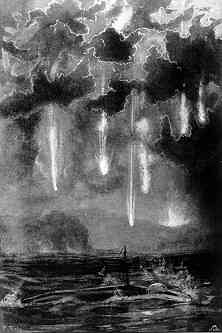 "The Clouds Were Rent And Rolled Up Into Vast Shadowy Billows." |
Alan glanced up and saw a series of intensely bright flashes stream through the clouds, which at the same moment were rent and rolled up into vast shadowy billows by some tremendous concussion of the atmosphere above them. There could be only one explanation of this. The attack on the island had begun from the air, and the flashes were those of the first shots of the aerial bombardment.
What had really happened was this.
A fleet of fifty submarine warships, under the command of Michael Lossenski, the eldest son of Orloff Lossenski, who was now Olga Romanoff's chief adviser in the conduct of the war that she had commenced with the Aerians, had reached the northern coast of Kerguelen Island about four o'clock in the morning in order to co- operate with an aerial squadron of fifteen vessels led by the Revenge, under the command, nominally, of Lossenski's second son Boris, but really of Olga herself.
As Alexis had surmised, the twelve vessels destroyed by the Narwhal were scouts sent out to, if possible, feel their way to the entrance of Christmas Harbour, which was known to be the headquarters of the station.
These were to have returned to the fleet with all the intelligence they could get as to bearings and soundings, and the position of mines and the defending fleet. Then at daybreak, that is to say about eight o'clock, the whole squadron was to have advanced to the entrance to the harbour, ramming any of the defenders who barred their way, and then, after sending a swarm of torpedoes into the mouth of the bay to explode the mines and blow up any submarine defences that might exist, to have made a rush for the inner bay at the same time that the air-ships engaged the land defences.
The naval portion of the programme was completely frustrated by the destruction of the scouts, while the aerial attack was foiled by the look-outs stationed above the clouds. Soon after seven it became light enough at their altitude for the powerful glasses of their commanders to make out the fifteen Russian air-ships coming up from the southward at a distance of about twenty miles.
A few minutes later they were themselves discovered by the Russians, and Olga, to her intense chagrin, saw at a glance that all hope of a surprise was gone. By some means or other the Aerians had received intelligence of the attack, and were ready for it.
The terrible experience taught by the disaster of Antarctica warned her and her lieutenants that any approach, now that they were seen, must be made with the utmost caution, for they had no precise knowledge as to the range of the Aerian guns. All they knew was that it was very great, and that where one of their projectiles found its mark destruction followed instantly.
Added to this, there was another difficulty. The dense masses of cloud completely hid both sea and land from their view, and made accurate shooting at the land defences impossible. Consequently there was nothing for it but to fight the battle out in the upper regions of the air, against a force of whose actual strength they were ignorant. They dare not attempt to surround the ten air-ships, which hung stationary over the island, for this meant bringing all their guns into play, while they could only use half of their own.
While they were debating on a plan of operations, two new factors in the coming struggle were swiftly and unexpectedly brought into play. As soon as the news of their arrival had been telegraphed to headquarters, the Ariel took the air and passed under the clouds to the rear of the Russian squadron. Ten miles behind them, she swept round sharply, and with her wings inclined to the utmost, and her engines working at the fullest capacity, she took a mighty upward swoop, passed through the clouds like a flash of light, and before the Russians knew what had happened, she was floating three thousand feet above them, out of reach of their guns, and hurling projectile after projectile into their midst. Three of their ships, struck almost simultaneously, were torn into a thousand fragments, and vanished through the clouds.
It was the glare and shock of this explosion that Alexis had seen from the conning-tower of the Narwhal. The remaining Russian ships instantly scattered and sank through the clouds to seek a refuge from the foe whose deadly blows they were completely unable to return.
But the moment they appeared on the under-side of the cloud-sea, all the guns of the land batteries opened fire in all directions with time-shells, and so rapid were the discharges, and so terrible the energy of the explosives, that the whole firmament above the island seemed ablaze with them, while the concussions of the nether atmosphere were so tremendous and continuous, that it would have been madness for the Russian air-ships to have approached within the zone of fire with which the Aerians had covered and encircled their positions.
The clouds were torn and broken up into vast whirling masses, which completely obscured the view of the Russians, and rendered anything like accurate shooting in the direction of the island impossible. Worse than this, the range of the great land guns, fired at an elevation of forty-five degrees, was so enormous that they were forced by the incessantly exploding projectiles, which were hurled up into the air in all directions, to retire to a distance which, beyond the most random shooting, the results of which were spent upon the rocks of the island and the sea, rendered their own guns useless
Rise up through the clouds they dare not, for they knew the Ariel was still there, and that the first ship that showed herself would be an almost helpless mark for one of the ten guns which, for the time being, commanded the heavens. There seemed nothing for it but an ignominious retreat, for, as Boris Lossenski said to Olga when, furious with rage and mortification, she reproached him with a lack both of skill and courage, an attack upon a volcano in full eruption would have been child's play to an assault at close quarters on Kerguelen Island.
Their one hope of success had lain in a surprise, and that, by some unaccountable means, had been made impossible. They had reckoned only on the air-ships and the submarine defences, and even these they had expected to take unawares. The terrible power of the battery guns, which were able to spread their seas of fire through the air and to shake the very firmament itself with their projectiles, had been a revelation to them.
They could not train their own guns without seeing their mark, and neither flame nor smoke betrayed the position of the batteries, while on the other hand the artillerists on the island had simply to surround the station with a zone of fire and a continuous series of atmospheric convulsions through which no air-ship could have passed without the risk of overturning or completely collapsing.
So Olga was at last convinced that her choice lay between abandonment of the attack or running the gauntlet of fire in the almost forlorn hope of engaging the land batteries and an aerial fleet of unknown strength at close quarters.
Baffled and defeated, and yet convinced that to continue the unequal contest under its present conditions would be merely to court still more disastrous defeat, and even probable destruction, Olga at last allowed Lossenski to give the signal for retreat, and the Russian squadron withdrew to a position twelve miles northward of the island. Its departure was seen both from the air and the land, and the cannonade immediately stopped.
Meanwhile Alan had run the Narwhal into the mouth of Christmas Harbour flying his red flag. He was met by the Cachalot, and, after telling Captain Ernstein what he had done, and learning of the repulse of the Russians in the aerial battle, he directed forty of the submarine vessels to follow him out to sea to look for the Russian flotilla.
All the craft were furnished with tell-tale needles similar to the one on board the Narwhal, for it is impossible to see a sufficient distance under water to effectively attack an enemy as agile as the submarine warships were, and this fact had led to the universal employment of the needles.
As it was now quite light, the whole Aerian squadron, with the exception of five vessels whose duty it was to act as scouts under water, proceeded seaward on the surface of the waves, keeping a sharp look-out for the remains of the Russian fleet, which they soon discovered lying about five miles off the island. They could make out thirty-five of the long, black, half-submerged hulls lying together like a school of whales with the waves breaking over them as over sunken rocks.
Alan immediately signalled from his conning-tower in the manual sign-language, used by the Aerians to communicate between their air-ships, to his consorts, and ordered them to scatter and form a wide circle round the Russian squadron at a distance of a mile, and a depth of two fathoms, but on no account to approach within a thousand yards of them. When they had reached their positions they were to rise to the surface and each was to discharge a couple of torpedoes towards the centre of the circle. After that they were to retire and leave the rest to him.
The moment the order had been passed through the fleet, everyone of the vessels disappeared and proceeded to her station. The Narwhal sank at the same time until nothing but the glass dome of her conning-tower remained above the water.
By carefully noting the course steered by the compass, and accurately measuring the distance travelled by the number of revolutions of the propeller, each captain was able to place his craft in the desired position.
So perfectly, indeed, was the manoeuvre performed that when the vessels rose to the surface they formed a circle two miles in diameter, in the centre of which lay, within a space of about two hundred yards square, the Russian flotilla, the commanders of which, afraid to advance nearer to the shore without the intelligence which they still awaited from their scouts, and confounded by the awful spectacle presented by the aerial battle, of the issue of which they were utterly ignorant, were waiting in bewilderment and indecision the issue of the events which had taken such a marvellous and unexpected turn.
The manoeuvre ordered by Alan had been executed so promptly and secretly that the Russians were not even aware that they were surrounded until torpedo after torpedo, coming in from all points of the compass, began exploding in their midst, hurling vast masses of water and foam up into the air, tearing their plates and crippling their propellers, and disabling half their number before they had time to recover from the confusion into which the sudden attack had thrown them.
To communicate signals from one vessel to another under such circumstances was impossible, and so united action was out of the question. All that the captains of the vessels could see was that there were enemies upon all sides of them. The explosion of the eighty torpedoes had churned the water up into a mass of seething foam, in the midst of which fifteen vessels were lying crippled and helpless on the surface, while six more had been sent to the bottom.
This was bad enough, but while the captains of those which had escaped were recovering from the stupefaction into which this sudden disaster had thrown them Alan saw his chance, and as soon as the last torpedo had exploded headed the Narwhal full speed into the midst of them. Then followed a scene which would have beggared all description.
The great ship, moving at a speed of nearly three miles a minute, tore her way through the half-crippled squadron, hurling everything she struck to the bottom of the sea. Every Russian vessel that was able to do so after the first assault sank out of the way of the terrible ram of the Narwhal and headed off at full speed into the open sea.
But for those that were partially or wholly disabled there was no escape. Alan standing in his conning-tower, his teeth clenched and his blue eyes almost black with the fierce passion of battle and revenge, whirled his steering-wheel this way and that, and as the steel monster swung round in rapid curves in obedience to the rudder, he hurled her again and again upon his practically helpless victims, piercing them through and through as though their plates had been cardboard instead of steel.
When the last one had gone down he left the conning-tower, hoisted his flagstaff, and flew a signal to his consorts to return to harbour. What had become of the Russian vessels that had escaped he neither knew nor, for the present, cared.
The victory of the Aerians both at sea and in the air was complete, and he was certain that the Russians had
received such a lesson as would convince them that Kerguelen Island was impregnable to any assault that they
could make upon it, unless they were able to take its defenders by surprise-- a contingency which was justly
considered impossible.
THE SYREN'S STRONGHOLD. AS soon as the first pitched battle in the world-war was over, a lengthy and detailed report of the attack on
Kerguelen and its repulse was drawn up by Alan, Captain Ernstein, and Admiral Forrest for presentation to the
Council. To this report Alan added a supplement, which is here reproduced in his own words.
"From what I know of the designs of Olga Romanoff and her advisers I am convinced that the defeats which
have been inflicted upon them will merely have the effect of checking, and not putting a stop to, their operations
against the peace and freedom of the world.
"I have seen and heard enough during the last five years to feel satisfied that there exists a very widespread
conspiracy, the object of which is the restoration of the Romanoff dynasty, in the person of Olga, the breaking up
of the Anglo-Saxon Federation, and the inauguration of an era of personal despotism and popular slavery.
"As far as we have been able to learn, this conspiracy embraces practically all the descendants of those
families who lost their rank, official position, or property during the reconstitution of Russia after the fall of the
Romanoffs. These people have, of course, everything to gain and not much to lose by the destruction of the present
order of things, and Olga has promised them, no doubt quite sincerely, that in the event
of her triumph they shall be restored to all that their ancestors lost.
"As a matter of fact, the greater part of Russia will be divided amongst them should she ever accomplish her
designs. The old order of things, as it existed before the days of Alexander II., is to be completely reinstated. The
lower orders of the people are to be reduced once more to serfdom, and the trading classes to a condition very little
better.
"If they resist they are to be terrorised into submission by the air-ships, and all who raise their voices for
freedom are to be banished to Siberia, which is once more to be the prison-land of the Russian Empire. A large
standing army is to be kept constantly on the war-footing, while the sea navy and the aerial fleet are to be kept up to
such a strength as to be able to hold the rest of the Continent in practical subjection.
"In short, Olga aspires to nothing less than the throne of an empire which shall stretch from the Yellow Sea to
the Atlantic Ocean. I am afraid, too, that there can be no doubt but that this conspiracy is not only favoured, but
actually assisted, by large numbers of people throughout the Federation area.
"In fact, during the latter part of our stay at Mount Terror, the stronghold was visited by men of all nations, who,
of course, came and went away in the submarine vessels, and who openly promised to do everything they could to
further what they called the cause of the New Revolution in their own countries, on the understanding that the old
evils of capitalism and private ownership of land by which their ancestors had grown wealthy are to be restored.
"This will, I trust, be enough to show you that the triumph of Olga Romanoff means nothing less than the
complete undoing of all the work that was done in the days of the Terror.
"We have proved so far that Kerguelen, and, therefore, Aeria, is impregnable to attack save by surprise, which
will now, of course, be impossible. But, on the other hand, the force at the disposal of Olga and her allies is still so
strong that all our present resources will have to be kept constantly employed to protect ourselves, and this leaves
the world at the mercy of any Power which can obtain the assistance of the Russians' aerial navy, which still
numbers twenty-seven vessels, all equal to our best ships.
"In addition to these they possess a submarine navy of at least forty vessels, all of which are swifter and more
powerful than ours, with the exception of the Narwhal. I therefore suggest that the whole of the resources at the
command of the Council shall at once be devoted to the building of at least fifty air-ships of the Ithuriel type, and the
same number of submarine battleships like the Narwhal, complete plans of which I enclose.
"Until this additional force is at our command, I think it would be useless to attempt the destruction of the
Russian stronghold in Antarctica, and until this is destroyed there can be no hope of peace. This stronghold, which
I will now attempt to describe for the information of the Council, is one of the most marvellous places on earth.
"It lies in and about Mount Terror and the Parry Mountains, which run from it towards the pole behind the ice-barrier
of Antarctica. Nearly ten years ago a Russian explorer named Kishenov reached the ice-barrier and made
the discoveries which have enabled the Russian revolutionists to create their stronghold. In addition to his ship, he
took with him three aerostats, which were chiefly constructed during his voyage, and also a small submarine vessel,
which he took out in sections and put together at sea.
"He skirted the coast of Victoria Land, and was stopped by the ice in latitude 78°, as all other Antarctic
explorers by sea have been since the voyage of Sir James Ross. The season was a singularly fine and open one,
and two days after his arrival he inflated one of his aerostats and crossed the great barrier, to make a thorough
exploration of the unknown land. Kishenov was the first man, not an Aerian, who had ever seen what there was on
the other side of the Antarctic ice-wall.
"But he discovered far more than our explorers did, for
while he was in the neighbourhood of Mount Terror an earthquake, accompanying a violent eruption of Mount
Erebus, made a huge fissure in the south side of Mount Terror. After waiting three days to make sure that the
earthquake had subsided, he and two of his officers entered the crevice, which they found to be over two hundred
feet wide at the level of the land ice.
"Furnished with storage batteries and electric lights, they penetrated into the interior of the mountain and found
that it was pierced in all directions with great galleries and enormous chambers, hollowed out by volcanic forces
during the period of Mount Terror's activity. Four days were spent altogether in exploring this subterranean region,
the existence of which was kept a profound secret by Kishenov and his officers.
"Not the least strange and, as it has proved, one of the most valuable portions of his discovery was the finding
of a subterranean lake in the heart of Mount Terror, the temperature of which was kept far above the freezing point
by the heat which the interior of the mountain derived from the neighbouring fires of Mount Erebus. Finding the lake
to be salt water, he concluded that it must have some connection with the open sea, and so the next day he and the
same two officers entered the submarine boat and penetrated underneath the ice-barrier.
"After a search of five hours, the search-lights of the boat revealed a huge tunnel leading south-west into the
land, that is to say, direct for Mount Terror. They followed this tunnel up for a distance of nearly five miles, and then
struck the end. They now rose, and finally found themselves floating on the surface of the lake in the interior of the
mountain.
"One of Kishenov's officers, a man named Louis Khemski, was a member of the Russian Revolutionary Society,
whose existence only became known five years ago. After the capture of the Ithuriel the heads of this society met,
and to them this man communicated the secret of Mount Terror. Kishenov and the other officer refused to join the
revolutionists, and were assassinated.
"Khemski was at once taken on board the Ithuriel, now renamed the Revenge, and guided her to the fissure
leading into Mount Terror. Its outer portion was of course filled and covered with ice and snow, but as soon as
Khemski had found its position by his landmarks, a couple of shells speedily reopened it, and it was here that the
Revenge lay hidden while you were ransacking the world for her.
"Olga inherited from her grandfather, the father of the Vladimir Romanoff who was executed for disobeying the
order of the Council, all the plans and directions necessary for the building both of air-ships and submarine
vessels, and as soon as this perfect stronghold and hiding-place was discovered, her accomplices in the
conspiracy for the restoration of the Russian monarchy at once devoted their fortunes to the supply of money and
materials. The Revenge made one more voyage to Russia, and by travelling at full speed at a great elevation
managed to make it unobserved.
"The services of the cleverest engineers and most skilful craftsmen among the revolutionists were secured.
Transports were chartered and sent out to Antarctica loaded with materials. On the shores of the subterranean lake
the first squadron of submarine vessels was built, and then began the system of ocean terrorism which soon
paralysed the trade of the world.
"Piracy was carried on with utter ruthlessness. Transports were sunk by the vessels, and then plundered by
divers of the treasure which they carried, and which was employed to purchase new materials and to repay those
who had furnished the first funds.
"Alexis and myself were kept by Olga, as I said in my first letter, under the influence of a drug which completely
paralysed our volitional power, and were compelled to reveal all we knew concerning our own air-ships, submarine
vessels, guns, and explosives. And in this manner was created and equipped the force which will be employed to
dispute with us the empire of the world unless we are able to extirpate it utterly."
While the despatch to the Council was being drawn up,
the Narwhal had been lying in the inner basin of Christmas Harbour, renewing her store of motive power from the
generating station ashore. As soon as the engineer in charge reported that her power-reservoirs were full, and Alan
had delivered the despatch for conveyance to Aeria by air-ship, Alexis, who had been apparently buried in a brown
study for the last two hours or so, asked Alan to come with him into his private cabin, and as soon as the two
friends were alone together he said to him--
"Look here, old man! While you fellows have been drawing up that despatch, and talking about the impossibility
of attacking the stronghold at Mount Terror, I've been doing some thinking, and I've come to the conclusion that as
far as an under-sea attack is concerned, it isn't quite so hopeless as you've made out."
"I shall be only too delighted to hear you prove us wrong," replied Alan, his eyes brightening at the prospect, for
he knew Alexis too well not to be sure that he would not have spoken in this way unless he had pretty solid reasons
for doing so. "Say on, my friend; I am all attention."
"Get out to sea, then, as fast as ever you can," said Alexis, "for there's not an hour to be lost if you adopt my
plan, and if you don't we can just come back."
"Very well," said Alan. "What's the course?"
"Clear the islands and head away southward as hard as you can go," replied Alexis briefly.
The excitement of the battle in which he had played such a terrible part had left Alan in just the frame of mind to
listen to the project of a desperate adventure, such as he instinctively knew was now in his friend's mind. Without
hesitating further he went into the saloon, summoned the crew of the Narwhal, and said to them--
"Alexis and I have decided upon an enterprise which will end either in very great injury to our enemies or our
own destruction. You have seen enough to-day to know that in the warfare we are engaged in there are only two
choices: victory or destruction. We don't want to take anyone against his will to what may be certain death. Those
who care to go ashore may do so."
Not a man moved. An athletic sailor named George Cosmo, who held the post of chief engineer, saluted, and
said briefly--
"We shall all go, sir. What are the orders?"
"Get out of the harbour as fast as you can, and us soon as you are clear of the islands sink two fathoms, steer
a straight course due south-east, and put her through the water as hard as she'll go," replied Alan.
Cosmo saluted again, and left the room with his comrades to execute the order.
"Now, my friend," said Alan, turning to Alexis as soon as they were alone again, "what is your plan?"
"Simply this," replied Alexis. "Mount Terror, or at any rate the mouth of the submarine tunnel, is in round
numbers three thousand geographical miles from here. Our speed is thirty miles an hour faster than that of Olga's
squadron. That means that even if they go back at once and at full speed we shall be there four or five hours before
them.
"They, I think, have had quite enough fighting for to-day, and I don't believe they'll attack the island again-- first,
because they know that they can't take our sea defences by surprise, and, second, because they think the Narwhal
will remain on guard.
"Either they will go off on a raiding expedition somewhere else with the air-ships-- in which case we can't follow
them, for we don't know where they're going -- or they will return to Mount Terror at an easy speed of fifty or sixty
miles an hour. They will never dream that you and I will venture to attack the stronghold single-handed, and,
therefore, that is just what I propose to do."
"That will be odds of about forty to one against the Narwhal," replied Allan, somewhat gravely. "Unless we can
destroy it completely before they get back. But go on. Let's hear the rest. I don't think you can propose anything too
desperate for me now that I have really tasted the blood of the enemy."
"Well, what I propose is not to destroy the stronghold, simply because it would be impossible to do that by sea. I
merely propose to get quietly into the tunnel, go to that narrow part about two miles from the entrance, fix a dozen
torpedoes with time-fuses up against the roof of the tunnel, and then clear out into the open water.
"When those twelve torpedoes go off if they don't bring a few thousand tons of rock down into the tunnel and
block it pretty securely I'll grant I know very little about explosives."
"Good so far, very good!" said Alan. "I confess I envy you that idea. What next?"
"Well, after that," replied Alexis. "You see we shall have shut in the vessels that are inside and shut out those
that are outside. The ones inside will be no use for some time, for it will take the divers a good many days to open
the tunnel again, even if they ever do.
"As for those outside, we can lie in wait for them if they return, and trust to the Narwhal's speed and strength to
sink as many of them as we can, or else, if they don't put in an appearance, we can come home with the
consciousness that we have done about all the damage in our power. Now, what do you think?"
Alan was silent for a few moments, weighing the pros and cons of the desperate venture-- for desperate it was,
in spite of the incomparable speed and strength of the splendid vessel he commanded.
It was easy enough, always supposing that it could be accomplished without interruption; but to be caught in the
tunnel, as was quite possible, between a force inside and one outside meant almost certain destruction, for if the
Narwhal was not rammed and sunk in a space too narrow for her to turn she would be certain to be blown up by the
torpedoes which would be launched against her.
In the end, the very character of the desperate venture, combined with the magnitude of the injury it would do to
the enemy, overcame the scruples of his prudence. He put his hand on Alexis' shoulder, and giving him a gentle
shake, said with a laugh--
"Bravo, old philosopher! You've done more with your thinking than we have with our talking and writing. We'll do
it, if there isn't a square foot of the Narwhal left when the business is over."
"I knew you'd say that," said Alexis. "Now let's have some dinner and go to sleep, for we shall want it."
It was then very nearly midday, and the Narwhal had cleared the islands, and, with her prow pointed direct for
the north-eastern extremity of Wilkes's Land, was rushing at full speed through the water about twelve feet below the
surface of the sea. For twenty hours she sped silently and swiftly and unseen on her way, swept round the ice-barrier
that fences the northern promontory of Victoria Land and into the bay dominated by the fiery crest of Mount
Erebus.
FROM THE SEA TO THE AIR. TWENTY-FOUR hours after she had reached Mount Terror the Narwhal came into the inner basin of Christmas
Harbour, running easily along the surface, with the red flag flying at her flag-staff. The news spread rapidly through
the little settlement, the dwellers in which had been wondering greatly at her sudden disappearance, and there was
quite a crowd on the jetty as she ran alongside. Max Ernstein was among it, and as the battleship came to a
standstill he saw to his amazement Alan spring ashore and come towards him with outstretched hands.
"Why, what does this mean?" he said, as he grasped his hand. "I thought you told me you were never going to
leave the Narwhal until"--
"Until we had done what we have done," said Alan with a laugh, as he returned his hand-clasp with a grip that
made the bones crack. "We have destroyed a good half of what remained of the Russian sea navy, and, what's
more, we've blown up the entrance to their submarine dockyard, and completely crippled them as far as building or
equipping new vessels is concerned until they can find a new harbour."
"Magnificent!" exclaimed Ernstein. "Glorious! You'll be wearing the golden wings again in forty-eight hours."
"If I am," said Alan, flushing with pleasure at the thought, "the credit will be due to Alexis, and not to me. It was
his idea entirely. But never mind that now. We've suffered rather badly, and only just escaped with our lives. Five
out of six of the Narwhal's crew are disabled, and I want you to get them out and send them away to Aeria as soon
as possible. Meanwhile Alexis and I will write our despatch to the Council."
His instructions were obeyed at once, and the invalids were transferred to the Vega, the air-ship that was to
convey them to Aeria, and in her luxurious state-rooms their hurts were attended to by the best skill on the island
while the despatch was being drawn up.
It was brief, plain, almost formal in language, and confined entirely to statement of bare fact, and in little more
than an hour after the arrival of the Narwhal at Christmas Harbour the Vega had risen into the air, and was
speeding on her way towards Aeria.
Meanwhile the news of the daring venture and brilliant exploits of Alan and Alexis and their comrades spread
like wildfire through the island, and everyone who was not engaged on duties that could not be left came to the
settlement to see and congratulate the two heroes of the hour, whose strange and romantic fate, so well known to
every Aerian, had thus suddenly been glorified by the triumph of the genius and daring which had proved capable
of wresting victory from defeat and glory from misfortune.
Although some were more demonstrative, none were heartier or more sincere in their congratulations than
Edward Forrest, the admiral of the station, and, unknown to Alan and Alexis, he and Ernstein had sent a joint
despatch by the Vega, strongly urging both the justice and the policy of at once restoring to the full rights of
citizenship the two men who had proved themselves possessed of such extraordinary ability.
If the battle for the empire of the world was to be fought over again, the command of the forces of Aeria could
not be entrusted to any hands so able and so daring as those of the President's son and his friend and companion
in misfortune and victory. The triumphs at Kerguelen and Antarctica had really been due to them alone. They had
given warning of the attack on the station, and it was due to the skill and boldness of their strategy that it had been foiled with such
disaster to the enemy.
This of itself was much, but it had not satisfied either their ambition or their devotion, for, after it had been
accomplished, they had carried the war almost single-handed in the Russian stronghold, and there, under
circumstances of unparalleled danger to themselves, they had struck a blow which could not fail to cripple the sea-power
of the enemy, and so influence to an incalculable extent the ultimate issue of the war which, ere long, might
be raging over the whole world.
That night, while the almost constant storms of the southern winter were sweeping over the barren surface of
Desolation Land, a feast was held in the central hall of the headquarters at Christmas Harbour in honour of the
double victory and the return of the two chief heroes of it from their long captivity. The next day was spent in a
rigorous inspection of all the defences of the island and the machinery and ammunition of the air-ships and
submarine vessels. At six o'clock in the evening, twenty-six hours after she had started, the Vega returned from
Aeria, bringing the reply of the Council to the despatches which she had taken.
In recognition of the great skill and devotion they have displayed, the Council invites them to assume the
command of the air-ship Ithuriel, and to make use of that vessel to execute such plans and purposes as in their
discretion will best serve the interests of the State of Aeria for a period of one year from the present date. They will
be supplied with motive power and all stores and materials of war at any of the oceanic stations.
The Council accepts the recommendation contained in the supplement to the first despatch, and has given
orders for the immediate building of a hundred air-ships of the Ithuriel class and the same number of submarine
battleships of the Narwhal type. These are expected to be ready for service at the end of the year, by which time
the Council Hopes to be able to call upon Alan Arnold and Alexis Mazarov to assume the duties of admiral and vice-admiral
of the aerial navies, and at the same time to restore to them full privileges of citizenship in Aeria.
The admiral and officers of Kerguelen will give all assistance in the carrying out of these directions, and will
make and transmit all necessary reports in connection with them. No further hostilities are to be undertaken for the
present by the aerial or sea forces, but they will maintain a strict watch against all possible surprises on the part of
the enemy, and be ready to repel any assault which may be made. This order does not apply to the air-ship Ithuriel.
Such was the reply of the Council to the news of the daring foray made by the Narwhal upon the stronghold of
Mount Terror, and the suggestions of Admiral Forrest and Captain Ernstein. Although it did not precisely adopt the
latter, which, indeed, the Council was well justified in looking upon as inspired rather by enthusiasm than the judicial
spirit proper to the occasion, it was even more satisfactory both to Alan and Alexis than an immediate recall would
have been.
True, they had done great and brilliant service in the first few days of their return to freedom. They had virtually
crippled the Russian sea-power by the blows which they had so skilfully, so swiftly, and so daringly struck, but
neither of them felt that this was a sufficient achievement to warrant their full restoration to all that they had lost
through the fatal error that they had made on board the old Ithuriel
Both, indeed, longed ardently for just such further opportunity of devoting themselves to the service of their race
and country as this order offered them. In command of the new Ithuriel, one of the swiftest and most formidable
aerial warships in existence, there was no telling the damage that they might do to the enemy or what service they
might render to their friends.
They knew that, as regarded the Russian force, the odds against them were about twenty-four to one, and they
also knew that Olga and her lieutenants would lose no time in increasing their navy to the utmost extent in their
power in preparation for the war of extermination that was now inevitable.
They had a year before them during which they would have an absolutely free
hand, and all the supplies that the resources of Aeria could give them. True, it was a year of exile
and probation, but they gladly welcomed the test of fidelity and devotion which it offered, and which, worthily
passed through, would mean restoration of all they had lost, and a return to their friends and kindred in their
beloved valley of Aeria armed with powers and responsibilities which would make them practically the arbiters of the
destinies of their people, and perhaps of the whole human race.
But the Vega had brought something more to the two friends and exiles than the reply of the Council to their
despatches, for immediately he landed her captain handed to Alan a small sealed packet addressed to him in the
handwriting of his sister Isma. When he opened it, as he did at the first opportunity that found him alone, he found
that it contained two letters and two chromatic photographs.
The letters were from his parents and sister. His father's was, as may well be imagined, very different from the
cold and formal despatch that he had signed as President of the Council. It was full of tender and loving sympathy
for him in the strange fate that had overtaken him, and, while it entirely absolved them of all moral blame for the loss
of the flagship and the lives of his companions, it exhorted him earnestly to apply himself without useless regrets to
the work of the year of probation which the Council had seen fit to impose upon him, and it ended with an
assurance that the happiest day that had been known in Aeria within the memory of its citizens would be that on
which the golden wings would be replaced on their foreheads in the Council Hall of the city.
To this letter was added another, written by Alan's mother, and written as only a mother can write to her son.
Strong and well tried as he was, there were tears in Alan's eyes when he had finished reading these two letters, but
they did not remain there long after he had begun the one from his sister.
Isma, proud beyond measure of the exploits of her brother and the man she still looked upon as her lover, and
absolutely assured that when the time came both would return covered with honour, wrote in the highest spirits. As it
was an invariable rule of life among the Aerians to be perfectly frank with one another, and to take every precaution
to avoid those misunderstandings which in a less perfect state of society had produced so much personal and
social suffering, she told him in plain yet tender language exactly what had passed between her and Alma on the
night that his first letter had been received.
Yet she said nothing that in any way committed either Alma or himself to a renewal of the troth which had been
broken by the designs of Olga Romanoff, and though she sent her remembrances to Alexis, she sent them as
though to a friend, tacitly giving both to understand that no words of love must pass between the two exiles and their
former sweethearts until they met again upon equal terms.
But there was another message not contained in the letter, or written in any words, which said more than all that
she had written, and this was conveyed by the photographs, which she sent without a word of allusion to them. As
Alan looked upon them the six years of mental slavery and degrading servitude to the daughter of the enemies of
his race passed away for the moment, and he saw himself standing with Alma in one of the groves of Aeria plighting
his boyish troth on the night before he started on his fatal voyage in the Ithuriel.
The face that looked at him with such marvellous lifelikeness, with all its perfection of form and exquisite
colouring, reproduced with the most absolute fidelity, was the same face that had been upturned to his to receive
his kisses on that never-to-be-forgotten night. And yet, in another sense, it was not the same.
That had been the sunny, smiling face of a girl to whom sorrow and evil were as absolutely unknown as they
would be to an angel in heaven, but this was the face of a woman who had lived and thought and suffered.
And when he remembered that whatever of sorrow or suffering she had known had been on his account, the
last lingering traces of the vile spells of the evilly beautiful Syren of the
Skies, who had so fatally bewitched him, vanished from his soul, and the old love revived within him pure and
strong, and intensified tenfold by the knowledge of the great reparation that he owed to the girl upon whose life he
had brought the only shadow it had ever known.
He knew that their hands would never meet again until all that had been lost was regained, at whatever cost of
labour or devotion that might be necessary on his part, but he also knew that in all these years no other man had
been found worthy to fill the place that he had once occupied, and which he was resolved to win back or die in the
attempt, and this knowledge made him look forward to the mighty struggle which lay before hint with an eagerness
that augured well for its issue.
He had gone into his own cabin on board the Ithuriel, which was being rapidly prepared for her roving
commission, to read his letters in solitude. He put Alma's photograph on the table, and sat before it with his eyes
fixed upon it until every line of form and tint of colour was indelibly impressed anew upon his memory.
Then he kissed it as reverently as a devotee of old might have kissed a sacred relic, and then he attached the
oval miniature to a chain of alternate links of azurine and gold, and hung it round his neck inside his tunic,
registering a mental vow that if death came before he once more wore the golden wings, it should find it lying
nearest his heart.
"This," he said, speaking to himself, as he took Isma's photograph up from the table, and looked fondly upon the
radiantly lovely face that looked out from its frame, "is evidently not intended for me. Isma doesn't say who it's for,
but I fancy that there is some one on board the Ithuriel who has a very much better right to it than I have. I wonder
if Alexis is in his room?"
So saying, he left his cabin and found his friend still deep in the perusal of two lengthy letters from his father
and mother.
"So you have had letters from home as well, old man? I hope they've been as pleasant reading as mine have,"
he said, going to the couch on which Alexis was sitting, and holding one hand behind his back.
"Yes, they're from my father and mother, and so they can scarcely be anything else, so far as what they do
say. It's what they don't say that gives me the only cause to find fault with them. But still that, I suppose, would be
expecting too much under the circumstances."
He ended with something very like a sigh, and Alan replied as gravely as he could--
"And what might that be, my knight of the rueful countenance? Don't you think the Council have treated us
splendidly, and given us a glorious opportunity of winning back all that the daughter of the Tsar has robbed us of?"
"Of course, I do," replied Alexis, looking up at him with a flush on his cheeks. "But for all that there is one thing
still, something that I am not ashamed to say I value above everything else that I have lost or can regain."
"And that is--?"
"Well, to put it plainly," replied Alexis, the flush deepening as he spoke, "these two letters don't contain one
single word about Isma. Now you know what I mean. Of course, I am ready to do everything that the Council may
call upon us to do, and the moment that I know I have won back the right to wear the golden wings will be the
proudest of my life, but it will be far from the happiest if I only go back to Aeria to find Isma another man's wife, and
what else can I think when they don't so much as mention her name?"
"Be of good cheer, my friend," replied Alan with a laugh, putting one hand on his shoulder, and taking the other
from behind his back. "You will never find that, I can promise you. I am the bringer of good tidings. There, take
those and feast your eyes and your heart on them in solitude as I have just been doing on something else."
So saying he put Isma's letter and photograph into Alexis' hand, and without another word left him to gather
courage and comfort from them as he had himself done.
OLGA IN COUNCIL. THE remains of the Russian submarine squadron, numbering now only seventeen vessels, headed out northward
into the open sea, after leaving their disabled consorts to their fate. In the brief space occupied by her first rush
they had recognised the Narwhal both by her size and speed, and one of the captains avowed that he had
recognised Alan Arnold, Olga's late captive, standing under the glass dome of the conning-tower, steering the great
vessel upon her devastating course.
Twenty miles out from the island they rose to the surface and made out the aerial fleet some five miles to the
southward, hovering at an elevation of about a thousand feet, and evidently on the look-out for them. Michael
Lossenski, who had escaped the ram of the Narwhal, ran up his flagstaff, and flew a signal which soon brought the
air-ships bearing down upon them. The Revenge sank down to the surface of the water, and took Lossenski off his
ship in order that he might report himself.
Olga and his father received the first news of the defeat of their naval forces with cold displeasure; but when
Michael told them that more than half the fleet had been destroyed by the Narwhal, and that it was believed that Alan
was in command of her, Olga's anger blazed out into fury, and she cried passionately--
"You fools and cowards to have fled like that from one ship and one man! Could not seventeen of you have
overcome that one vessel? Had you no rams, no torpedoes, that you fled before this single foe?"
He took the bitter rebuke in silence. He knew that he had failed both in duty and courage, and that a reply would
only make matters worse. Olga looked at him for a moment, with eyes burning with scorn and anger. Then she rose
from her seat, and, pointing to the door of the saloon, said--
"Go! You have disgraced yourself and us. Take your ships back to Mount Terror, and await our further
commands."
With bowed head and face flushed with shame, the disgraced man walked in silence out of the saloon and left
Olga alone with his father. As soon as he had gone Olga began striding up and down the saloon, her hands
clenched and her eyes, black with passion, glittering fiercely under her straight-drawn brows.
Orloff Lossenski knew her too well not to let her anger take its course uninterrupted, so he sat and watched her,
and waited for her to speak first. At last she stopped in front of him, and said in a low fierce voice, that was almost
hoarse with the strength of her passion--
"So! you were right, my friend. I was a fool, an idiot, to let those two escape. I ought to have killed them, as you
advised. They were of no further use to us, and we could have done without them. Yes, truly I was a fool, such a
fool as love makes of every woman!"
"Not of every woman, Majesty," replied Lossenski in a low soothing tone, that was not without a trace of irony.
"If I may say it without disrespect, your ancestress, the great Catherine, knew how to combine love and wisdom.
When she wearied of a lover, or had no further use for a man, she never left him the power of revenging his
dismissal."
"Yes, yes," she replied. "I know that; but I did not weary of this man, this king among men, for whose love I
would have sold my soul. I only wearied of my own attempts to win it. You know what I mean, Lossenski, and you
can understand me, for you have confessed that he was well worthy of the sacrifice.
"You know that when he seemed my lover he was only my
slave-- that I could not compel the man to love me, but only the passive machine that I had made of him, and you
know, too, that the moment I had let him regain his freedom of will he would have loathed and cursed me, as no
doubt he is doing now.
"Why did I not kill him? How could I, when I loved him better than my own life, and all my dreams of empire? Why, I could not even kill the other one because he was Alan's friend, and because he would have hated me still more for doing so.
"But, after all," she continued, speaking somewhat more calmly, "it is not setting them free that has done the
mischief. It is the treason or the miracle that enabled them to capture the Narwhal. I would give a good deal to know
how that was done. They cannot have done it themselves, for I had given them enough of the drug to deprive them
of all will-power for at least twenty-four hours, and I told that traitor, Turgenieff, who must have betrayed the attack
on Kerguelen, to give them more when he landed them on the island."
"But is your Majesty sure that they took the drug?" said Lossenski, interrupting her for the first time. "Did you
give it with your own hand, or see them take it with your own eyes?"
"No!" said Olga, with a start. "I did not. I sent it to them by my maid, Anna, but she swore that she put it in their
wine, and when they had finished their last meal the decanter was empty."
"That was a grave mistake, Majesty," said Lossenski, in a tone of respectful reproof, "and one which may yet
cost you the empire of the world. It is such trifles as that which destroy the grandest schemes."
"I know! I know!" said Olga impatiently. "You may think me a fool and a weakling, but I could not bring myself to
see or speak to Alan again after I had at last resolved to give up the hopeless task of winning him, and send him
away.
"But for that mistake the Narwhal would still have been ours, and we should have taken Kerguelen unawares. He
could have told his people nothing else that would have harmed us for the more he tells them about Mount Terror the
more impossible they will see any attack upon it to be. No. no, it was all that one fatal mistake! But there, it tortures
me to talk about it! Tell me, my old friend and counsellor, what we are to do to repair the damage?"
Exhausted by her fierce and sudden outburst of passion, and the bitterness of her regret, Olga threw herself
into a chair and sat waiting for Lossenski to speak. He remained silent for several moments, buried in thought, and
then he began speaking in the low, deliberate tone of a man who has weighty counsels to impart.
"We cannot deny, Majesty, that we have been worsted in our two first encounters with these Aerians, but we
must learn wisdom and patience from defeat. It seems plain to me that the Aerians are too strong for us as we are.
"When we attacked them we forgot that, while we are children in warfare, they are perfect masters of it. They
have preserved the traditions of their fathers, and for four generations they have been trained in the use of the
weapons which we have only just learnt to use. Therefore my advice is that we do not attack them again for the
present."
"But," interrupted Olga, "in any case, they will attack us, and we shall still have to fight."
"Not of necessity, your Highness," replied Lossenski. "You see they have not pursued us, and the reason for
this is that they know that both our air-ships and our submarine vessels are swifter and more powerful than theirs,
with two or three exceptions.
"They will not attack us till they can do so on equal terms, and we must take care that they never do that. You
have plenty of treasure and plenty of men at your command. Let us retire to our stronghold again and devote
ourselves to increasing our strength both by sea and in the air, until we have made ourselves invulnerable.
"And remember, too, Majesty," he continued with an added meaning in his tone, "Aeria is not the world. There
are vast possibilities before you in other directions. I am convinced now that we have made a mistake in attacking
the Aerians first. Russia is ripe for revolt, and great quantities of arms
have already been manufactured. The tribes of Western Asia need only a leader to take the field, and the Sultan
Khalid could put an army millions strong into the field within a few months.
"On the other hand, Anglo-Saxondom is a babel of conflicting opinions, and the mob rules throughout its length
and breadth. Where everyone is master there can be no leaders, and those who are without leaders are the natural
prey of the strong hand.
"They are wealthy and weak, and divided among themselves. The Aerians have given them over to their own
devices. Why should you not, when we have repaired the damage we have suffered, take your aerial squadron to
Moscow, proclaim the new revolution, and crown yourself Tsarina in the Kremlin?"
In speaking thus Orloff Lossenski was really only putting into formal shape the project which it had all along,
been the aim of Olga and her adherents to carry out. There was nothing new in the suggestion save the proposition
that the revolution should be proclaimed in Russia, and that Olga should crown herself Tsarina before, instead of
after, the attempted subjugation of Aeria.
Up to the present it had been believed that nothing could possibly be done until the power of the Aerians was
either crushed or crippled, but the battle of Kerguelen had clearly shown that this was a task far beyond their
present resources. Even the mastery of the sea was now no longer theirs, thanks to the two fatal mistakes which
Olga had made, first in setting Alan and Alexis free, and second in sending them away from Mount Terror in the
swiftest and most powerful vessel in their sea-navy.
Why she had been guilty of this last imprudence she could not even explain to herself. It was one of those
mistakes, made in pure thoughtlessness, which again and again have marred the greatest schemes of conquest.
Another vessel would have done just as well, save that she would not have performed the errand quite so quickly;
but the Narwhal happened to be in readiness at the moment, and as Peter Turgenieff, her commander, was one of
Olga's most trusted sea-captains, she had given him the order to convey Alan and Alexis to the island, and so the
fatal error had been committed.
It must, however, be remembered that when she made it, it was impossible for her to foresee its disastrous
outcome. She implicitly believed that the two Aerians were completely under the influence of the will-poison, and so
utterly unable to think or act independently, or to form and execute the daring design which they had so
successfully accomplished.
But now that the mistake had been made, Orloff Lossenski saw that the course he suggested to his mistress
offered the only hope of counteracting it. His advice pointed out the shortest road to the attainment of the designs of
Olga and her followers; and he gave it in all sincerity, for he was absolutely devoted to Olga's person and fortune,
and the realisation of her ambition was the dearest dream of his own life.
It meant, too, the restoration of his own order to all its ancient rights and privileges with the added wealth and
dignity that would be won by conquest. It meant the establishment of a Russian empire far greater and more
powerful than that of the last of the Tsars, for its power would extend from the Pacific coast of Asia to the Atlantic
coast of Europe.
Olga heard him with flushed cheeks and shining eyes, and, when he had done speaking, she rose to her feet
again and faced him, looking every inch a queen, in the ripe beauty of her perfect womanhood, and said, in tones
from which every trace of her former anger and sorrow had vanished--
"Well spoken, Orloff Lossenski! That is worthy counsel for you to give and for me to hear. I will follow it, for it is
wise as well as bold, and the day that I crown myself in the Kremlin you shall be the first noble in Russia. But, stop--
what of the Sultan? Surely he and his armies will have to be reckoned with?"
"True," said Lossenski. "But if he will not listen to reason, cannot your air-ships destroy his armies like swarms
of locusts, lay his cities in ruins, and sweep him and his dynasty from the face of the earth?"
"Yes, that is true again," replied Olga. "Provided that the Aerians did not come to his aid."
"They would not do that, I think," he replied.
"But to make that impossible why should you not make an alliance with him and offer to help him with your air-ships
and submarine navy to the conquest of the world, on the condition of the restoration of the Russian Empire
and the division of the world between you? Remember that as long as you kept the command of your navies of the
air and the sea you could always keep him to the terms when once made."
As the old man ceased speaking Olga laid her hand upon his shoulder, and said in a low, clear, steady voice
that spoke of a great resolution finally taken--
"My friend, you are the wisest of counsellors, and when I regain my throne you shall be the first Minister of the
Empire. I will pardon your son for his failure to-day for the sake of his father's wisdom, and we will say no more
about disaster and defeat. We will look forward only to victory and the empire that it will bring us!"
But when the defeated squadrons arrived at Mount Terror Olga was rudely awakened from her dreams of
empire by the tidings of the disaster that had occurred during her absence.
The damage inflicted by the Narwhal was speedily proved to be irreparable. For a distance of nearly a mile the
roof of the tunnel had sunk bodily down, blocking it for ever. Millions of tons of rock and earth had fallen into the
submarine channel, and all hope of clearing it again was out of the question.
The explosion of the twelve torpedoes had not only brought down all the rocks in their vicinity, but it had so
shaken the earth in both directions that a general subsidence had taken place, forming a barrier which was so vast
and massive that its removal, even if possible, would have taken many months of labour; and so there was no
avoiding the dismal conclusion that their submarine dockyard was useless, and, for the present at least, their sea-power crippled.
The effects of the explosion in the interior of the mountain, though bad enough, were much less serious. Nearly
seventy men, or more than half the total garrison that had been left behind, had been either killed or maimed for life.
The six submarine warships that had been lying in the lake were, of course, useless now that their way to the sea
was barred, and five of the twelve air-ships which had been lying in the vast cavern whose floor formed the shores
of the subterranean lake were so seriously injured that considerable repairs would be necessary for them.
The whole of the lower level of the vast system of chambers and galleries which pierced the interior of the
mountain in all directions had been flooded by the volumes of water projected from the lake by the explosion.
Workshops, laboratories, and building-slips had been wrecked or thrown into complete confusion, and the
appearance of the whole of the level was that of a place which had been swept by a tornado.
As soon as the amount of the damage done had been estimated, Olga called a council of war, composed of
twelve of her most skilled and trusted adherents, in a chamber which was led up to by a path sloping steeply up
from the shores of the lake. This chamber was an almost perfect oval, about sixty feet long by twenty wide, and
about thirty high.
Neither its temperature nor its internal appointments would have given any idea of the fact that it was situated at
the uttermost end of the earth, and buried under the eternal snows of Antarctica. The rough rock walls had been
smoothed and hung with silken hangings, against which statues of the purest marble gleamed white, and pictures,
some of vast size and exquisite execution, brought the scenes of sunnier lands to the eyes of the occupants.
Electric light-globes hung in festoons all around, shedding a mild diffused lustre over the luxurious furniture of the chamber. The floor of lava, smoothed and polished, was covered with priceless carpets into whose thick pile the foot sank noiseless, as though into soft, shallow snow.
Treasures, both of art and luxury, which had been plundered from ocean transports that had fallen victims to the rams of the submarine cruisers were scattered about in lavish profusion that was barbaric in its excess. Behind the hangings of the walls ran an elaborate system of pipes which circulated fresh air drawn from the exterior of the mountain and, heated by passing through electric furnaces, at once warmed and ventilated this council-chamber of the extraordinary woman who, in virtue of her strange conquest of the air, had come to be known among her followers as the Syren of the Skies.
Human art and science had completely conquered both the ruggedness of Nature and the inclemency of the elements, and had transformed these gloomy caverns, excavated by the volcanic fires of former ages out of the heart of Mount Terror, into warm, well-lighted, and airy abodes, capable of sheltering several hundred human beings from the rigours even of the Antarctic winter.
This subterranean retreat and stronghold was roughly divided into two levels, on the lower of which were situated the chambers and galleries which served for the performance of all the work necessary for the building of the air-ships and submarine vessels, while the upper was devoted to store-rooms and dwelling-places for the followers and assistants of the Queen of this strange realm.
No other region could have presented such a marvellous contrast to the sunlit and flower-scented paradise which was the home of their mortal enemies, the race with which they had dared to dispute the empire of the world. The powers of darkness and of light could hardly have been better typified than were these two contending forces by the different characters of their respective strongholds.
When the Council of War, summoned at Olga's bidding by Orloff Lossenski, had assembled in the Central Chamber, a pair of heavy purple velvet curtains parted, and the Syren entered from the gallery, which had been hewn through the solid rock and which communicated with her private suite of apartments. The members of the Council rose as she entered and greeted her as subjects were wont to greet their sovereigns in the days before the Terror.
She acknowledged their reverence with a royal condescension, and took her seat on a raised divan at the inner end of the chamber. Beckoning Lossenski to her side, she exchanged a few words with him in an undertone, and then called upon Andrei Levin, the Secretary of the Council, to enumerate the nature and extent of the losses they had sustained in their brief but disastrous first attempt to cope with the mighty race which had dominated the world for nearly a century and a half.
When Levin had finished, it was found that, in addition to the irreparable damage done to the submarine dockyard, no less than thirty-five submarine cruisers had been destroyed or rendered useless, while twenty-three air-ships had been annihilated by the projectiles of the Aerians. This left an available fighting force of twenty-eight submarine and twenty-four aerial warships fit for service.
It had been calculated that it would take at least a month of hard work to get the subterranean arsenal into such working order as would enable them to repair their losses, and after this at least twelve months would have to elapse before they had brought their fighting force up to the strength it had possessed but five short days before.
In addition to their losses in ships and war materials, more than a hundred of Olga's chosen and most devoted followers had lost their lives in the terrible warfare which knew no sparing of life, and it would be necessary to draft more men from Russia to replace them before the work could be carried on upon an adequate scale.
Olga listened to the catalogue of disasters with frowning brows and eyes gleaming with hardly-suppressed fury. When it was over, she rose and spoke in a voice whose wonderful music and witchery seemed to charm all sense of misfortune for the time being out of the hearts of her listeners. A born queen of men, she knew when to wither with her scorn or to charm with her sweetness, and she was well aware that this hour of defeat and disaster was no time for reproaches or rebuke.
So her voice was low and sweet, and almost pleading, as she reviewed the situation, which, for the moment, seemed so dark, and appealed to her followers, through those who commanded them, not to yield before a sudden and temporary misfortune, but to learn from defeat the lessons of victory. She reminded them of all that their ancestors and hers had lost at the hands of the Terrorists, the forefathers of the hated and arrogant Aerians, and she painted in glowing colours the glory and the boundless wealth that would be the reward of victory.
Heavy as their losses had been, there was no reason why they should not repair them. She reminded them how, five years before, they had possessed but a single air-ship, and were only a weak and scattered body of revolutionaries. Now they possessed, even after all they had lost, an aerial fleet superior to all the vessels of the Aerian navies save two, and submarine cruisers swifter and more powerful than any that floated, save only the stolen Narwhal. More than this, they were now supported by a vast organisation numbering thousands of devoted men and women, any one of whom would give his or her life for the cause for which they were fighting
She only spoke for a quarter of an hour or so, but every word went home, and when she concluded with an appeal to their loyalty and devotion, the twelve members of the Council rose with one accord to their feet, and there and then spontaneously renewed the oaths of fealty to her person and dynasty which they had taken when they enlisted in her service. Every man of them was a scion of some once noble Russian house, and her cause was theirs in virtue of personal interest as well as that sentiment of blind, unreasoning loyalty which even four generations of freedom had failed to eradicate from the Russian blood.
Olga thanked them with a tremor in her voice which, whether it was real or not, spoke to them with far greater eloquence than words, and then she bade Lossenski lay before the Council the plans which she had already discussed with him for the future conduct of the vast enterprise which had opened so inauspiciously.
Lossenski rose at once, and for over two hours unfolded a vast and subtly conceived scheme, which has been very briefly outlined in a previous chapter, and the results of the working out of which will become apparent in due course.
At the end of the discussion which followed it was decided that a transport should be purchased as soon as possible in a Russian port and sent out to Antarctica with fresh supplies of men and materials.
A flotilla of twelve marine cruisers was told off to convoy her on her voyage, and protect her from possible attack in case the Aerians should suspect or discover the purpose to which she was devoted.
As no more submarine vessels could be built in Antarctica-- for the fearful cold of the outside waters made such work totally impossible-- all efforts were to be concentrated upon the increase of the aerial navy, and a hundred air-ships, in addition to those already in existence, was fixed upon as the minimum strength that it would be safe to depend upon, when the hour for the final struggle came.
No force was to be wasted, if possible, upon minor attacks or isolated engagements, for the Russians, like the Aerians, had learnt that, under the conditions of the new warfare, skirmishes only meant destruction in detail and loss of strength entirely disproportionate to the advantage gained.
Thus virtually the same decisions were arrived at in Aeria and Antarctica. Both sides resolved to husband their resources and increase their strength, and then to risk everything upon the issue of one mighty conflict, a veritable struggle of the gods, in which both equally recognised that the defeated would be annihilated and the victors would remain undisputed masters of the world.
Finally, it was decided that Orloff Lossenski should depart at once with a formal offer of alliance to the Sultan of the Moslem Empire, and that a day later Olga should follow with
a squadron of twenty air-ships and give him the alternative of alliance or immediate war.
If, as was confidently expected, he chose alliance, five submarine cruisers were to be given to him, so that he might use them as models for the construction of a fleet which should be powerful enough to sweep the Aerian warships from the seas, and which would be supplied with the secret motive power at a station to be established at Larnaka under Russian control.
Then, when all was in readiness for the world-war, Olga was to be proclaimed Tsarina in Moscow, and the standard of absolute monarchy once more reared over the re-erected throne of the House of Romanoff. Anglo-Saxondom was to be invaded and conquered, and Aeria itself attacked and either subdued or depopulated and laid waste.
KHALID THE MAGNIFICENT. A FEW minutes before midnight on the fifteenth of May, in the year 2036, Khalid the Magnificent, lord and master
of the greatest and most splendid realm that had ever been ruled over by a single man since the world began, stood
alone on the spacious terrace of his palace in Alexandria, gazing up at the myriads of stars that shone in the
cloudless firmament above him, and dreaming one of those dreams of world-wide empire which had haunted the
soul of such men as he from the days of Rameses the Great until his own.
He was a man of thirty-four, tall, swarthy, and athletic, with the proud aquiline features of the Arab, the dark,
alternately flashing and melting eyes of the Circassian, and the strong, reposeful dignity of the Turk-- a man whom
women looked upon with love and men with respect that was often akin to dread.
The lord of seven hundred million subjects who, even in those days, so strong was still the faith and loyalty of
the Moslem, looked upon him only as something less than Allah and the Prophet whose sacred blood flowed in his
veins, his soaring ambition was not content even with the splendid inheritance that he had received from his
ancestors.
In his being were closely blended those elements of religious enthusiasm and worldly ambition which had made
the men of the Golden Age of Islam such irresistible conquerors and such
mighty rulers of men. He had pondered over the past history of his faith and his people from the times of the
Prophet down to his own, until he had come to believe himself the man chosen by Destiny to subjugate the world,
and to compel all men, from pole to pole, and east to west, to accept the rule and faith of Islam, and to confess the
unity of God and the apostleship of Mohammed.
He saw in the vast area of the Anglo-Saxon Federation, which now, in name at least, dominated Europe,
America, and Australasia, only a collection of democratic and ill-governed States in which the mob ruled by blind
counting of heads, and in which religion had been refined into a mere philosophy of life and morals, the last word of
which seemed to him to be: Make the best of to-day, lest to-morrow should never come.
In his own breast the flame of the fierce, uncompromising faith of Islam burnt, undimmed by the mists of the
centuries that had passed since the first Moslem armies had emerged from the deserts of Arabia to conquer the
greater part of the Roman world.
Why should he not send forth his armies, as the Khalifs of old had done, to plant the banner of the Crescent
over the subjugated realms of Christendom, and rule, the greatest of the Commanders of the Faithful, sovereign lord
of a Moslem world?
It was a splendid destiny, but there was a power in the world, located in one tiny spot of earth, and yet, so far
as he knew, universal and irresistible, before which the armies which he had called into existence would be as
helpless as a swarm of locusts before a forest fire.
This power possessed the empire of the air, and therefore of the earth. In the days of the Terror it had led the
Anglo-Saxon race to the conquest of the world. Would it sit idly now behind the bulwarks of Aeria and watch his
armies conquering the domains of Anglo-Saxondom?
Was it not far more likely that those terrible air-ships would be sent forth to hurl their destroying lightnings from
the skies and overwhelm his armies and his cities in irretrievable ruin? These Aerians had ruled the world for a
hundred and twenty-five years, and yet had committed no act of aggression upon the rightful liberties of any nation.
How, therefore, could he believe that they would hold their mighty hand while he carried fire and sword through the
habitations of their blood and kindred?
If he gave the word for war, within forty-eight hours after he had spoken more than ten millions of men, armed
with weapons of fearful precision and destructive power, would stand ready to do his bidding and to carry the
banner of the Crescent to the uttermost ends of the earth; but of what use would be their numbers, their valour, or
their devotion with a squadron of aerial cruisers wheeling above them and hurling death and destruction upon them
from the inaccessible heights of the sky?
He remembered how his ancestor Mohammed Reshad had been stopped in his career of conquest, and how
his victorious armies had been decimated and thrown into confusion by a flotilla of air-ships and war-balloons which
a dozen cruisers of the present Aerian navy would have swept from the skies in a few minutes. Intolerable as the
thought was to his haughty soul, the truth remained that, in the midst of all his power and splendour, he was as
helpless as a child before the real masters of the world. He had armies and fleets, but he could not make war
without their permission or the assurance of their neutrality, save with the certainty of disaster and defeat.
What would he not give for a squadron of these aerial battleships? Half his empire, willingly, and yet he knew
that even an attempt to build a single air-ship would be the signal for his own death and the end of the dominion of
his dynasty.
He had no knowledge of the momentous events which had just been taking place on the other side of the world.
He still believed implicitly in the unquestioned supremacy of the Aerians throughout the domain of the skies,
although he was well aware that some mysterious power had successfully
disputed with them the command of the seas, and he remembered the stern threat of immediate war and
annihilation that the President of Aeria had promulgated against any who should even help in the concealment of
the air-ship that had been lost six years before, and, so far as the world at large was concerned, had never been
heard of since.
Anglo-Saxondom, and therefore Christendom, lay at his mercy but for this guardian power of the air. Its millions
were unarmed and its wealth unprotected. Its indolent and luxurious democracies, occupied solely with social
experiments and the increase of their material magnificence, would be crushed almost without resistance by his
splendidly armed and disciplined legions.
The Crescent would replace the Cross above their temples, and the world would be a Moslem planet but for this
empire of the air, universal and unconquerable, which barred his way to the dominion of the world and the final
triumph of his faith.
For the hundredth time he had revolved the hopeless dilemma in his mind, alternately looking upon the
conquests he longed for, and on the splendid but useless forces at his command, when a huge, strange shape
dropped swiftly and silently out of the sky overhead, and, as though in answer to the unspoken call of his intense
longing, one of those very air-ships of which he had been thinking with such angry despair swept with a majestic
downward sloping curve out of the dusk of the night, and ran up close alongside the low parapet of the terrace on
which he was standing
It was the first time he had ever seen one of these marvellous vessels, which were the talk and the wonder of
the world, at such close quarters. Paralysed for the moment by mingled curiosity and amazement, he recoiled with
a startled invocation to the Prophet on his lips, and then stood staring at it in silence, wondering whether the strange
apparition meant the visit of a friend or an enemy.
While he was standing thus the air-ship drifted as silently as a shadow over the parapet, and sank gently down
until it rested on the marble floor of the vast terrace. Then a sliding door opened in the after-part of the glass dome
which covered the deck from stem to stern, a light metal stairway fell from it, and three men richly and yet simply
dressed descended to the terrace and advanced to where he stood.
Two of them halted at a respectful distance, and the third, a man whose dignity of bearing was enhanced by the
snowy whiteness of his hair and beard, advanced alone, and with a grave and courteous gesture of salute said in
English, the language of universal intercourse--
"Am I right in believing this to be the palace of his Majesty the Sultan?"
It was some moments before Khalid recovered his composure sufficiently to answer the question, simple as it
was. His wonder was increased tenfold when he saw that his visitor from the skies did not wear the golden wings
which were the insignia of the Aerians.
Was it possible that some other inhabitants of the earth had, in spite of the rigid prohibition of the Supreme
Council, managed to build an aerial navy? His heart leapt with exultation at the thought. Obeying the impulse of the
moment, he took a stride forward and held out his hand, saying--
"I know not who you are, or whence you come, but if you come in friendship there is my hand in welcome. This
is the palace, and I am Khalid, the Commander of the Faithful. What is your errand?"
His visitor took the outstretched hand, and, bending low over it, replied in a tone of the deepest respect--
"I am honoured and fortunate beyond measure! I trust your Majesty will pardon the strangeness of my coming
for the importance of the mission that brings me."
"Say on, sir, and tell me freely who you are and what your mission is, for I am all impatience to know," said the
Sultan, speaking even more cordially than before.
"I am Orloff Lossenski," replied the ambassador from the skies, "and I am the bearer of a message from my
mistress, Olga Romanoff, by right of descent Tsarina of the Russias,
and deprived of her lawful rights of rule by the Terrorists who reign in Aeria."
"Then you are enemies of the Aerians?" broke in the Sultan, "and you possess air-ships like that marvellous
craft yonder! How have you-- but pardon me, I have interrupted you. You can satisfy my curiosity later on."
"Her Majesty, my mistress, possesses a large fleet of airships, of which this is one," replied Lossenski, "and
she has sent me as her envoy to give your Majesty this letter which will explain my mission in full. At this hour to-morrow night the Tsarina will come in person to receive your answer to it."
As he spoke he presented a letter to the Sultan, and then drew back a pace. Khalid took the missive without a
word and walked towards one of the electric lamps with which the terrace was lighted, breaking the seal as he went.
This is what he read--
You have dreams of world-wide conquest, but the fear of the power of the Aerians restrains you from putting
them into action. You command armies and fleets, but they are useless and helpless because you cannot fight in
the air as well as on land and sea
I can give you the power of doing this, and I will help you to the conquest of the world if you will help me to
regain the dominions that were stolen from my ancestors in the days of the Terror.
Twenty-four hours after you receive this I will come for your answer to it. If you agree to the general terms I
have no fear but that the details will be easily arranged between us. This is brought to you by Orloff Lossenski, my
chief counsellor and responsible minister, who, at your Majesty's desire, will lay the particulars of my proposals
before you in full.
Hardly had the Sultan finished the perusal of this strangely curt and yet all-pregnant letter when a cry from
Lossenski's two attendants caused him to look up. If what he had seen but a few minutes before had amazed him,
what he saw now fairly stupefied him. A second air-ship, similar in size and shape to the first, but with a hull of a
strangely lustrous blue metal, had dropped without sign or sound out of space, and was hovering exactly above Lossenski's vessel with
her ten long slender guns pointing in all directions.
A moment later she seemed to drop bodily on to the Russian air-ship, splintering her thin steel masts with the
weight of her hull, and yet stopping in her descent before she crushed in the glass dome of the deck. The next
instant a score of men slipped swiftly over the side and gained the open door of the Russians' deck-chamber. Then
there came a sound of fierce cries and oaths, and the quick crackling reports of repeating pistols.
The envoy's two companions turned as though to fly, but two shots fired in quick succession brought them down
before they had made a couple of strides. Then a dozen men leapt down upon the terrace and covered Lossenski
and the Sultan with their pistols before they had time to recover from the stupefaction into which the suddenness of
the attack had thrown them.
The next moment a man, whose splendid stature raised him a good head above the Russian and the Moslem,
came down the steps from the deck of the now captured air-ship. As he advanced towards them Khalid, brave and
haughty as he was, looked up at him almost as he might have looked upon the visible shape of one of the angels of
his faith.
He was dressed in the Aeria costume, save for the fact that, instead of azurine and gold, his winged coronet
was black and lustrous as polished jet. In his left hand he carried a magazine pistol, and in his right a long slender
rapier with a blade of azurine that gleamed with an intense blue radiance in the light of the electric lamps.
"Orloff Lossenski, you are our prisoner! Go back to your ship or you will be shot where you stand. Sultan
Khalid, have you received that letter in your hand from this man?"
Alan's words came quick and stern, but before they were spoken the Sultan had put a golden whistle to his lips
and blown a shrill call, in instant obedience to which a stream of
armed guards issued from a door of the palace opening on to the terrace, spread out into a semi-circle, and in turn
Alan and his companions were covered by a hundred rifles.
"Now, sir, whoever you are," exclaimed the Sultan, recovering at once his courage and his composure, "you
are my prisoner! Throw down your arms, or"--
"Stop!" cried Alan, in a voice that rang clearly over the whole terrace. "Don't you see that your palace is under
our guns? Fire a shot, and in an hour it shall be a heap of ruins."
Khalid had forgotten the air-ships for the moment. He glanced up at the two rows of guns, and saw in the lighted
interiors of the deck-chambers men standing ready to rain death and ruin in every direction.
Lossenski, too, grasped the suddenly changed situation in an instant. He knew far better than the Sultan did
what would be the effect of a discharge of that awful artillery upon the palace and the city, and more than this, he
saw the hopeless ruin of his mistress's plans that would follow the death of the Sultan. He turned to him with an
appealing gesture, and said--
"Your Majesty, for the sake of all you hold dear, send back your guards! I surrender to save you!" and then,
with a glare of impotent hate at Alan, he turned and walked quickly towards the air-ships.
Nothing could have brought the terrible power of the Aerians home to the mind of Khalid the Magnificent more
convincingly than the position in which he now stood. Absolute master of the greatest empire on earth, he stood on
the terrace of his own palace, in the midst of his own capital, and with thousands of soldiers within call, as helpless
as a child.
But before he could force the words of surrender from his reluctant lips an event occurred which, brave as he
was, struck terror to his heart. Alan had raised his rapier to command the attention of his men at the guns, and the
captain of the Sultan's guards, thinking he was going to strike his master, rushed forward and struck at the uplifted
blade with his scimitar. As the steel rang upon the azurine the Damascus blade splintered to the hilt.
With a cry half of rage and half of fear the Moslem whipped a pistol out of his sash, but before he could level it
the bright blue blade descended swiftly, and when its point was within a foot of his assailant's eyes Alan dropped his
own pistol and pressed a jewel in the centre of his belt-clasp. As he did so a pale blue flame leapt from the point of
his sword, and the Moslem, without as much as a sigh, dropped dead on the floor of the terrace.
"Mashallah!" cried the Sultan, recoiling in ungovernable terror. "What are you, man or fiend, that you carry the
lightnings in your hand?"
"A man like yourself, Sultan, and one who wishes your Majesty no evil," replied Alan. "I am Alan Arnold, the
son of the President of Aeria, and therefore your friend, unless you choose to make me your enemy. I am at
present in command of the cruiser Ithuriel, and we have followed that Russian vessel for over five thousand miles to
find out what his errand was. When he landed on your palace we guessed it, I think, pretty nearly. Lossenski came
to propose an alliance between your Majesty and his mistress, Olga Romanoff, did he not?"
Before he replied the Sultan, seeing some of his guards advancing again, and being now convinced that
resistance was both unnecessary and impossible, ordered them to take away the body of their comrade and those
of the two Russians who had been shot. Then he turned to Alan, and said with politeness that was perhaps more
Oriental than sincere--
"Pardon my ignorance, Prince of the Air! I did not know that I was speaking to the son of one who is above all
the kings of the earth. That slave deserved his death for raising his arm against your Highness. Yes, you are right.
The Russian came to me with such a proposal from her you name. Here is her letter. She styles herself Tsarina of
the Russias, but I have never heard her name before. Who is she?"
"I will tell your Majesty," said Alan, taking the letter which the Sultan now held out to him without hesitation, "for
no one can tell you better than I can. She is the last living child of the House of Romanoff. She is beautiful beyond
description, and evil beyond comprehension. She aspires to rule in fact as what she styles herself in name, and to
bring back the gloom of despotism and oppression on the earth.
"She and her accomplices are responsible for that terrorism of the seas which has paralysed international
commerce for more than five years, and they are also in possession of a fleet of about thirty air-ships. How they
were enabled to construct them there is now no time to explain. Suffice it to say that they have them, that they have
dared to challenge the forces of Aeria to a contest for the empire of the world, and that during the fortnight they
have been fighting they have had very much the worst of it.
"We have practically crippled their sea-power, blown up their submarine dockyard, and destroyed about half of
their aerial fleet. I tell you this in order that you may receive her proposals with your eyes open. The course of
events has made your Majesty to a great extent the arbiter of the destinies of humanity.
"Olga Romanoff knows that you have a splendid army at command, that you have illimitable wealth to spend on
war material, and that an alliance between you would be irresistible. As an independent sovereign it is, of course,
within your right, as it is within your power, to conclude this alliance if you think fit. Do so if you choose; but
remember that if you do you must assume the tremendous responsibility of plunging the whole world into war, and
bringing inconceivable desolation upon your fellow-creatures. You will be allying yourself with the worst enemies of
humanity-- nay, with the only enemies that humanity has on earth.
"This Olga Romanoff is called by her followers the Syren of the Skies, and the name is an apt one, for she is a
very syren, armed with arts that can charm a man's heart out of his breast, make him forget his duty to himself and
his loyalty to his race, and, like Circe of old, reduce him to an animal that exists only for the execution of her will
and the gratification of her desires. I speak with knowledge; for I have felt, and through me the world will feel, the
terrible force of her spells, and I tell you frankly, as man speaking honestly with man, that if you make this alliance
there will be war between your people and mine to the death.
"As far as a single man can do so, you hold the fate of mankind in your hand, and within the next forty-eight
hours you will decide it. Now I have done my duty, and given you such warning as I can. You will answer for your
decision at the bar of God, and it is not for me to say more.
"Whether we meet again as enemies or not, let us part friends, and let me implore you, for the love of God and
your kind, to rest content with what the Fates have already given you. You have raised the Moslem power to a pitch
of splendour and dominion far beyond all its former glories. You have all that man could ask for"--
"Yes, as a man," interrupted the Sultan, who up to this point had listened with silent attention to Alan's quick,
earnest words. "But not all that the Commander of the Faithful may be content with. I know not what the religion of
your people is, but you know that the laws of mine command me, as they command every true Moslem, to plant the
banner of the Prophet over the habitations of the infidel and to give the enemies of the Faith the choice between the
sword and the Koran.
"It is not for mere conquest that I have created my armies and my fleet. It is in obedience to the commands of
Heaven, which has given me the means of conquering the earth for Islam."
Khalid spoke rapidly and fiercely with heaving breast and eyes blazing with the lurid light of fanaticism. Alan
heard him out in silence. Then his hand fell heavily on the Moslem's shoulder, and holding him at arm's length he
looked him straight in the eyes and said, slowly and deliberately--
"Sultan, a man's faith, by whatever name it may be called, is no concern of ours. He is responsible for it to his
God, and there is an end of it. But when you tell me that your faith commands you to force it with fire and sword
upon the consciences of those who hold another creed, then I tell you to your face that you are a fanatic and a
persecutor.
"Blood enough and to spare has been shed in the wars of creeds, and if I believed that you meant to revive the
warfare between Cross and Crescent, I would strike you dead where you stand, as I struck your slave down just
now. But I cannot believe it either of you or any other enlightened man.
"I am not in any mood to utter empty threats, but I am speaking no idle words when I tell you that the hour in
which you make war on Christendom, either for political or religious conquest, shall be the hour in which you will
hear the voice of Destiny speaking your own doom.
"More than that, I ask you now to pledge me your word as an honest man and a ruling King that for twelve
months from now, at the very least, you will neither draw a sword nor fire a shot either against Anglo-Saxondom or
any other Power."
He stopped, and took his hand from the Sultan's shoulder. Khalid recoiled and drew himself up to the full height
of his royal stature as he replied--
"Prince of the Air-- demi-god almost as you are-- you must learn that the Commander of the Faithful is not to be
dictated to on the roof of his own palace, even by you. Am I your slave that you should lay these commands upon
me?"
Before he made any reply in words Alan communicated a few rapid orders to those in command of the two air-ships
in the Aerian sign-language. The Ithuriel rose from above the Vindaya, as the Russian air-ship was named,
and both vessels ranged themselves alongside the front of the terrace. The Sultan watched this manoeuvre in
helpless silence, well knowing that whatever it imported he was powerless to resist. Then Alan went on--
"Not my slave, Sultan, but my fellow-man, and as such I will, if I can, and by any means within my power,
prevent you from committing such a colossal crime as that which I am afraid I must now believe you are
contemplating. Now listen well, for my words mean much.
"Those two air-ships could lay your capital, vast and splendid as it is, in ruins before to-morrow's sun rises, and
as surely as those stars are shining above us they shall do so unless you give me the pledge I ask for. I ask it in the
name of all humanity, and I will not spare a few thousands of lives to enforce it."
"If you could!" ejaculated the Sultan, half involuntarily. "I have heard much of your wonderful air-ships, but do
you know that I have a hundred thousand soldiers in the city, and that I have hundreds of guns which will hurl their
projectiles for miles into the air? If only one of the hundreds struck either of those vessels of yours, she would fall
like a stone and be dashed to pieces on the earth. The fighting would not be all on one side."
His tone grew more and more defiant as he went on, and Alan saw that some stern lesson would be necessary
to induce him to give the pledge upon which the safety of millions depended. In quiet, even tones, that contrasted
strongly with those of the Moslem, he said--
"We of Aeria are not accustomed to boast our prowess lightly, and I am threatening nothing that I cannot do.
Still, I do not wish you to give the pledge I ask save in the fullest knowledge. If you will trust yourself with me on
board the Ithuriel for an hour under my pledge of your safe return I will prove to you to demonstration that your city
would be as defenceless beneath our guns as a collection of tents would be. The moon is high enough now to give
us plenty of light for the experiment if you think fit to make it."
The Sultan hesitated for a few moments, as though in doubt whether he would be permitted to return if he once
allowed the Ithuriel to carry him away from the earth. Then he remembered that no man had ever known the Aerian
who had broken his word. He looked into Alan's strong, frank
face, and read there an absolute assurance that his safety would be respected. Then, with a slight inclination of his
head, he said--
"Your words are wise. I will come, and if you convince me that you can do as you say I will swear by the holy
name of the Prophet that I will make no war upon any man for a year from now."
Alan signalled to the Ithuriel, which ran in close to the terrace. The door of the deck-chamber opened, a
gangway was run out, and for the first time in his life Sultan Khalid trod the deck of a cruiser of the air. The Ithuriel
and the Vindaya at once mounted up into the now brightly moonlit atmosphere.
The Sultan saw the myriad lights of his splendid capital sink swiftly down into a vast abyss that seemed to open
beneath him. The dim horizon widened out until it enclosed an immense expanse of pale grey desert to the south,
while to the north a dark stretch of sea spread out farther than the eye could reach. Up and up the air-ships soared
until the lights of Alexandria glimmered like a faint white mist at the bottom of a seemingly unfathomable gulf. At
length Alan, who was standing beside him, pointed down and said--
"There is your city. If I gave the word, a hundred shells a minute would be rained on to it from here. Do you
think your guns could reach us?"
"No," said the Sultan, striving in vain to repress a shudder at the fearful prospect disclosed by Alan's words.
"But how could your shells strike that little patch of light which is miles away, and thousands of feet below us?"
"That, too, I will prove to you, but not at the expense of your city."
He sent an order to the engine-room, and the Ithuriel swerved round to the northward and, followed by the
Vindaya, swept out over the Mediterranean, in the direction of Crete.
Half an hour's flight at full speed brought them in sight of a small rocky islet which showed like a black spot on
the surface of the moonlit sea. The two air-ships were stopped six thousand feet above the water, and about four
miles from the heap of rocks. Alan then gave orders for each of the ships to train four guns upon it.
"Now," he said to the Sultan, "fix your glass on that mass of rocks down yonder and watch what happens."
As he spoke he raised his hand and the eight guns were discharged simultaneously. The Sultan heard no
report and saw no flash, but a few seconds later he saw through the night glasses that Alan had given him a vast
mass of flame of dazzling brilliancy burst out over the islet, covering it completely, for the moment, with a mist of
fire.
"Now you shall see the effects of our shells," said Alan. The two vessels sank rapidly down in a slanting
direction towards the spot where the projectiles had struck. A hundred feet from the surface of the water they
stopped, and Alan said--
"Now look for the island."
Khalid swept the sea with his glass. The islet had vanished, the waves were breaking over what seemed to be a
sunken reef, and that was all. With hands that trembled, in spite of all that he could do to keep them steady, he took
the glass from his eyes, saying in a voice that was shaken by irresistible emotion--
The Council has heard with great satisfaction of the repulse of the attack on the station at
Kerguelen and of the distinguished services rendered by Alan Arnold and Alexis Mazarov, both at Kerguelen and
Mount Terror.
To Edward Forrest
Given in the Council Hall of Aeria on the Eleventh day of May in the hundred and thirty-second year of the
Deliverance.
ALAN ARNOLD, President.
FRANCIS TREMAYNE, Vice-President
Admiral in Command at the Station of Kerguelen.
To Khalid the Magnificent,
Sultan of the Moslems. OLGA ROMANOFF,
Tsarina of the Russias.
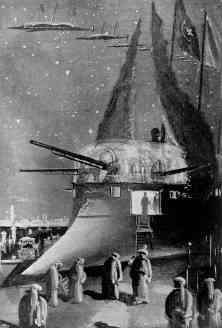 "Evil In Such A Shape Might Be Something More Than Good." |
Evil she might be, but evil in such a shape might be something more than good in the eyes of some men, and of these Khalid the Magnificent was one. His hot Arab blood was aflame the instant that he looked upon her intoxicating loveliness, and half her errand was accomplished before a word had passed between them.
She returned his greeting with a gracious inclination of her wing-crowned head, and as she did so he said--
"The Tsarina is welcome! My house and all that is in it is hers if she will honour me by entering it, for she will make it more beautiful by her presence."
"Your Majesty's welcome is sweet in my ears," she answered, almost insensibly adopting his Oriental style of speech, "for I come as a friend and I hope to go as an ally."
The gangway stairs dropped as she spoke, and as they did so the Sultan made a sign and a pair of attendants brought forward some steps covered with crimson velvet, which they placed so that she could descend from the parapet, to which the Sultan himself ascended to meet her as she came down. Taking her hand on the parapet, he led her down to the terrace with the grace of a king and the deference of a courtier. Then he bent low over her hand and kissed it, and as he did so the attendant officers of his empire bowed in silent and respectful salutation.
Olga was at once conducted to one of the state apartments of the palace in which the Sultan was wont to receive his most distinguished guests. She was treated with even more respect than would have been accorded to one of the crowned monarchs of the earth, for not only her wonderful beauty and royal carriage, but the marvellous manner of her coming and the tremendous power represented by the flotilla of air-ships inspired both the Sultan and his subjects with a deference that amounted almost to homage.
Then, too, the mystery and romance which invested her name and family and fortune distinguished her as a woman apart from all other women in the world. It might be, as Alan had told the Sultan, that she was really the enemy of the human race, that her true object was to destroy the peace of the world, and rekindle the fires of war on earth, but still the present romance was stronger than the future, and possibly problematical, reality, and so it would hardly be too much to say that Olga had succeeded in removing the impression left by Alan on Khalid's mind before she had been an hour under his roof.
She naturally expected that one of the first to receive her would be the ambassador who had preceded her, but, after looking anxiously for him and not finding him either on the terrace or in the reception-room, she turned to Khalid and said--
"I do not see my ambassador here, and yet he must have arrived, since your Majesty tells me that you have been expecting me."
The Sultan's face darkened, and his brows slightly contracted, as he replied--
"Tsarina, I have been waiting for an opportunity to tell you what cannot but be unwelcome news. Your ambassador, Orloff Lossenski, is not here"--
"What!" cried Olga, half rising from her seat, "not here! Surely he has not presumed to leave before my arrival? I can hardly believe that of him."
"He has gone, nevertheless," said the Sultan, "though not by his will or mine, I can assure you. Scarcely had his vessel alighted on the terrace yonder, and he had disembarked, when an Aerian cruiser dropped down as silently as a shadow from the skies.
"Whence it came I know not, but it would seem that these Aerians see everything, and that their hands reach everywhere. In a moment she had dropped upon your ambassador's vessel, splintering her masts, and yet so softly did she alight that the glass dome was not broken. Then her crew streamed out of the doors of the deck-chamber, and the next I knew was that your ambassador and I were covered by half a score of pistols and rifles and commanded to stand still on pain of death.
"Then Alan Arnold alighted, forced your envoy to surrender, struck one of my guards dead by some mysterious lightning that flashed from his sword, and, after carrying me away into the air over the sea and blasting a rock out of the waters to prove to me the power of his guns, brought me back honourably and in safety to await your coming. Truly these Aerians are more as gods than men!"
Furious as the unexpected tidings made her, Olga yet managed to restrain her anger sufficiently to reply with wonderful coolness--
"Your Majesty gives me sad and bitter news; but it is the fortune of war, and I must not complain. The air-ship that is taken by surprise is lost, and Orloff Lossenski fell a victim to his own carelessness."
Then her mood changed swiftly, and a soft and musical laugh came from her smiling lips as she went on--
"But it is a poor revenge, after all. That same Alan Arnold, the son of the great President of Aeria, was my would-be lover and slave for over five years. For my sake he turned traitor to his name and race, gave up the Revenge to me and told me all the jealously-guarded secrets of aerial navigation. He killed my brother in a quarrel, but he was useful, so I let him live-- a prisoner of war, till I had done with him. Then I set him free, when, perhaps, I ought to have kept him safe, to go and tell his people what a fool I had made of him. I suppose he did not tell your Majesty that?"
"No," laughed Khalid in reply, wondering what magic she had used to accomplish so marvellous a charm, "he did not. But such a miracle proves that you have been truly named the Syren of the Skies, as he said you are, for no other woman could have worked such a wonder and disputed the empire of the air with the masters of the world."
"That is true," replied Olga, lowering her voice to a tone of intense earnestness, "and the fact that I did it singlehanded proves, I hope, that with good friends and true allies I can do more than dispute that empire with the Aerians these despots of peace who have made the world a paradise of the commonplace, and fettered all strongest and most aspiring spirits so that they might be equal with the coward and the fool.
"But those are matters which I would discuss with your Majesty in private, and it is too late in the night to go into them now. You tell me that Alan Arnold has shown you what his air-ships can do. If your Majesty will honour the Revenge by being my guest for to-morrow I will show you that mine are in no wise inferior to them.
"Indeed, as I have told you, the Revenge is an Aerian ship, built in the enchanted land of Aeria, and if you will to-morrow she shall carry you over the whole of your dominions, and after that over those other dominions that shall be yours if you approve the plans that I will lay before you."
She paused and looked at Khalid with cheeks glowing and eyes shining with enthusiasm and passion. He returned her glance with one no less fiery and passionate as he replied--
"I will be your guest, as you say, but the honour and the favour will be to me, your Majesty-- for Majesty you are, crowned by the hand of favouring Nature with that which makes all men your subjects. Your air-ships shall rest in the garden of my palace to-night, and an hour after sunrise you shall find me ready for another journey to the skies, for my first experience has given me a taste for more. Till then farewell. The memory of your eyes will make me dream of Paradise to-night!"
There was that in his tone which told Olga that his words meant more than a neatly turned Oriental compliment, and as he stooped and kissed her hand in leave-taking she said half in jest and half in earnest--
"And I shall dream of the nearer glories of the world-empire which your Majesty and I may in the not very distant future divide between us."
"Or share together!" said Khalid in his soul, as he raised his head again and their eyes met.
At the appointed time the next morning the squadron rose into the air from the palace gardens. In order to produce as widespread an effect as possible, Olga had extended her invitation to the Grand Vizier and about a score of the Sultan's highest officials, including the commanders of his armies and fleets who happened to be in Alexandria at the time. These were distributed among the twenty air-ships, but Olga took care to arrange matters so that only the Grand Vizier should accompany the Sultan on board the Revenge.
In order that the Vizier, who was a cool-headed, wary, far-seeing man of nearly seventy, and therefore beyond the power of her own personal spells, might not interfere with her designs upon his master, she lost no time in placing him under the power of the drug which she had already used with such disastrous results to the world.
Although he had said nothing about it, she felt certain that Khalid must have been warned by Alan of the danger of taking anything to eat or drink from her hands, and therefore she had decided to make no attempt upon his liberty of will, unless it became absolutely necessary to do so; but the Vizier was easily taken unawares, and she had little difficulty in causing him to drink a cup of coffee while her chief engineer was explaining the working of the machinery to the Sultan in the engine-room.
The coffee, of course, contained a sufficient quantity of the drug to deprive the Vizier of all power of opposing her will or resisting her suggestions for many hours to come. So far as all independent advice was concerned, he was safely disposed of.
The air-ships rose to an elevation of some two thousand feet, and at a speed of two hundred miles an hour ran first along the valley of the Nile to the southward. At Khartoum they swerved to the eastward, crossed the mountains of the Red Sea littoral at a height of nine thousand feet, then sank again and skirted the Arabian coast until Mecca, the sacred city of Islam, came in sight.
The ancient temple of the Kaaba, containing the tomb of the Prophet, still stood, almost unchanged by the hand of time, amid the splendid buildings, verdant gardens, and long groves of palms with which the new Mecca of the twenty-first century was adorned. Pointing down towards it, Olga said to the Sultan, who was standing by her side on the deck, dazzled by the splendours of the swiftly-changing prospects of the scene below--
"There is the Holy City, which your Majesty may some day make the religious capital of the world. That would be an achievement worthy of the Commander of the Faithful and the descendant of the Prophet, would it not?"
Khalid looked down at the city, over which they were now speeding in the direction of Medinah, and was silent for a few moments; then he raised his eyes to hers and said--
"Even so; but have you counted the cost of achieving it to me and my people? Before the banner of the Crescent could float over a world-wide empire of Islam we should have to triumph in a war which would involve the whole human race, and this means that we should first have to destroy those who have been lords of the earth and of the air for more than a century."
"The Aerians are but men," said Olga, a trifle coldly. "Why should your Majesty fear them if you are armed with the same weapons that they wield? I suppose Alan Arnold has threatened you and your people with nothing less than annihilation should you conclude this alliance with me? But why should you fear? I have met the Aerians in battle, and you see I am not annihilated."
"I do not fear them as personal enemies," replied Khalid proudly, "but only as the possible destroyers of my people, who would be defenceless against them. Think of the destruction you could rain upon the sacred city down yonder, while it could strike no blow in return. That would be the fate of Alexandria and all the capitals of my empire, and while my armies were marching to the conquest of Christendom our homes would be laid in ruins and our wives and children slain without mercy.
"Show me," he continued, speaking more earnestly and rapidly, "how they are to be protected against this, and our alliance may become possible."
"It is purely a matter of relative strength," replied Olga. Do you know why this squadron of mine is allowed to pursue its way unmolested, although the Aerians know of its existence? It is because, although, as Alan Arnold truly told you, by superior skill and experience in handling their ships they have been able to destroy about half my fleet, I am still stronger in the air than they are, and they know that we have now gained the experience which we lacked.
"They have only three vessels, counting the one you saw captured, as swift and powerful as this, while I have twenty-six. None of their smaller vessels dare venture within reach of my guns, for to do so would be to meet certain destruction. They are doubtless building others as strong and swift as these in preparation for the struggle which they know must come. But if we join hands against them we shall be stronger than they will be when the year of your truce is ended.
"My engineers shall teach yours how to build air-ships in all respects equal to these, and submarine cruisers, a dozen of which could destroy your present navies in a day. With all the resources of your empire at command, you could possess in a year from now an aerial navy of a thousand ships and a sea fleet of equal strength.
"Then you would be strong enough to sweep the seas from pole to pole, and to storm the mountain battlements of Aeria itself. You must not forget that what the Aerians could do to your cities you could do to Aeria and to all the capitals of Christendom. City for city, you could take your revenge, until"--
"Until the whole earth was laid waste and the habitations of men were desolate," broke in Khalid, overwhelmed by the horror of the prospect. "It is too great a price to pay, even for the empire of the world and the supremacy of Islam, even if we survived the ruin that we should have brought upon the world."
"Too great if there were any need to pay it," said Olga quickly, seeing that her lust of conquest and revenge had carried her too far. "But matters will never come to such a pass as that.
"Our battlefields will be the countries that we shall invade and conquer, not our own, and enough air-ships can be devoted to the defence of your cities to repel any attack the Aerians may make upon them. Your Majesty must not forget, too, that they will not dare to send any very large force away from Aeria, for they well know that the final battle for the possession of the earth will have to be fought out round the summits of its mountains."
"You are right and I was wrong, Tsarina," said the Sultan in an altered tone, "and the Prophet has said of the infidel, 'Such as are stubborn and refuse the true faith ye shall slay without mercy. Kill them wherever ye find them'-- but alas"--
He stopped suddenly and looked at her, and she could see a smile moving his lips under his black beard and moustache. She divined instantly what was passing in his mind, and saw the opportunity for a stroke of diplomacy which, base as it was, she made without a moment's hesitation. Before he could continue, she turned and faced him, looking into his eyes with a glance that dazzled him, and said in a low, quick, earnest tone--
"I know what you would say, Sultan Khalid. You would say that I and my people are infidels in your eyes, and therefore worthy of destruction. I have thought of that-- but the deck is too public a place for the discussion of such a matter. Call your Vizier and we will retire to my own saloon and talk of it there."
Khalid obeyed, wondering what was coming next from the lips of the Syren whose fatal beauty of person and subtlety of mind were luring him on to plunge into an ocean of blood of which no human eyes could see the further shore-- if it had one at all-- and as soon as the three were seated in the room which had once been Alan's, Olga, addressing the Vizier first, rapidly but very clearly sketched out the project that had been suggested to her by Lossenski, and then, turning to the Sultan, she said--
"There seems now but one real bar to such an alliance, and that is the difference in our faiths, or, I should rather say, in our creeds. I have not ignored this; nay, I have pondered it deeply and earnestly. Creeds change with times, and Russia, like the rest of Europe, has now no real, living faith like yours. But you shall give it to them if you wish, and the day that I am proclaimed Empress of the Russias the Crescent shall shine on the towers of the Kremlin."
"What do I hear?" cried Khalid, springing to his feet in amazement at her astounding words; "you and your people will accept the Koran and acknowledge the Prophet?"
"I will and they shall," said Olga calmly and firmly, committing herself to the huge apostasy without a tremor in her voice. "Remember, too, that millions who should by right be my subjects in Asia are already good Moslems. If the Russians refuse to obey me in this they will be rebels, and you shall do with them as you will do with the other peoples of Christendom if they remain stubborn. Let your Majesty's chief minister and favourite counsellor speak and say whether or not I have spoken fairly."
"Speak, Musa al Ghazi!" said the Sultan, in a voice that betrayed intense emotion, "and weigh your words well, for many and great issues may depend upon them."
"Commander of the Faithful!" said the old man, speaking slowly and with some hesitation, as though he were repeating a lesson hardly yet learnt, "I can speak but the words that my soul echoes from without. A strange power has seemed to take possession of me, and I speak as one to whom another has taught what he should say.
"Yet the words seem wise to me, and I will speak them, lest, not doing so, I should have to answer for my negligence. If it is written that you shall be the one chosen of Heaven to plant the Crescent where now falls the shadow of the Cross, and reign supreme, sole lord of a Moslem world, then have the means been sent to you by the hand of her who gives you the means of measuring strength with the masters of the nations, by whose pleasure we possess that which we have, and without whose countenance your Majesty would not much longer remain Commander of the Faithful.
"I would not willingly speak words of offence, but it is necessary to recognise that the Moslem practises his faith only by permission of those who, if they hold any, hold another."
"By the Beard of the Prophet, thou hast said it, Musa! I am a King by permission, a High Priest of Islam by sufferance of the infidel!" exclaimed Khalid, as the hot blood rushed to his swarthy cheeks and the fire of fanaticism leapt into his eyes.
"But I will be so mean a thing no longer than the time of the truce to which I have pledged my word. In the blood of the infidel I will wipe out this shame on Islam, yea, though the whole earth shall be drenched with the blood and tears that shall be licked up by the fires of war. It is my destiny, and I will do it, or my name shall perish from the earth for ever!
"Tsarina Olga, I have seen and heard enough. Let us return to my palace and arrange the terms of our alliance; and when you have sworn upon the Koran that you will take Allah for your God and Mohammed for your Prophet, I will sign them, and together we will conquer the world for Islam. It is kismet, and that which is written shall be done!"
Olga looked upon the splendid figure of the Sultan as he stood before her, his athletic form dilated and his face glorified by the passion of religious fervour that was burning within him, and as she did so a new light dawned upon her. She saw that this strong, fiery soul might some day conquer even hers, and fuse it into itself.
It would be an unholy union, a love bought with apostasy from her faith and sealed with treachery to her people and the trust that she had inherited from her forefathers; but what were apostasy and treachery to her now that the love she had stained her soul with blood and untold crime to win was lost to her for ever?
Earthly pomp and power, the pomp of imperial rule and the power of life and death, of happiness and misery, over millions of her fellow-creatures were well worth living for, and with them might come love again, or if not love, then passion, fierce and all-consuming, for this one king of earth who dared to be a king in fact as well as in name, and then-- Before she could make any reply to the Sultan's words, the slow, measured tones of the Vizier sounded again, saying--
"If I may speak again, Majesties"--
"Say on, good Musa!" said the Sultan, "for so far thou hast spoken the words of wisdom."
"I would say," continued the old man, "that even as the winged steed Alborak bore the Prophet from earth to the Seventh Heaven, so may it be written that the winged ship of Tsarina Olga shall bear thee, my Master, into that Paradise of love which so far thou hast sought and not found."
"What say you, well-named Syren of the Skies, to that?" said Khalid, taking a step towards the couch on which Olga was sitting, and making a half-appealing gesture with both his hands.
She rose to her feet and faced him. One look into his passion-lighted eyes told her that the victory was already won, and that strength could now give place to softness. She dropped her eyes before his burning gaze, and, crossing her hands upon her bosom with a pretty semblance of submission, said, in a low, sweet tone that he heard now for the first time--
"All things are possible, and if this be possible, then more than Cleopatra lost for Antony I will win for you, and you shall reign sole Cæsar of a subject world. As for me, when that comes to pass, let it be to me as it shall seem good in the eyes of my lord the King!"
And so saying she bowed slightly before him and turned and passed out of the saloon, seeing the vision of him
whom she had loved in vain through the mist of tears which rose in that instant to her eyes.
A MOMENTOUS COMMISSION. TWELVE hours after they had left the Sultan on the terrace of his palace, the Ithuriel and the Vindaya dropped through the clouds on to the snow-covered surface of Kerguelen Island, and within an hour the despatch-vessel Vega was speeding away north-westward to Aeria with a full account of the results achieved by the first cruise of the Ithuriel.
The twenty-four hours which would have to elapse before the reply of the Council could be received were
employed in repairing the damage done to the Vindaya and in renewing the motive-power and ammunition of both
vessels. Sundry small but effective improvements in the mechanism and appointments of the Vindaya were also
made, and last, but by no means least important, the name of the prize was changed.
"You are henceforth her commander, old fellow," said Alan to Alexis when the question of the new name came
up, "and therefore it is for you to say what her name shall be."
"I knew you would say that," replied Alexis, his grave, thoughtful face lighting up with a quick flush and an
almost boyish smile, "and, of course, I needn't tell you what name I should like above all things to give her, but,
then, you see"--
"I see nothing but a quite unaccountable embarrassment written largely upon those ingenuous features of
yours, my blushing Achates," interrupted Alan, with a laugh that deepened the colour on his friend's cheeks.
"Well, you see, I'm not quite sure whether she would like it under the circumstances," said Alexis hesitatingly.
"I didn't know that air-ships had any choice in the question of their names any more than children have," said
Alan, gravely stroking his beard and looking at his friend with a laugh in his eyes.
"Don't assume a density that the gods have not given you," laughed Alexis in return. "You know very well who
the she is to whom I refer. Now, suppose you were going to name and command the Vindaya, what would you call
her?"
"I would do as you want to do, my friend," said Alan, laughing outright now, "although, I fear, with more chance
of getting snubbed for my temerity, and trust to winning forgiveness from the lips of her name-mother by good
service and hard hitting."
"Perfectly reasoned!" exclaimed Alexis, "and so henceforth, until I have express orders to call her something
else-- the Forlorn Hope, for instance-- she shall be the Isma, and on her decks I will win the right to ask-- I mean to
wear the golden wings again, or else she will never cross the confines of Aeria."
"You will win more than the golden wings, I hope and believe," said Alan, now very serious again, "for you
evidently have a better chance of forgiveness than I have, though I don't despair, mind you, for I am determined
never to go back to Aeria unless I feel that I can fairly ask Alma to forgive what is past. And if she refuses I will hunt
Olga Romanoff to the ends of the earth till I take her alive, and then I will carry her to Aeria, and at Alma's feet I will
strike her dead with my own hand so that she may know the truth!"
"Amen," said Alexis, striding forward and taking his hand. "And if Alma says 'No' to you I will never see Isma's
face again till I have helped you to clip the Syren's wings, and take her to meet her just reward. It is a bargain!
Between us we will bring these proud damozels to sweet reasonableness. Now let us go and get a bottle of sparkling
Aerian, and rename the Vindaya in proper form."
Thus it came to pass that when the Ithuriel next took the air her consort bore the name that was dearest to her
commander's heart.
The anxiously-expected Vega did not return till nearly thirty hours after her departure. The delay proved that the
Council had considered the tidings that she had brought of great importance, and had therefore taken some time to
deliberate over them. This turned out to be the case, and the decision arrived at by the rulers of Aeria showed that
they looked upon the crisis as grave in the last degree.
The return despatch stated that within twenty-four hours after the arrival of the Vega at Kerguelen a fleet of fifty
airships would be at the disposal of Alan and Alexis, who were ordered to place themselves at the head of it and
proceed with all speed to Alexandria, taking Orloff Lossenski and the other Russian prisoners with them.
Alan was to be the bearer of an ultimatum to the Sultan confirming, in the name of the President and Council of Aeria, the provisional declaration of war which he had threatened as the result of an alliance with Olga Romanoff,
and stating that at sunrise on the 16th of May in the following year, hostilities would be commenced against him,
and continued to the point of extermination so far as all men who bore arms were concerned.
He was also called upon to order the Russian squadron to leave his capital, should it still be there, within two
hours. If he refused, or if Olga declined to remove her ships, they were to be engaged there and then, and, if
possible, destroyed at all costs. This latter part of the message was to be conveyed to Olga in a different form by
the hands of Lossenski, who was then to be set at liberty with his fellow-prisoners.
If Olga consented to go within the given time, it would be necessary to allow her to depart unmolested, as the
superior speed of her ships would place the bulk of the Aerian fleet at a hopeless disadvantage in a pursuit, and
expose it to certain destruction. If she insisted on fighting, then, of course, the hazard of battle must be taken, and
the Council relied upon the commanders of its fleet to do their duty as their judgment should point it out to them. No
specific terms were to be made with Olga and her adherents, but hostilities were, if possible, to be avoided until the
Sultan's year of truce had expired, and the new Aerian fleet was ready to take the air.
If no fighting took place Alan was to proceed with his squadron to London with a third despatch to the King of
Britain, as head of the Anglo-Saxon Federation, advising him, in the face of the threatening danger, to call together
the rulers of Anglo-Saxondom and take immediate measures for mutual defence against the Moslems in case they
should invade Europe when the year of truce was up. For this purpose arms in any quantities that might be needed
would be sent out from Aeria, and the Aerians would undertake the task of drilling the newly-formed armies and
instructing them in the use of the weapons.
In addition to this the necessary works and power-stations for building and equipping at least a thousand of the
largest air-ships were to be established under Aerian control in England, and at the same time dockyards were to
be set up for the construction of an equal number of submarine vessels of the Narwhal type. It was, however, to be
made an absolute condition of this assistance and protection that the armies and aerial and sea navies were to be
entirely officered by Aerians, and were to be under the unquestioned control of the President of Aeria.
This condition was, for obvious reasons, held by the Council to be absolutely essential to success. Divided
commands in the face of a foe which would obey blindly the orders of a single chief who had already shown that he
could create armies and fleets of high efficiency, would mean inevitable
failure and disaster. Therefore the absolute control of Anglo-Saxondom must once more be placed in the hands of
the Supreme Council until the danger was passed and peace was restored, or Aeria would fight the battle alone and
leave the nations of Anglo-Saxondom to their fate.
The immediate effect of the orders brought by the Vega was to throw the station of Kerguelen into a state of the
most intense activity. Alan at once assumed command by common consent, and, assisted by Alexis, Admiral
Forrest, and Captain Ernstein, got everything in readiness for the reception of the coming squadron from Aeria. All
the defences of the station were also thoroughly inspected, from the air-ships floating above the clouds to the
submarine mines which guarded the entrances to the harbours, and a general plan of the now inevitable campaign
was sketched out at a council of war held on the evening of the Vega's return.
It is scarcely necessary to say that the orders from headquarters put both Alan and Alexis into the highest
spirits. They had already vindicated their claim to the confidence of the Council and their fellow-countrymen, and
the claim had been allowed without stint or hesitation.
Though their year of probation had only just begun they found themselves intrusted with a mission, dangerous it
is true, but also of the most supreme importance, and Alan in particular felt his pulses thrill with justifiable pride
when he found himself charged with the glorious task of doing almost exactly what his great ancestor, Alan
Tremayne, had done a hundred and thirty years before, when he marshalled the millions of Anglo-Saxondom
against the leagued despotisms of Europe and overthrew them in the mighty conflict which had given peace on
earth for nearly five generations.
Whether he would succeed as the Chief of the Terror had done depended not upon himself so much as on
Anglo-Saxondom itself. If the once conquering race of earth had kept intact its old martial strength and imperial
spirit through the long years of peace and prosperity as its kindred in Aeria had done, all would be well, and the
disturbers of the welfare of humanity would pay dearly and bitterly for their tremendous crime.
But if, like the Romans of old, they had allowed the tropical atmosphere of material luxury to relax the fibres of
their once sturdy nature and weaken the arms which had once enclosed the world in their embrace, then his
mission would fail, however eloquently he might urge it. A desolation infinitely greater than that which overwhelmed
Rome or Byzantium would fall upon Anglo-Saxondom, and its name would be the only monument of its vanished
glory.
But the Vega brought something more to Alan and Alexis than the despatches and orders of the Council. This
was a letter from Isma to Alan, filled with the tenderest expressions of delight at the triumphs which he and his
"companion in arms" had already achieved, and of brave and hopeful confidence in them, despite the terrible
dangers that they were going forth to confront.
The letter concluded with the significant sentence-- "When you come back in triumph, as I know you will, there
will not be one heart in Aeria that will not beat more gladly for your sakes, not one hand that will not be stretched
out to greet you either in friendship or in love. Remember this against the day of battle, and in the day of peace you
shall see how true my words are."
Although the letter made no mention of Alma, save as one of the intimate friends who sent their "loving
greetings" to the two men who were going to lead the navy of Aeria to what might be the first battle of a war that
would be the most colossal and unsparing struggle ever waged on earth, Alan was able to read enough between the
lines to give him hope.
He knew enough of Alma's proud and sensitive nature to fully understand why no word had come directly from
her to him, and also to recognise that the task of winning her back from her estrangement would be no light one.
Indeed, of the two tasks which lay before him, the conquest of the world and the reconquest of Alma's heart, he
looked with less misgiving upon the former than he did upon the latter. Still he by no
means despaired, and what he had said to Alexis was justified in his mind by the belief that in Isma he had the most
eloquent of advocates always at Alma's side, pleading his cause even better than he could do it himself; at any rate
for the present.
As for Alexis, his lover's eyes and more sanguine temperament found in the letter ample justification for the re-naming of the Vindaya, and if he forgot to return the precious sheet of paper to Alan after he had read its contents,
it was because he honestly felt that he had the better right to it, and his companion in love and war apparently
recognised this, for he carefully refrained from asking him for it. Thus well comforted with new-born hope, and
impatiently longing to begin the momentous work in hand, whether it was to be war or diplomacy, they awaited the
arrival of the promised fleet from Aeria, which was expected to alight on the surface of Kerguelen about noon on the
day after the arrival of the Vega.
A few minutes before twelve o'clock on the 19th of May one of the look-out vessels floating five thousand feet
above the clouds which overhung Desolation Land telephoned, "Fleet from Aeria in sight," and half an hour after the
receipt of the anxiously-expected news at headquarters the fifty air-ships were grouped round the power-station at
the head of Christmas Harbour, renewing the motive power which had been expended on the voyage from Aeria.
When this operation was completed the fleet was equipped for a voyage of thirty thousand miles if necessary.
As every vessel was completely furnished with all stores and munitions of war, no further preparations had been
made, and Alan was able to give the signal for the flotilla to take the air in little more than an hour after its arrival at
Kerguelen.
It was divided into two divisions of twenty-five ships each one led by the Ithuriel and the other by the Isma, and
these rose into the air, formed in two straight lines each about a quarter of a mile long. The two flagships flew one
on either flank, and slightly ahead and above the main body. This formation enabled any signals made from either
of them to be instantly seen by every ship in the fleet.
The distance to be traversed was five thousand eight hundred geographical miles, and the voyage was
performed at a speed of four hundred miles an hour without incident.
At daybreak on the 20th, the two divisions were floating in a wide circle six thousand feet above Alexandria at a
sufficient distance to be practically invisible from the city, which nevertheless lay completely at the mercy of the
four hundred guns which were trained upon it, and which, if the terms of the Council's ultimatum were not accepted
by the Sultan and Olga, would reduce it to a wilderness of ruins within an hour from the signal to fire being given.
That the Russians were still the guests of the Sultan was made apparent as soon as the light became strong
enough for their squadron to be seen resting on the earth in the gardens of the palace, with one look-out ship
stationed about fifteen hundred feet above the roof of the palace. When all the ships were in their stations the
Ithuriel and the Isma ran up close to each other, and Alexis boarded the flagship to receive his final instructions
from Alan, who had undertaken the perilous duty of conveying the ultimatum to the Sultan and his possible ally.
Orloff Lossenski was on board the Ithuriel, and Alan requested him to be present when Alexis received his
orders. As he shook hands with the Vice-Admiral, Alan said--
"I have asked Orloff Lossenski to hear our last arrangements made so that he may recognise as well as we do
that this is a matter of life and death for all of us. For my own part, I am determined that the wishes of the Council
shall be obeyed, or the Ithuriel and her crew shall be buried with our enemies in the ruins of Alexandria.
"We have not been seen yet from the Russian look-out ship, but they will of course see the Ithuriel going down.
I shall descend flying a flag of truce, and I feel certain that the Sultan will recognise it himself and compel his allies
to do so. But if not, if a single shot is fired, or if the Russian squadron
attempts to rise in the air until my return, you are to give the signal to open fire upon the city, and the fleet is not to
cease firing until it is destroyed.
"You are to forget that you are destroying friends as well as foes, for I and all on board the Ithuriel recognise
that the honour of Aeria and the safety of the world demand the sacrifice; and we are resolved to make it.
"I not only order this as your superior in command, I ask it as a friend and brother in arms. I know you would
gladly die in the same cause if necessary, and so you must not hesitate to kill me and destroy the Ithuriel if the
fortune of war compels you to do so."
Alan's speech, spoken with the perfect steadiness of an unalterable resolve, found a fitting response in the
breast of his companion in arms. Still holding his friend's hand in what might be a farewell clasp, Alexis simply
replied--
"I see the necessity, and I will obey to the letter! God grant that you may all return safe and sound; but if you
don't, you shall have such a tomb as no man ever had before. Good-bye."
"Good-bye," said Alan in the same steady tone, and then their hands parted, and Alexis returned to his ship.
"Now, Orloff Lossenski," said Alan, turning to the Russian, "you have heard my instructions, and you know that
they will be obeyed. Neither you nor your mistress have any right to expect mercy at my hands, and you shall have
none. Obey my orders to the letter, and see that your mistress does the same, or Alexandria will be in ruins before
that sun reaches the zenith."
"I have heard and I will obey, for the fortune of war is with you and I must" replied Lossenski, completely
overmastered by the heroic devotion displayed by Alan in what bade fair to be a crisis in the fate of the world.
A broad white flag of truce was now flown from the aftermast of the Ithuriel. At the fore flew as a greeting to the
Sultan the Star and Crescent of Islam, while above both at the main floated the sky-blue banner of Aeria,
emblazoned with the golden wings united by a mailed hand armed with a dagger. With every man at his station and
every gun ready for instant use, the flagship dropped swiftly down towards the Russian vessel floating over the
palace.
Within a mile of her the signal, "We bring despatches to the Sultan," flew from the signal staff at the stern. The
captain of the Russian scout-ship read the signal and at once telephoned to the palace, with which his ship was
connected by an electric thread, for instructions.
The Ithuriel then flew a second signal, "If you rise we shall fire," and this he was forced to obey as the Aerian
vessel was too far above him for his guns to come into play. He therefore replied with the signal, "I have asked for
instructions. Wait for reply." A few minutes later Alan, keeping the Russian well under his guns, saw her drop down
to the earth and alight on the flat roof of the palace, on which several figures could be seen moving about and
scanning the skies with glasses, which were speedily centred on the Ithuriel.
Then a white flag was run up to the top of a flagstaff on one of the minarets of the palace, a similar one was
hoisted by the Russian air-ship, and she rose towards the Ithuriel. Alan, feeling now sure that the flag of truce would
be respected for the Sultan's sake, allowed the ship to come stern on to the Ithuriel until the two were within
speaking distance.
As she approached, the Russian swung her stern guns out laterally, and Alan did the same with his, so that for
the time being neither ship could injure the other. The stern doors were then opened, and the Russian captain
delivered a message to the effect that the Sultan had just risen for morning prayers, and would receive the captain
of the Ithuriel in hall an hour. The Aerian vessel could therefore descend without fear.
"There is no question of fear," replied Alan shortly. "I have not come alone. Use your glasses and you will see
that the city is surrounded, but we shall respect the truce if you do."
The Russian stepped back with a hurried gesture and seized his glasses. It was now quite light enough for him
to see at that elevation a wide circle of points of flashing blue light reflected from the hulls of the Aerian fleet. He put
down his glasses and replied--
"So I see! You would not have got here if patrols had been sent out as I advised."
"Or else your patrols would not have come back," said Alan, turning on his heel and walking forward.
Half an hour later the white flag on the minaret was dipped three times as an invitation for the Ithuriel to
descend, and Alan, determined to guard against any possible treachery on the part of the Russian scout-ship,
signalled to it to precede him, and so the two vessels sank down and alighted almost together on the roof of the
palace.
The Sultan surrounded by his ministers was awaiting them, and as soon as salutes had been exchanged Alan
handed him the ultimatum of the Council. As Khalid read the brief but pregnant message his brows contracted, and
an angry flush showed through the bronze of his skin.
He read it twice over, stroking his beard slowly and deliberately as he did so. Then he looked up and said to
Alan in a tone from which he made no effort to banish the accents of anger--
"Was not my word enough? Have I not promised that I would make no war for a year? By what right do you
order me to compel my friend and ally to leave my city within two hours?"
At the word "ally" Alan's face assumed an expression of wrathful sternness, and he replied--
"By the right which has always governed the issues of war-- the power to compel obedience."
"To compel!" cried the Sultan, in a still angrier tone. "What! with one air-ship against twenty? Not even a
Prince of the Air could do that."
"No Prince of the Air would be mad enough to make the attempt" replied Alan coldly. "Ask the captain of your
scout-ship, and be will tell you that your city is surrounded; and I can tell you that four hundred guns are trained
upon it at this moment, and that the firing of a shot, or the rising of any air-ship but my own from the ground, will be
the signal for them all to be discharged. I need not tell your Majesty what the result of that would be."
Khalid recoiled with a cry that was almost one of fear. He knew instinctively that Alan was speaking the literal
truth, without the confirmation given by the captain of the scout-ship. He saw, too, that Olga had deceived him, or at
any rate had been grievously mistaken, when she had said that the Aerians would not send a fleet after her
squadron. They had done so, and so skilfully had its movements been ordered, that the city had been taken by
surprise, and lay at its mercy.
Brave as he was, the strange terrors of the situation sent a thrill of fear through his soul. There he stood, the
proudest king on earth, on the roof of his palace, beneath the smiling sky of an Egyptian summer morning; and yet
that smiling sky was charged with death and destruction a hundredfold greater than if the thunder-clouds were
lowering on it, ready to hurl their lightnings upon the earth.
He could see nothing but the blue heavens and the eastern sunlight shining over the roofs of his capital; and yet
he knew that the man standing before him could, with a single signal, reduce the splendid city to heaps of
shattered, shapeless ruins and bury its inhabitants and its guests in one common tomb.
Then what seemed to be a saving thought flashed through his mind, and he said, almost in a tone of banter--
"But in that case we should not die alone, unless you have taught those unsparing guns of yours to distinguish
between friend and foe-- the signal for our destruction would be the signal for yours as well."
"Even so!" replied Alan gravely. "That is a contingency which I have foreseen. Orloff Lossenski, tell his Majesty
what my last orders to the fleet were."
The Russian stepped forward, and after saluting the Sultan said--
"I heard the orders given, Majesty, and they were to that effect. Friends and foes are to be destroyed alike, and
nothing is to be left of Alexandria but its ruins.
"I am also charged with a message to my mistress, the Tsarina, which tells her that if she does not leave within
two hours her ships will be attacked in the city, and that, too, would be disaster; and if my words have still any
weight with her I shall advise compliance with the order of the Council. Will your Majesty permit me to be conducted
to my mistress in order that I may deliver my message in due form?"
The Sultan did not seem to hear the request at all. The idea that Alan and his crew should thus deliberately
devote themselves and their beautiful vessel to annihilation in the event of their orders being disobeyed appalled and
unnerved him. He knew nothing, save by tradition, of the heights of heroism to which men can rise under the
stimulus of war, and he looked upon the man who had so calmly pronounced the provisional death sentence of
himself and his companions as something more than human, as beings of a higher order, to fight against whom
would be impious rashness rather than courage.
It was a situation that would have shaken the nerves of the sternest and most experienced soldier of the
nineteenth century, and so it was no wonder that his spirit, unbraced by the discipline of war, shrank from facing its
terrors. He saw, too, that there was literally no choice save between submission and destruction. To save, not only
the lives of himself and his people, but also those of his guests and allies, he and they must submit and obey this
imperious mandate.
"It is the will of God!" he said, bowing his head slightly towards Alan as he spoke. "They who cannot fight must
yield. Hereafter we may meet upon more equal terms, and then to-day's humiliation shall not be forgotten."
Alan inclined his head in reply, and said--
"So be it! As your Majesty has seemingly decided to involve the world in the horrors of war, it is not for me to
say any more. When the day of battle comes, let the fortune of war decide between us. Meanwhile, Orloff
Lossenski, it is time that you took the Council's message to your mistress."
"Give it to me," said the Sultan, stepping forward with outstretched hands, "and I will take it to her, if she has
risen yet."
"There is no need for that," said a voice a few yards beyond Alan. "I am here, and I will take it."
As the sweet, low, even tones, now so hatefully familiar, reached Alan's ears he turned sharply round, with a
blaze of ungovernable anger in his eyes, and saw Olga, calm and self-possessed in all the pride of her imperial
beauty, walking towards the group from an arched doorway that led up from the interior of the palace.
FACE TO FACE AGAIN. SMILING and self-possessed as Olga appeared when she gained the roof of the palace, she had passed through a
perfect purgatory of conflicting and agonising emotions since the news of the arrival of the Ithuriel had reached her
in her room. Her tremendous and, but for the fact of her strange, hopeless love, incomprehensible blunder in setting
Alan and Alexis free, instead of either killing them or keeping them in life-long captivity, had already borne terrible
fruit; but this visit, made at the very moment when her plans were apparently crowned with success, seemed to
threaten nothing less than the complete ruin of all her schemes.
She knew instinctively that the city must be surrounded by an overwhelming force of Aerian ships, for a single
one to venture thus into the midst of her own squadron, and, judging by her own tactics, she expected nothing less
than immediate annihilation as the alternative to surrender. But even more bitter than this was the thought of
meeting, not only as a freeman, but as the commander of the Aerian navy, the man who but a few days ago had
been her docile, unresisting slave, robbed of the highest attribute of his manhood by the Circe-spell that she had
cast over him, and which she now knew was broken for ever.
And, more than this, she must now meet as an implacable enemy the man whom, in spite of herself, she still
loved with all the passion of her fiery nature, and who, now that he was free again, could but look upon her not only
with hatred, but with disgust. This, so far as her own feelings were concerned, was the miserable end of her
scheming, but there was no help for it. She had deliberately sown the wind, and now the time was approaching for
her to reap the whirlwind.
She thought of her dream in St. Petersburg, and a new and awful meaning was made apparent to her in those
few minutes of mental torture before she went to meet her well-beloved enemy face to face. She saw herself
mistress of a conquered world, seated on a lonely throne, wailing over her own broken heart in the midst of a
desolation that she had brought upon the earth-- for nothing.
This, it seemed, was to be the penalty of the unspeakable crime she had committed to gain possession of the
air-ship, a hopeless love that should turn all the fruits of conquest, if she ever won them, into the bitter ashes of the
Dead Sea apples in her mouth, a love not only unrequited, but repaid with righteous horror and almost divine
disgust.
And yet, despite all this, her marvellous fortitude and royal pride came to her aid to help her to bear herself
bravely before her enemies, and so, with a smile on her lips and a hell of raging passions in her bosom, she
ascended to take her part in the debate, big with the destiny of a world, that was being held on the palace roof.
As Alan turned and confronted her in all the strength and splendour of the manhood that not even her almost
superhuman arts had been able to tarnish or weaken, and looked at her with the stern, steady gaze without one sign
of recognition in the eyes that shone blue-black beneath his straight-drawn brows, her heart stood still and seemed
turned to ice in her breast, and for one brief moment her foot faltered and the light died out of her eyes and the
colour from her cheeks.
Then she caught the Sultan's gaze turned inquiringly upon her; her indomitable spirit rose to the emergency,
and her self-possession returned. Passing Alan by with a slight
inclination of her head which did not conceal the mocking, smile which curled her dainty lips, she went to Khalid
and, holding out her hand, said in steady, musical tones which, do what he would to resist it, sent a thrill to Alan's
heart--
"Where is the message that my faithless servant brings from the tyrants of the world?"
The Sultan gave it to her, and as she read it Lossenski stood silent like the rest, but with head bowed down in
shame and sorrow. When she reached the last word of the despatch the crimson deepened on her cheeks and her
hands closed convulsively on the paper. Then with a quick movement she tore it in twain, flung the two fragments to
the ground, and then, looking up with eyes blazing with passion, she cried--
"I should be a slave to obey! Lossenski, signal to the squadron to rise. Boris, train a gun on that ship and blow
her to pieces if a man moves on board of her. Out of the way there, Alan Arnold. If you lift a hand I will shoot you
like a dog!"
As she spoke she snatched a pistol out of her belt and had almost levelled it at Alan's heart, when, like a flash of
lightning, his rapier leapt from its sheath, and as the pistol came up it was dashed from her hand.
"I could have killed you with less trouble," he said, in quick stern accents, raising the glittering blue blade to a
level with her eyes, and keeping it outstretched towards her. "Have you forgotten what I told you, or that I am no
longer under your vile spell? If those orders are obeyed I will kill you now, though you do wear a woman's shape.
The city is surrounded, and if one vessel rises from the earth, Alexandria will be in ruins in an hour. Now, give the
signal for its destruction if you dare, and let the earth be rid of you!"
"And of you, my gallant Knight of the Air, who draws his sword upon a woman!" she almost hissed at him in her
fury. "Yes, I dare and I will. Lossenski"--
In another moment the fate of the world would have been changed; but, before the order could be repeated, the
Sultan strode forward and placed himself between Alan and Olga with outstretched arms--
"No, Tsarina! that order shall not be given on my palace or in my hearing. You have forgotten our agreement
and my oath. I have sworn on the Koran that there shall be no war between Islam and Aeria for a year, and by the
glory of Allah there shall he none!
"What have I and my people done that you should bring this destruction upon them? Your servant shall be shot
if he opens his lips, and if you must fight, go into the desert and do it; but that will end our alliance, for you will have
broken the peace to which I have sworn, and made me a liar. It is enough! Let us talk like reasonable beings, and
not quarrel like children."
Olga was conquered for the time being, and she saw it. Few as had been the moments of the Sultan's speech,
they were enough to allow her agile intellect to get the better of her anger, and to convince her that it would have led
her to suicide in another minute.
Her manner changed with a swiftness that was almost miraculous. Her long, thick lashes fell, hiding, the still
burning fires of her eyes. Her attitude changed from one of defiance to one of deference, and as she stepped
back a pace or two, she said in a totally altered voice--
"Your Majesty has justly rebuked me. My anger overcame my reason for the moment. My hatred of these
tyrants of the air is not a thing of to-day or of yesterday, as you know, but the legacy of generations of wrong and
robbery, and the arrogance of this man, who but a few days ago was my slave, and now ventures to dictate terms
of war or peace to me, was more than my patience or my temper could bear. I have done wrong, and in atonement
I will promise, on the honour of a Romanoff, to be bound absolutely by such engagement as your Majesty may
make until the period of your truce is expired."
So saying, she retired to a distant part of the terrace, beckoning Lossenski to follow her. Throwing herself on
seat in full view but out of earshot of the group she had left she bade him tell her the story of the loss of the
Vindaya, and how he came to be the bearer of the message of the Council of Aeria to her.
Lossenski told the story simply and truthfully, and as he finished, the Grand Vizier approached, and after an
obeisance, made with Oriental reverence, said--
"Tsarina, my master commands me to inform you that he has settled all matters with the Prince of the Air save one, and to settle that he craves your assistance. Will it please you to come and speak with him?"
"I will come," said Olga, rising and following him with the words of Lossenski fresh in her ears.
"Tsarina Olga," said the Sultan, coming to meet her as she approached the group amidst which Alan was still standing, "I have come to an agreement with Alan Arnold upon all points but one, and that one only you can decide.
"He asserts that six years ago he took you and your brother as guests on board the air-ship, which you now
call the Revenge, that you drugged the wine drunk by him and his comrades, and, sparing only him and his friend
Alexis Masarov, you poisoned the rest of the crew, and threw them out on to the snows of Norway, after which you
kept him and Alexis under your influence by means of a drug, which deprived them of their will-power and forced
them to reveal the secrets of the air-ship to you and assist you in building your fleet."
"And has your Majesty given credence to such a monstrous story, or do you only wish to hear me give it the
contradiction which its absurdity and falsity deserve? If the former, the sooner I and my ships leave your city, never
to return save as enemies, the better. If the latter, you shall soon be satisfied."
Olga spoke with an air of angered innocence which completely deceived the Sultan, anxious as he was to find
the extraordinary story false, and he hastily replied--
"It is the latter that I desire, of course. I was obliged to say that if you were unable to deny the accusation it
would be impossible for me to continue an alliance with one who had been guilty of a crime which my faith and the
customs of my race denounce as vile beyond all human measure. But I refused to believe it against you until your
own lips had confessed it, or undeniable evidence had proved it, and therefore I have asked you to come and let us
know the truth."
"I thank you, Sultan Khalid, for your confidence and your chivalry," she said, looking up into his eyes with a
glance that rendered all denial from her once and for ever unnecessary. "You shall hear me deny the foul falsehood
to my traducer's face."
Stung to fresh fury by the knowledge that Alan had sought to expose her in her true nature to the man whom
she sought to make her slave in his place, she strode forward to within three paces of where he was standing, and,
drawing herself up to the full height of her royal stature, she faced him with pale cheeks and blazing eyes, her
beauty so transfigured by anger that the Moslems standing about her instinctively shrank back, awe-stricken by
such an incarnation of wrath and loveliness as no man of them had ever dreamed of before. Even Alan himself
forgot his hate and disgust for the moment in the contemplation of her almost miraculous beauty and the
indescribable dignity with which her anger invested her, and waited in silence that was almost respectful for the
tempest of wrath and reproach which he saw was about to be let loose on him.
Her lips trembled mutely for a moment or two before any sound came from them, but when she spoke her tone
was low and clear, though almost hoarse with passion, and shaken by the manifest effort she made to keep it under
control.
"So this is the return that your chivalry makes for my generosity in giving you life and liberty when you were
lost to the world; when I might have killed you, as I see now that I should have done, without a single soul among
your people knowing anything of your fate!
"I expected that you would false up arms against me, for your people and mine are enemies to the death; and I
knew, too, that the love which I had spurned would not be long in turning to active hate. But you excelled my
expectations-- you, one of the Princes of the Air, the scion of a race that holds itself above all the other races of the
earth, the son of a man who but a few years ago was lord and master of the world! You come in the guise of open
and honourable warfare to smirch with your foul lies the fame of a woman for whose sake you made yourself a
traitor to your people and a murderer of your own comrades. A pretty story, forsooth, to tell in the ears of my
friends and allies. Do you take them for children or fools that you expect them to believe it?
"Imagine such a miracle, your Majesty," she continued, turning, with the clear ring of a mocking laugh in her
voice, to the Sultan, "imagine this Alan Arnold, son of the President of Aeria, with his friend and lieutenant, Alexis
Masarov, and a crew of eight Aerians on board their flagship, armed with the most tremendous means of
destruction ever invented by human genius, and each man of them, moreover, possessing in his own person the
power of life and death, as he himself has proved before your own eyes.
"These kings among men invite two casual acquaintances for a trip to the clouds, and these two guests, a youth
of twenty and a girl not seventeen, unarmed and without assistance, seize their ship, kill eight of their invincibly
armed comrades and lead the captain and his lieutenant away captive. And how? By means of some mysterious
drugs, subtle and irresistible poisons, of which such a boy and girl could not possibly have known either the
composition or the use, and which they would have been afraid to employ if they had done.
"But let me come to the facts as they are," she went on, turning again to Alan, who stood literally dumbfounded
before her, amazed beyond power of thought or speech by the audacity of her words. "It is you who are the liar,
the traitor, and the murderer. It is you who killed my brother before my eyes because he sought to protect me from
your violence; and it is you and your friend Alexis who, of your own free will, struck your comrades dead, threw
them out of the air-ship upon the Norwegian snows, and then, in the hope of gaining my favour, took the Ithuriel to
Vorobièvo, near Moscow, and delivered her into the hands of my friends.
"I have fifty men within call at this moment who will swear that this is true. Orloff Lossenski, you are one of
them. Were you not at the villa at Vorobièvo when these two came with me in the Ithuriel and delivered her into your
hands; and did you not find the corpse of my brother Serge in one of the state rooms with his neck bruised and
blackened by the grip of his murderer?"
"Yes, Majesty," replied Lossenski, stepping forward as he was addressed. "That is true, though they told us at
the time that your brother had been killed in a struggle with their comrades."
"And is it true," continued Olga, "that they accompanied me into your villa and had supper with us as friends,
and did not I forgive the death of my brother for the sake of the advantages which the possession of the air-ship,
which they consented to surrender to us, would be to the cause of the revolution in Russia to which we were
pledged?"
"That is also true, Majesty; and there are several here now with the squadron who can also testify to the fact."
"And also," interrupted Olga, "to the fact that these two traitors worked willingly to help us to secrete the air-ship,
and finally to take her to Mount Terror, and there explained the working of her machinery to us and helped us
to build other air-ships and submarine vessels, and commanded these in their attacks upon the commerce of our
enemies. Is that true, also?"
"It is, Majesty," again replied Lossenski. "Shall I summon the crews of our ships that they also may testify to it
lest my word should not be enough?"
"Is it your Majesty's wish that they shall be called?" asked Olga again turning to the Sultan, who all this time had
been standing shifting his gaze from her face to Alan's, and
from Alan's back again to hers, horrified by the fearful accusations with which she had replied to the story, of the
falsity of which he was already thoroughly convinced.
"They can be called if Alan Arnold desires it," he said, in grave, deliberate tones. "But would it not be better
that he should speak first? At present we have two words against one. Has he any proof that what you say is false?"
he continued, looking inquiringly towards Alan.
"I have none but my own word and that of Alexis, up yonder in the skies, and him I cannot-- and if I could,
under the circumstances, I would not-- call," said Alan, who by this time had recovered his self-possession. "If
your Majesty proposes to judge between us according to spoken testimony, I say at once that I will accept no such
tests, for I well know that this woman could produce a hundred of her accomplices who would swear anything she
bade them swear.
"She has given me the lie with equal skill and audacity. I can only give her the lie in return, if not as skilfully, at
least as boldly, and with a knowledge that I am telling the truth. Your Majesty can believe her story or mine, as you
choose. If you believe hers, I am willing to do you the justice of confessing that you will be judging according to the
weight of testimony, such as it is, for that is certainly against me."
"And so I must judge," replied the Sultan coldly. "I cannot believe your story, for it seems to be impossible,
while the Tsarina's has every appearance of truth. Into your motives I have neither the right nor the wish to inquire,
and all that is left for me to say is that what I have heard has finally decided me to espouse the cause of the Tsarina
and her friends against those who have wronged and slandered her, be the cost to me and my people what it may.
"We shall keep the truce if you do, and in the day of strife let the God of Battles decide between us. My answer
to your Council's message shall be ready for you in half an hour. Farewell!"
So saying, Khalid the Magnificent turned his back upon Alan, and walked, followed by his Vizier and his
ministers, to the doorway leading to the interior of the palace. Olga, pausing for a moment to cast one glance of
triumphant hatred at her discredited foe, beckoned to Lossenski, and followed the Sultan without a word.
Alan, amazed and enraged beyond measure by the unexpected turn that affairs had taken, and yet confident in
his own knowledge of the truth, turned on his heel, and went back on board the Ithuriel where he went into his own
cabin and sat down to write his directions for enforcing the order of the Council with regard to the evacuation of the
city by the Russian squadron.
He bitterly regretted that the orders of the Council did not permit him to destroy the Russian air-ships there and
then while they lay at his mercy. But the orders were explicit, and forbade him even to pursue them after they had
left Alexandria, unless they committed an act of hostility against him.
If he could have done so, he would have fought them at all hazards, and then, if he had conquered, he would
have been able to enforce the general prohibition of the Council against building air-ships upon the Sultan; but as
disobedience was not to be thought of, he could only carry out his orders, and hope that the judgment of the
Council might prove in the end superior to his own.
At the end of the half-hour he was summoned to meet the Grand Vizier, who brought the reply of his master.
This ran as follows:-- In the Name of the Most Merciful God!
Khalid, Commander of the Faithful, to Alan Arnold, President of Aeria.
I have received your message from the hands of your son. I shall faithfully observe the terms of the truce I
promised to him, and of which he has told you.
As my city lies for the time being at the mercy of your fleet, I can only save my people and my guests from
destruction by agreeing to your demands. The Russian air-ships shall leave Alexandria within an hour of the
delivery of this to your son. But this is to tell you that I have made alliance with Olga Romanoff, rightful Tsarina of
the Russias, and that when the year of truce has expired, I will no longer be a king merely in name and hold my
power and dignity at your pleasure.
At the end of the year of truce there shall be war between you and me and your people and mine unless before
then you shall recognise my independence in due form and my right to create such armaments as I think fit for the
protection of my dominions against yourself or any other Power, and unless you consent to restore Olga Romanoff
to the throne and dignity which is hers by right, and of which your ancestors robbed her in the days of the Terror.
If you do this there shall be peace between us, but if not, there shall be war, and we will fight until the God of
Battles has decided between us, and given to you or to me the dominion of the world. Alan's brows contracted slightly as he read this defiant missive, but there was a half-pitying smile on his lips
when he said to the Vizier as he handed him the instructions he had just written--
"I am deeply sorry-- sorry for him and his people, and, indeed, for the whole human race-- that he has been
misled into writing words which in a year's time will set the world in a blaze. Our reply to this will be written in blood
and fire, and the smoking ruins of cities throughout the length and breadth of his dominions. But he has chosen,
and he and you must abide by his choice. I cannot believe that he knows what he is doing and if you are a faithful
friend and servant you will counsel peace and moderation."
"My master," said the Vizier haughtily, "does not seek advice from his enemies; more than ever would it be
impossible for him to do so when their lips are fresh-stained with lies."
Alan's hand instinctively sprang to the hilt of his rapier, and in another moment the Vizier's life would have paid
for the insult, but when the blade was half out of its sheath his self-control returned, and he thrust it back again, saying--
"You are an old man and an ambassador, so you are safe. You shall live so that you may some day find out for
yourself where the truth in this matter lies. Who knows but that the Syren may before long put you or your master
under her spell. If she does you will drink something from her hand, and when you have drunk it you will have no
will but hers; you will obey her blindly, and the thoughts that you speak shall be only those she suggests to you."
Later on that day, when the excitement of the hour had passed, Musa al Ghazi remembered these words, and
the strange acquiescence which he had given to Olga's plans in the saloon of the Revenge. If he had remembered it
while Alan was speaking, millions of innocent lives might possibly have been saved, and the curse of war averted
from the world for many more generations, perhaps for ever. But he did not, and so events took their logical course.
As it was, he made no direct reply to Alan's words, but handed him another paper, saying--
"I have been commissioned also to give you this. The instructions agreed upon shall be obeyed, and now I
have only to remind you that you are no longer my master's guest."
With that he saluted with frigid dignity and turned away towards the palace door.
Alan looked after him for a moment with a smile half of contempt and half of pity, then he opened the paper in
his hand. As he expected, it was from Olga, and, beginning without any form of address, it ran thus-- I shall obey your orders and leave the city, not because I will, but because I must, in order to save the Sultan
and his people from destruction. I will also undertake to refrain from hostilities until the Sultan's truce expires,
provided you do not molest me. If you do, or if the Sultan is subjected to any unreasonable commands or acts of
oppression, I will consider the truce at an end, and I will not only recommence my submarine attacks upon the
world's commerce but I will send out my air-ships and scatter death and destruction far and wide over the earth,
without mercy and without discrimination between enemies or neutrals; it is therefore for you to choose whether the
issue between us shall be fought out when the time comes, and in fair and honourable warfare or whether the dogs
of war shall be let loose at once. I have still thirty air-ships, and as many submarine cruisers, and I can do what I
say.
OLGA ROMANOFF. "No doubt," said Alan to himself. "I'm afraid we shall have to accept your terms. I didn't think that even you
would be capable of such a colossal crime as that; but now I know something like the full capacity of your
wickedness, and if you threaten it you will do it.
"With those thirty ships, if you have as many as that, and I suppose you must have twenty-four or twenty-five at
least you could wreck half the great cities of the world in six
months, and we could do little or nothing to stop you. We have only eleven ships equal in speed to yours, and most
of those must be kept in call of Aeria.
"I would give my life and my ship willingly for permission to fight it out here and now, and yet, after all, that
would be frightful cruelty and injustice to the unoffending thousands who would lose their lives by the destruction of
the city, so I suppose it must be peace for a year, and then-- ah, what then?"
His soliloquy began on the terrace and ended on the deck of the Ithuriel. He gave the order to rise into the air,
and the aerial cruiser soared slowly upwards, still flying the flag of truce as a signal to her consorts that the mission
had been successfully accomplished. As he felt certain that the Sultan would carry out the directions agreed upon
to the letter, he left the city without any misgivings, and in a few minutes the Ithuriel was floating alongside her
consort the Isma, and Alan and Alexis had clasped hands once more.
THE CALL TO ARMS. WITHIN an hour the wondering inhabitants of Alexandria saw the Russian fleet rise a thousand feet into the air and
form in two columns of line ahead. Then the Aerian fleet ranged itself in two long lines five hundred feet outside
them and a thousand feet above them. A time-shell from the Ithuriel gave the signal to start, and the two fleets leapt
forward to the south-east at a speed of a hundred miles an hour, and in a few minutes had vanished over the
desert. The speed was quickly increased to two hundred miles, and so they sped on all day and through the next
night-- the Russian ships being forced to show their lights while the Aerians remained in darkness-- until, when
morning dawned and Olga and her captains looked for Alan's fleet they found that it had vanished, and that they
were floating alone over the solitudes of the Southern Ocean.
They had been escorted like offending school children out of harm's way, and then left to their own devices. It
was a bitterly humiliating ending to an expedition which had really produced such important results, but there was
no possibility of present revenge, and so Olga gave the order to proceed straight to Mount Terror, intending to begin
there and then the working out of her part of the compact that she had made with the Sultan.
This arrangement was briefly to the following effect:-- Olga placed at Khalid's disposal all the necessary plans
for the construction of both air-ships and submarine vessels, and also supplied members of her own immediate retinue,
well skilled in the work, to supervise the building, which was, of course, to be carried out with the utmost secrecy
and speed, so as to guard, as far as practicable, against the possible destruction of the factories and dockyards by
the Aerians.
The Sultan had engaged to find money and material for building a thousand air-ships, and the same number of
submarine cruisers, within the year, and these were to be supplied with motive power at conversion-stations
established at the dockyards under the exclusive control of certain of Olga's lieutenants.
The secret of this motive power, which was identical save for slight differences in the process of conversion
with that possessed by the Aerians-- that is to say, electrical energy derived directly from atomised carbon and
vaporised petroleum-- was retained in her own keeping by Olga, who had simply promised that an unlimited supply
of it should be forthcoming as it was wanted.
She had insisted on a strict engagement that no one not authorised by her should even approach the
conversion-stations, and she had given the Sultan and his ministers distinctly to understand that any attempt to
discover the secret of the process would terminate the alliance, and expose the cities of the Moslem empire to
destruction.
At the expiration of the year of truce, the Sultan's army and navy, supported by the immense aerial fleet that
would then be in existence, was to be in complete readiness for any emergencies. Olga was to be proclaimed
Tsarina in Moscow, and the House of Romanoff formally restored in her person. If any portions of Russia refused
to receive her, they were to be terrorised into submission by the air-ships.
The tribesmen of Western and Central Asia were to be armed as rapidly as possible, so as to be ready to form
a reserve force for compelling the submission of the Russians if they resisted the new order of things, and to
participate in the invasion of Europe, which was to take place at several points as soon as the Holy War of Islam
was proclaimed, and Cross and Crescent once more confronted each other on the battlefield.
Meanwhile, too, the resources of the dockyard at Mount Terror were to be strained to the utmost, and the
conspiracy in Russia for the restoration of Olga to the throne of the Romanoffs was to be developed by every
means that money could purchase or skill dense.
The scheme of defence arranged by the Council of Aeria had already been completed, and it was to execute
this that the Aerian fleet had left the Russian squadron during the night. Indeed, the Russians had been travelling
southward alone for more than eight hours before they had discovered the fact. As soon as it became impossible
for them to see the Aerian vessels these had stopped, in accordance with a prearranged plan, and had wheeled
round and steered for London across the African continent at a height of about ten thousand feet.
Flying at the full speed of the smaller vessels, a twenty-hour flight carried the fleet over the eight thousand miles
which separated its starting-point from the capital of the world, and about six o'clock in the evening of the 21st of
May the fifty-two vessels, flying the Aerian and British flags, appeared in the air over the open space which is now
called Hyde Park, and, to the amazement of the astonished citizens, dropped quietly to the earth and lay open to
the unrestricted inspection of the thousands who speedily gathered in the park to avail themselves of the unwonted
spectacle, and to learn, if possible, the reason of the unexpected visit.
No attempt was made by the crews of the ships to prevent the sightseers from seeing all they could of the
exteriors of the vessels, which were arranged on the sward in two long lines, so that they could walk down between
them and admire their beautiful shape and wonderful construction at their leisure. A sentry was stationed by each
vessel to warn the sightseers not to approach too close to the wings and propellers, and that was the only
precaution taken.
Alan learnt soon after landing that King Albert the Second, the fourth in descent from Edward VII., who was
King during the War of the Terror, was at Windsor, and that the House of Commons and the Senate, which for over a hundred
years had filled the place of the old House of Lords, had dissolved for the spring recess, and would not meet again
until after the General Election, which was held every 1st of June.
He therefore caused a message to be sent to His Majesty at Windsor, requesting him to name a time for an
interview on the following day, and then, sufficient watches having been set on all the vessels, he and Alexis, with
the majority of the crews, took a few hours' leave, not a little glad of the opportunity of stretching their legs on terra
firma, after their three days' confinement to the air-ships.
The reply which he received from the King fixed eleven o'clock in the morning of the 22nd as the time of the
interview for which he had asked, and, just as the castle clock was beginning to sound the strokes of the hour, the
Ithuriel swept up out of the distance towards Windsor Castle, and, after hovering for a moment in mid-air, sank
quietly down until she rested on that portion of the terrace which overlooks the Home Park. Her arrival had been
announced to the King as soon as she hove in sight, and he was on the terrace ready to receive his visitors when
she alighted.
Albert II., King of England, Emperor of Britain, and President of the Anglo-Saxon Federation, was a monarch
only in name. Nothing but the trappings of sovereignty remained to himself or his station, and he would not even
have retained these had it not been for the fact that, during its hundred years of actual rule, the Supreme Council
had insisted upon the maintenance of the monarchical principle in those countries where it had obtained at the end
of the nineteenth century.
The first formal greetings over, the King caused Alan to be escorted to his private apartments in the castle, and
as soon as they were alone together in the room which he reserved for his own special use, he motioned Alan to a
seat and, throwing himself back upon a lounge with an air of weariness which accorded but ill with the hour of the
day, he said in a somewhat querulous tone--
"We are quite alone now and you can speak with perfect freedom. I am sure it must be important business that
has brought you here with a whole fleet of your air-ships, and I shall be glad if you will tell me at once what it is. I
hope nothing has occurred to imperil our peace and safety?"
"On the contrary, your Majesty," replied Alan. "I regret to say that my errand is to tell you that, not only is that
the case, but that it is a practical certainty that within twelve months from now the whole world will be plunged into
war."
"What! what!" exclaimed the King, jerking himself up to a sitting posture. "Surely you don't mean that? I thought
that no war would be possible without the permission of your Council. Surely you would not allow the nations of the
world to go to war with each other again, and repeat all the horrors that happened a hundred and thirty years ago?"
"Your Majesty forgets that when we renounced the control of the world six years ago we gave back to the
nations the right of making war upon each other, although we hardly believed that they would be foolish enough and
wicked enough to exercise it. That, however, is beside the question, because war is now inevitable, and, what is
even more important, the Council of Aeria is unhappily powerless to prevent it."
"Eh! what is that?" exclaimed the King, this time rising to his feet and facing Alan with an air of petulant
reproach. "Powerless to prevent it? You, with all your fleets of airships and submarine vessels? You, who have
called yourselves the masters of the world for nearly a century and a half-- you cannot stop war?"
"We cannot do so, your Majesty," said Alan, also rising to his feet, "simply because I regret to say that we no
longer possess the undisputed empire of the air, and therefore, in a measure at least, we have lost the command of
the world.
"As for the responsibility which your words impute to us, I must tell you at once that it does not exist. The rulers
of the world, and yourself among them, voluntarily and with full knowledge accepted perfect freedom, and therefore
the individual responsibility that is inseparable from it. You knew that from
the time we resigned the world-throne you were free to make war upon each other, on land and by sea.
"It is your fault and not ours that you are now so defenceless that you have cause to fear the war against which
you ask us to protect you. You have known for nearly four years that the Sultan of Islam has been creating armies
and fleets and diligently training millions of his subjects in that art of war which we hoped was to be forgotten for
ever among men.
"Did you suppose, you Kings and Princes of the Anglo-Saxon Federation, that Khalid the Magnificent, a man of
boundless ambition, was creating these armies and fleets simply to play with them? Could you not see that nothing
but some dream of world-wide conquest could be inspiring him to do this, and do you need to be told that the
realms of Christendom offered him the only possible area of conquest in the world?
"What have you done to defend yourselves, or to prepare against a possible day of battle? You have done
nothing. Saving your international police, now little more than an ornamental body of officials, the Federation does
not possess a single soldier. You have seen the Sultan building battleships and arming them with the deadliest
weapons that skill and science could devise, and you, with all your wealth, and skill, and knowledge, have not built a
single vessel that would be of use in time of war.
"I understand that the Council has warned you again and again that the Sultan's designs could not have been
peaceable, and yet your Parliaments have not voted a single pound for the defence of your homes and your riches.
"Ah, yes!" broke in the King, now in an apologetic tone, for he was completely cowed by the direct, earnest
force of Alan's reproving words. "That is it! You must not blame myself or my fellow-monarchs, you must blame the
Parliaments. We can do nothing without them; they have usurped all the power that formerly belonged to Kings. It is
this democracy that has weakened us and left us defenceless. Every man thinks himself a ruler, and so there are
no rulers, except in name. Every man has a vote, therefore every man must be consulted about everything, and so
nothing can be done but what the multitude wishes. They want only riches, splendid buildings and cities, light work,
and comfortable lives. That is all they have cared about, and so that is all they have got. If we, their Kings and duly
appointed rulers, could have done as we wished to do affairs would have been very different; but it is impossible to
rule where every man fancies himself a king!"
"That is but a poor excuse, King Albert," replied Alan sternly and yet somewhat sadly. "It is the old story of
Greece and Rome and Byzantium over again. The weakness of the rulers has been the strength of the
demagogues, and that has always spelt national decay from the days of Cleon until now.
"I might ask you how it comes that Sultan Khalid has been able to keep his millions of subjects in hand and to
be to-day the sole actual ruler of the greatest empire the world has ever seen; but neither you nor I have any more
time to waste, either in reproaching each other or regretting what cannot now be helped."
"No, no!" said the King, almost appealingly. "That is quite right-- quite right. Tell me, if you please, what has
really happened to bring about this terrible danger which threatens us, and let us see if we cannot yet protect
ourselves."
"You can yet make such preparations as will at least enable you to meet your enemies on equal terms," replied
Alan, following the King's example, and seating himself again, "and it is to put before you a necessary scheme of
defence that I have come here, and when I have described it you will see that we Aerians have not forgotten that
our ancestors once led Anglo-Saxondom to the conquest of the world."
"Pray proceed," said the King, sitting up on his lounge again. "I can assure you that I am all attention."
Alan then began, and told in detail all that was necessary for the King to know of what had happened during the
last six years, concluding with a graphic narrative of startling vividness of the marvellous and momentous events that
had been crowded so thickly into the last twenty-one days.
It would not be saying too much to state that the close of the recital, which he had listened to with the most
anxious attention, left King Albert in a state of nervous excitement that bordered closely upon absolute panic. He
had heard enough to show him that the splendid fabric of Anglo-Saxon civilisation would, if left in its present
defenceless state, totter and fall like a house of cards at the first onslaught of its powerful and disciplined enemies.
He saw that its wealth and splendour, like those of the effete empires of old, were a source of weakness and not
of strength, a temptation to its foes and an encumbrance to itself.
Then, as Alan went on to describe the scheme of defence proposed by the Council of Aeria, he seemed to find
support and consolation in the quiet, masterful tones of the man who, without a tremor in his voice, could calmly
discuss the prospect of a war which would involve the whole of humanity in one colossal struggle, which could have
no other result than an indescribably appalling loss of human life and the complete subjection, if not destruction, of
those who were vanquished in it.
Yet when he had finished King Albert shook his head sadly and doubtfully, and said--
"Yes, yes, it is a splendid scheme, a scheme worthy of you and your wonderful race, but it can only be
accomplished if our Parliaments agree together to sanction it and support it. I hope with all my heart that they will do
so, but I sadly fear that not even your influence, and the fearful danger which threatens them, will make them agree
one with another.
"Of late years, since the power of the democracy has increased so enormously, they wrangle for weeks over the smallest matters of municipal government. As for national policy, they seem to have forgotten what it means. I may be wrong, and with all my soul I hope I am, but I sadly fear they will never consent to what they will call a military despotism, even to save themselves. The elections take place during the last four days of this month, and by that time the news that you have brought me shall be published everywhere, so that the people may know what is before them, but everything will depend upon the men and women whom they return to Parliament."
"Ah," interrupted Alan, stroking his beard to conceal a smile, "I had forgotten for the moment. You have lady
legislators now as well as male ones. We were ungallant enough to refuse them admittance to the Parliament during
our period of control."
"Yes," said the King, with a smile that had but little mirth in it. "But we have progressed fast since then. In our
Parliament men and women were almost equally balanced in both Chambers, and scarcely any business was done
during the year."
"Which proves," said Alan, "that what was called our discourtesy and unfairness was not so very unwise after
all."
The interview ended shortly after this remark, for the time for action had already arrived. Alan had learnt
enough from the King's own lips to see that he was merely a crowned puppet in the hands of the rival parties, which
contended in both Chambers for the favour of the democracy and the continuance of office. He therefore saw
further that, if anything was to be done in working out the scheme of international defence, he would have to take
the initiative.
As full discretion had been given to him in his commission from the Council of Aeria, he did not scruple to half-persuade
and half-frighten the King into investing him with such authority as he could give, and, armed with this, he
went to work that very day with a vigour and promptness which amazed the feeble monarch, and raised a storm of
indignation among the members of the two Chambers who were seeking re-election.
A very short experience of these people proved to him that nothing must be hoped from them. Day after day he
met committees and deputations of them, who argued with him and wrangled among themselves until he was utterly
disgusted and out of patience with them.
At last, on the evening of the 27th, after he had spent the
whole day in striving to convince a joint-committee, consisting of twenty members of each Chamber, of the
tremendous danger which threatened the Federation, and the immediate and urgent necessity of united action in
preparing to meet it, he lost the last remnants of his temper, and, springing to his feet, he faced them with anger in
his eyes and scorn on his lips, and said--
"We have talked enough, ladies and gentlemen! I came here expecting to find the old spirit of Anglo-Saxondom
still alive, and so far as you are concerned I find it dead. You are not patriots or competent rulers. You are simply
members of a noisy and verbose debating society! When absolute destruction at the hands of a well-armed and
implacable foe is threatening your country and your allies, you talk of averting the calamity by discussion and
arbitration, instead of armed resistance. By all means discuss and arbitrate, if you can, but also prepare for battle
in case it proves, as I am certain it will prove, to be inevitable. Do you suppose that the lamb can argue with the
wolf, or that the rich and defenceless man can save his wealth from the armed plunderer by mere force of
argument or an appeal to his moral sense? If you do, you are something worse than simple, you are guilty of a
folly which is a crime against those who have committed their affairs to your keeping.
"But I, like most of my people, have Anglo-Saxon blood in my veins, and I will not leave my kindred defenceless.
I bear an English name, and that name and my descent shall be my title to do what I now tell you I am going to do.
In my own person, and with the full authority and sanction of the Council of Aeria and your own lawful monarch, I
here and now reassert the supremacy over the realms of Anglo-Saxondom which my father resigned in St. Paul's
Cathedral six years and a half ago! Hold your elections if you choose, and conduct your noisy pretence at
government according to your own tastes, but do not expect me to be guided or bound by any enactments that you
may choose to make. You may call this a revolution if you will. So it is, but remember that your foolishness has
made it necessary! I can make Anglo-Saxondom ready to meet its enemies on equal terms when the day of battle
comes, as come it surely will in less than twelve months from now, and, God helping me, I will do it! You either
cannot or will not do this, but I will take good care that you do not prevent it being done.
"I believe that the old spirit which won the Armageddon of 1904 still survives in Anglo-Saxon breasts, and I
believe that it will respond to the call to arms which shall be heard throughout the length and breadth of the
Federation before another sun has set. To-morrow I shall take possession of the means of intercommunication, and
I warn you that you will oppose me at your peril.
"You know that I have a force at command before which you are as helpless as the worms that crawl in the earth, and as there is a heaven above me I will use it without ruth or scruple if I see that the interests of Anglo-Saxondom require me to do so. You have your choice, to act with me or to remain neutral. Oppose me, and I will destroy you as traitors and enemies to your country and your race!"
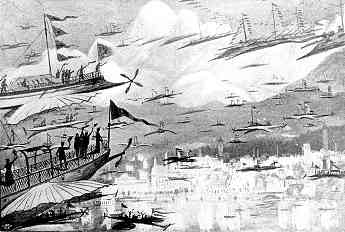 "The Combined Squadrons Swept Across The Mountain Barrier." |
When the two fleets were within half a mile of each other the Avenger, with twenty-five of her consorts on each side, swung round into line with their prows pointing towards the mountains, and in this order, at fifty miles an hour and an elevation of a thousand feet above the Ridge, the combined squadrons swept across the mountain barrier, and Alan and Alexis, each steering his own vessel in the conning-tower, saw for the first time, after nearly seven years of exile, the incomparable beauties of the Aerian landscape opening out before their eyes.
Following the movements of the leading squadron, they dipped as soon as they had passed over the Ridge, and were met on their downward flight by the hundreds of pleasure-craft which were waiting for them in mid-air.
Thousands of gaily-coloured handkerchiefs were waved in welcome to them, and many a greeting in the sign-language passed from the crews of the warships to the occupants of the pleasure-craft and back again, for some of the former had been on foreign service for nearly a year, and there were many pleasant relationships to be renewed which had been interrupted by the calls of duty.
Far below the home-comers could see the spacious streets of the great city, brilliant with the gaily attired throngs who had come to welcome them, and heard the greeting chorus of thousands of bells chiming in gladsome peals from hundreds of towers and minarets scattered over the city and its environs.
Signals were now flown from the Avenger directing the whole of Alan's fleet, excepting the Ithuriel and the Isma, to alight on a great sloping plain to the northward of the city, where their crews were to disembark and then proceed to the central hall of the Temple. Acting on previous orders, the consorts of the Avenger did the same. The pleasure-craft puttered downwards on to the housetops, and so the three battleships were left alone in the air, the Ithuriel now floating on the right of the Avenger and the Isma on the left.
Amid the welcoming cheers of the throngs which now filled the great square they sank slowly down, and at length alighted on the roof of the President's palace. Then the doors of the deck-chambers opened and a last and loudest cheer of all rose up as, in full view of the assembled thousands in the square, the President and Maurice Masarov once more clasped hands with their long-exiled sons.
Then they descended into the interior of the palace, followed by the Council and the other guests on board the Avenger.
In the President's room, the same in which he had received Olga Romanoff's challenge from the skies, Alan and Alexis were welcomed home again by those who were nearest and dearest to them. Only their immediate kindred were present, for, in the nature of the case, the occasion could have been nothing but a private one. Nor could mere words of description do justice to the tender pathos of the scene that was enacted in that inner chamber, for but few words were spoken even by the actors in it. The emotions of such a moment were too intense and overpowering for speech, and so heart spoke to heart almost in silence.
Alma, who had, of course, remained outside in the reception-room of the palace with the Council and her parents, felt even more keenly than she had expected the truth of the prophecy that she had uttered to Isma an hour or so before. Amidst all the thousands of Aeria she was the only one whose heart was heavy on that day of universal rejoicing.
Once, and once only, her eyes had met Alan's, but the single swift glance had been more than enough to tell her how far they now stood apart. She had seen the light of pleasure and triumph suddenly die out of his eyes and the bright flush on his cheek pale as he looked at her.
There had not even been a greeting smile on his lips as he bowed his cold, grave salutation to her and then turned away to look down upon the city and the splendid prospect of the valley that was opening before him. This had happened up in mid-air, just as the ships had crossed the Ridge in close order, and she had not been able to trust herself to look at him again even when they had disembarked on the roof of the palace.
The swift telegraphy of that one glance had been enough to tell her that it was not the fond, light-hearted lover of her girlhood that had cone back, but a strong, stern, and prematurely grave man, who knew all and more than she knew of the new relation between them, and who knew also that they could not meet as they had parted, and so accepted the changed conditions with a proud reserve that drew a sharp dividing line between them which, for all she knew, might never be crossed.
Though outwardly she was calm and perfectly self-possessed, she waited in a suspense that almost amounted to mental agony for the moment when the greetings in the President's room would be over and Alan and Alexis would be brought out to be formally presented to the Council. Then their hands would have to meet and words would have to pass between them.
Meet as strangers they could not, for everyone knew -- even he knew -- why she had refused all these years to wed with any other man, nor yet could they meet as lovers, as Isma and Alexis had perhaps done by this time, for between them the shadow had fallen, and even if there was love in their hearts there could be none upon their lips.
If Olga Romanoff could have looked into Alma's soul at that moment, she would have seen something very like a fulfilment of a prophecy she had made on board the old Ithuriel six years and a half before to Alan, when she first heard of her rival-- "By your hand I will wring her heart dry, and cast it aside to wither like an apple shaken from the tree!" In those moments of suspense it seemed to Alma that even now her heart was withering under the blight of this great sorrow that had fallen upon her life after all her years of loving and patient waiting.
At last she heard footsteps and voices in the corridor that led from the private apartments of the palace. They were coming, and almost mechanically she turned her eyes towards the curtains which screened the doorway through which they would enter. They parted, and Alan came in walking by his father's side and with Isma hanging laughing on his arm.
She shrank back a little as she saw Isma look at her for a moment and then say something to Alan. But he appeared to take no notice, and walked forward with his father to where the members of the Council were waiting to receive him. She heard the President say the formal words of presentation, and saw the rulers of Aeria one after another grasp his hands, and then those of Alexis, greeting them heartily as they did so.
Then the little group opened, and she saw, as in a waking dream, Alan's tall form striding towards her with both hands outstretched, and heard a voice that was his, and yet not his, so deep a ring of unwonted gravity was there in it, say--
"Are you going to be the only one who has no greeting for the prodigal, Alma? Have you forgotten that we were sweet-hearts once, and therefore surely may be friends now?"
There was an emphasis on the word "friends" that was perhaps imperceptible to all ears but hers, but she caught it, and took her cue from it instantly. With admirable tact he had, in that one word, shown her the only basis on which it would be possible for them to take part together in the society of the valley.
As man and woman they must be to one another as friends whose friendship was sweetened by the recollection that long ago, as boy and girl, they had been lovers. She accepted the situation with a sense of thankfulness and infinite relief, and, frankly placing her hands in his and summoning all her self-command to her aid, she looked steadily up into his bronzed bearded face, and said gravely and sweetly--
"You know that that is not so, Alan, and if my welcome is a little tardy it is none the less sincere for that reason. There were others who had a prior claim, and so I waited, for it is only right that friends should come after kindred. Welcome home! I suppose we are going to the Council Hall now, to see what we are all longing so much to see-- the Golden Wings once more upon your brows."
"Yes," replied Alan colouring slightly, as he noticed her upward glance at his sable head-gear, "we are going there immediately, I believe, but," he continued in a lower tone and still holding her hand in his, "long and anxiously as I have looked forward to to-day and its promise, half of that promise will be betrayed unless you tell me first that you believe I have fairly won the right to wear the Golden Wings again. Tell me, now, do you in your heart think so?"
"If you have not done so," she replied, only keeping her voice steady by a supreme effort, "then it would be hopeless for any man to look for forgiveness on earth. You have fallen and you have risen again, and to-day there are no two men in Aeria more worthy of honour than you and Alexis are."
He looked down into the clear depths of her soft grey eyes as she spoke, and in another instant he might have forgotten that which sealed his lips to all words of love, and all the reserve to which he had been schooling himself for so long, but at that moment Alma's mother came towards them saying that the President was ready to take Alan to the Council Hall, and-- this with a smile-- that thousands should not be kept waiting for the sake of one. Her words recalled him to himself, and, with an inclination of his black-plumed head, he said--
"That is enough, for now I know that I have heard the truth from the lips of my severest judge, and I am well content with it. I have not lost everything if you believe that I have regained my honour."
"We all believe that, Alan," said Alma's mother before her daughter could reply; "and, more than that, I know of no one in Aeria who thinks that you ever really lost it. Now go to your father. He is thinking of the thousands who are waiting anxiously for you in the Council Hall. You can finish this conversation later on."
He accepted the dismissal with a smile, and as he went back he saw Isma slip away from Alexis' side with a tell-tale blush on her lovely face, and, giving him a saucy, laughing glance as she passed him, run lightly across the room to Alma's side.
"Well," she said, reading too swiftly and not very correctly the altered expression of her friend's face, "have you made friends, then, after all? I thought you would, and-- oh, Alma, I am so happy!"
"Yes," replied Alma gravely, though she could not repress a smile at the radiant face that looked up at hers, "we have made friends. But you seem to have done something more than that. Your explanations"--
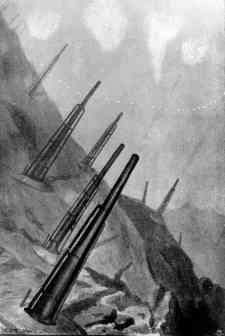 "Batteries Which Would Be Able To Surround Aeria With A Zone Of Storm." |
In addition to these, two squadrons of twenty-five of the most powerful warships of the newest type alternately kept watch and ward against surprise in the upper regions of the air from fifteen to twenty thousand feet above the valley, while all round the great circuit of the mountains were planted in the most favourable positions nearly a thousand land batteries mounting three, five, and ten guns each, which, if necessary, would be able to surround Aeria with a zone of storm and flame which nothing living could pass and still live.
By day the range of vision from the decks of the sentinel ships would make surprise impossible, and at night the great electric suns on the summits of the mountains, aided by hundreds of search-lights flashing through the darkness in every direction, made an attack under cover of the darkness almost equally hopeless.
The news of the alliance between Olga and the Sultan had acted like a trumpet-call to battle on the proud and martial spirit of the Aerians. Generation after generation their young men had been trained in the arts of war as well as in those of peace, for the wisdom of their ancestors had foreseen that, in the ordinary progress of science, it was impossible for many generations to pass without some independent solution of the problem of aerial navigation, which must, sooner or later, result in a challenge of their supremacy.
Consequently, all through the years of profound peace which the outside world had enjoyed under their rule, their vigilance had never slept for a moment, and their men and ships and materials of war were kept in the highest possible state of efficiency. Thus, though the Aerian nation numbered little more than a million souls, inhabiting a territory of some two hundred and fifty square miles, the amount of effective strength that it was able to put forth on an emergency was totally disproportionate to its size.
Living in a region of inexhaustible fertility and boundless mineral wealth, with no idle or mere consuming classes, no politics, and no laws that a child of ten could not understand, they led simple, natural, and busy lives, accumulating immense public and private riches, which were as constantly expended in increasing the splendour and power of the State, which, as a whole, was the expression of the wealth and patriotism of its citizens.
No sooner had the alliance of their enemies become an accomplished fact than they devoted the whole of their vast resources to increasing their offensive and defensive armaments to the utmost of their power. Reserves of material that had been stored up year after year had been drawn upon, the mighty natural forces that they had brought into subjection laboured night and day for them, and ships and machinery and guns came into existence as though at the bidding of some race of magicians.
Magazines were filled with immense stores of ammunition, potential death and destruction such as had never been wielded by human hands before-- and commanders and officers for all the battleships of the Federation had been sent out as each squadron of vessels was completed.
In a word, Aeria had donned her panoply of war, and stood armed at all points, ready to fight the world if necessary in defence of the priceless heritage which its citizens had received from their fathers, the giants who in the days of the Terror had taken despotism and oppression by the throat and flung them headlong out of the world.
The defences of Aeria were to be under the immediate command of the President. All the oceanic stations, save Kerguelen, Teneriffe, Bermuda, and Hawaii, had been abandoned so as to permit of greater concentration of forces, while fifty new ones had been established in different parts of Europe and the British Islands, for here the brunt of the attack was to be expected, and here the enemy must be met and crushed if Anglo-Saxon civilisation was to be saved from a new era of militarism and personal oppression.
Alan and Alexis were to take command of the Western and Eastern fleets into which the aerial forces were to be divided, Alan in the West with Britain as his chief base of operation, and Alexis in the East with the Balkan Peninsula as his base between the Russian and Moslem headquarters.
The naval fleets, in three divisions, the Atlantic, Mediterranean, and Pacific squadrons, had already received their general instructions, and were waiting at their various rendezvous for the outbreak of hostilities. The Atlantic squadron blocked the Straits of Gibraltar, the Narrow Seas of Britain, and the approaches to the Baltic, the Mediterranean division patrolled the Inland Sea from Gibraltar to Cyprus, and the Pacific fleet were blockading the southern approach to the Red Sea, ready to operate against any junction of the Indian and African sea forces of the Sultan.
At midnight, on the 14th, Alan and Alexis were to set out for their respective fields of operation, and that evening there was a farewell banquet given by the Council in the President's palace in honour of them and the commanders of their ships. Many a hearty toast was given and drunk in the sparkling golden wine of Aeria, and many a hearty God-speed and loving farewell passed between those who remained at home and those who were going forth to do battle for them and for the peace of the world in distant skies, and to pass through the fiery storm of such warfare as had never been waged in the world before.
Just before twelve, when the fleets were ready to take the air, and the last farewells were being said, the Avenger and the Isma were lying on the roof of the President 's palace, and their commanders were standing by the gangway steps which hung down from the deck-chambers, the centres of two little groups of grave, silent men and sorrowing women, their nearest and dearest in a land where all were friends.
The last blessings of fathers and mothers had been given and taken, and then came the hardest farewells of all. Isma and Alexis parted as declared lovers will part as long as the Fates are cruel, but when Alan took Alma's hands in his for the last time, and looked down upon the pale loveliness of her perfect face and into the clear calm depths of her eyes, the word that he had been longing to say ever since his return died upon his lips.
The contrast between her stainless purity and the darkness of the blot that Olga's unholy passion had placed upon his life rose up in all its horror for the hundredth time before him, and once more the impassable gulf opened between them. All that he could say was--
"Good-bye, Alma! You, too, will wish me God-speed, won't you?"
"With all my heart, yes, Allan," she replied in low, sweet, steady tones. "God guard you in your good work and send you back in safety to us. You will come back rich in honours and followed by the blessings of the world you are going to rescue from the oppressors"--
"Or I shall never come! Good-bye, Alma, good-bye, all!" he said, breaking upon her speech, for he could bear to hear no more, and as he spoke he stooped and kissed her forehead as he had kissed Isma's a few moments before. Then he turned and ran up the steps just as Alexis took his last kiss and did the same.
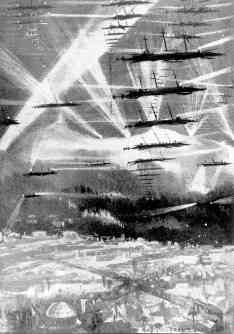 "The Four Hundred Battleships Of The Two Squadrons Rose Into The Air." |
As they gained the decks of their ships the great bell in the dome of the Temple boomed out the first stroke of twelve. At the sixth stroke the electric suns on the summits of the mountains blazed out simultaneously at a hundred points, a long, deep roar of thunder rolled round the bulwarks of Aeria and with search-lights flashing out ahead and astern, the four hundred battleships of the two squadrons rose into the air and swept up towards the Ridge.
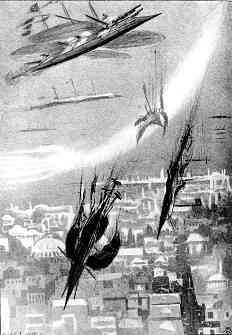 "Three Of The Air Ships Seemed To Break Up And Roll Over." |
The propellers whirled faster and faster, and the quadruple wings undulated with ever-increasing velocity until the crowds in the streets of Alexandria saw something like a swift flash of blue light stream downward from the southern sky, and heard a long screaming roar as though the firmament was being rent in twain above them.
Then three of the air-ships floating in line above their heads seemed to break up and roll over. The crowds held their breath and pointed upwards with one accord in sudden horror, as the crippled air-ships dropped like stones towards the earth. In another moment they struck it, and then, as though the central fires of the earth had burst through in the heart of the great city, there came a crash and a shock that shook the ground like an earthquake spasm.
A vast dazzling volume of flame shot up from amidst a wide circle of blackened ruin, towers fell and roofs collapsed all round the focus of the explosion, the whole atmosphere above the city was convulsed, and the very sea itself seemed to writhe under the stress of the mighty shock, and so, leaving death and ruin and consternation behind her, the Avenger swept out over the Mediterranean at a speed that the eye could scarcely follow, after striking the first blow in the world-war of the twenty-first century.
To say that this sudden and unexpected catastrophe spread panic through the Moslem capital would be but a very inadequate description of the Avenger's first blow in the world-war. Consternation, wild and unbounded, blanched every cheek, and made every heart stand still as the mighty roar of the explosion burst upon the deafened ears of the inhabitants and then instantly died into silence, broken only by the crash of falling ruins and the screams and groans of the wounded and dying.
The red spectre of war in its most frightful form had suddenly appeared to the terrified and horror-stricken vision of millions of men and women, scarce one of whom had ever seen a deed of violence done.
Khalid, like a wise leader, did all he could to prevent the panic spreading to the troops on board the transports by issuing peremptory orders for the expedition to start at once. At the same time he signalled for half a dozen air-ships to ascend as far as possible and attempt to discover the source from which the inexplicable attack had come, an errand destined to be entirely fruitless.
In orderly succession the hundred huge transports, each carrying from eight to ten thousand men, left the outer basin in two long lines in the rear of the fifty air-ships already in position.
A hundred submarine battleships took up their stations five hundred yards in advance of the first line of transports. Fifty of these sank to a depth of thirty feet, and shot two thousand yards ahead as soon as the whole flotilla was in motion, while the other fifty ran along the surface of the water with their conning-towers just showing above the waves, ready to sink in obedience to any signal that their commanders might receive from the air-ships, which commanded an immense range of vision over the waters.
To all appearance the enemy was content with the one terrible blow that had already been struck. The smooth, sunlit sea betrayed no trace of a hostile vessel, and as far as the glasses of those on board the air-ships could sweep the sky nothing but the blue atmosphere, flecked here and there with white, fleecy clouds, could be seen.
But the Moslem commanders were far from being deceived by these peaceful appearances. From Sultan Khalid, who was commanding the expedition in person, to the engineers who worked the transports, all knew that the invisible line of the Federation patrols had to be passed somewhere in the depths of the sea before the shores of Italy could be reached.
The speed of the three flotillas was limited to twenty-five miles an hour, in order that there might be no headlong running into danger, and the commander of each of the submerged battleships had orders to rise to the surface the instant that his tell-tale needle denoted the presence of an enemy, and signal the fact to the rest of the squadron. The transports were then to stop, and were not to resume their passage until the battleships had cleared the way for them. The first division was to engage the enemy, while the second was to remain on the surface ready to defend the transports in case of need.
For six hours the expedition proceeded on its way northwest by west from Alexandria without interruption. The intention was to pass about a hundred miles to the south of the Federation post at Candia, between which island and the Cape Spartivento the ocean patrol would most likely be met with.
Soon after twelve those on board the Sultan's flagship detected half a dozen little points of light shining amidst the waves to the north-westward. They could be nothing else but the scout-ships of the patrol; and although they were nearly ten miles away, a couple of shells were discharged at them from the Al Borak's bow gun, more as a warning to the Moslem flotilla than in the hope of doing any damage. Whether they did or not was never known, for before the explosion of the shells was seen in the water the points of light had vanished.
Signals were at once made from the flagship ordering the transports to stop, and the second division of battleships to stand by to protect them. A dozen remained on the surface of the water, running round and round the now stationary troopships in concentric circles. The others sank to varying depths, and scattered until the vague fluctuations of their needles showed that they were more than a thousand yards from each other and the transports.
As the first division had orders to keep more than two miles in advance as soon as an enemy was discovered, there would be no danger of ramming friend instead of foe. It ran on for seven miles after the main body stopped. It was moving in a single line, the vessels being at an equal distance apart, so that with the exception of the two ships at the extremities of the line, the attraction of the steel hulls on the needles should be neutralised, and therefore only give indications of vessels ahead.
At the end of the seventh mile the tell-tales ceased their wavering motions and began to point steadily, in slightly varying directions, ahead. The moment they did so the engines were stopped and the flotilla rose to the surface of the water. Their commanders found themselves out of sight of the transports, but the Al Borak, attended by ten other air-ships, was floating about a thousand feet above them. From the flagship's mainmast-head flew the signal-- "Fleet eight miles to the rear. Enemy ahead. Sink and ram."
The order was instantly obeyed by the whole division, and the fifty battleships simultaneously sank out of sight to engage the invisible enemy, while the Sultan and his companions on board the air-ships waited in intense anxiety to see what the next few fateful minutes would bring forth.
No human eye could see what work of death might be going on down in the depths of the sea. Even those who took part in it would know it only by its results, and of these only the victors would know anything. They would reappear on the surface of the waves, but the vanquished would never rise again.
Minute after minute passed and still the anxious watchers on the air-ships saw nothing. The bright, sunlit waves rippled on over the abyss in which the conflict must by this time be almost over. Five, ten, fifteen minutes passed, and still no sign. Had Khalid been a mile or two farther on and closer down to the surface of the sea, he would have seen streams of air-bubbles rising swiftly here and there and instantly breaking. But from where he was he could see nothing.
Five more minutes went by and suspense gave place to apprehension. Had the whole of the first division simply sunk to its destruction into some invisible trap that had been laid for it deep down in the watery abyss? If not, how came it that not even one of the battleships had risen to the surface to tell the tale of victory or defeat?
Khalid knew that the squadron would obey orders and hurl itself at full speed, that is to say, at some hundred and fifty miles an hour, upon the enemy the moment the tell-tales found their mark. In two or three minutes -- five at the outside-- their rams must either have done their work or failed to do it. If they had done it they would have risen to the surface; if they had failed and themselves escaped destruction they would still have risen.
Now twenty minutes had passed and not one of the fifty battleships had reappeared. What could this mean but disaster?
And disaster it did mean, but great as it was it was as nothing compared with the frightful catastrophe which followed close upon it. All eyes on board the air-ships were so intently fixed upon that portion of the sea where the squadron was expected to rise again that no one thought for the moment of looking back towards the transports until the dull rumbling roar of a series of explosions came rolling up out of the distance.
Instantly every glass was turned in the direction whence the sound came, and Khalid saw his great fleet of troopships tossing about in the midst of a wild commotion of the waves, out of which vast masses of white water spouted as if from the depths of the sea, and amidst these ship after ship heeled over and sank into the white seething waters.
Uttering a cry of rage and despair, he headed the Al Borak at full speed towards the scene of the disaster. In three minutes he was floating over it, helpless to do anything to avert or even delay the swift destruction that was overwhelming the splendid fleet. Distracted by impotent rage and passionate sorrow for the fate of his soldiers and sailors, who were being slain hopelessly and by wholesale beneath his eyes, he watched the awful submarine storm rage on, wrecking ship after ship and swallowing them up with all the thousands on board in the boiling gulfs which opened ever and anon amidst the waves.
When the first panic passed, the transports which were still uninjured scattered and headed away as fast as their engines would drive them to the southward, where the only chance of safety seemed to lie. But there was no escape for them from their invisible and merciless enemies.
The fate of one magnificent transport, the flagship of the fleet, may be described as an illustration of the general disaster. She was a vessel of fifty thousand tons measurement, and her crew and complement of troops numbered together nearly twenty-five thousand. She escaped the first discharge from the submarine torpedoes unharmed, and heading southward with her triple propellers revolving at their utmost velocity, rushed through the water at a speed of more than forty nautical miles an hour.
She had scarcely gained a mile on her course when the glass-domed conning-tower of a battleship appeared for an instant above the waves. Before Khalid, not knowing whether it was friend or foe, could make up his mind to fire on it, it disappeared again.
A few seconds later the great ship stopped and shuddered with some mighty shock, as though she had run head-on to a sunken reef, and heeled over to one side. Then came a dull roar, a huge column of white foaming water rose up under her side amidships, and she broke in two and vanished in the midst of a white space of swirling eddies.
Such scenes as this were occurring simultaneously in twenty different parts of the naval battlefield. The foe never showed himself save for an instant. Then came the blow that meant destruction, and the victim vanished. There was none of the pomp and pageantry of modern naval warfare; no splendid armaments of mighty ironclads and stately cruisers vomiting thunder and flame and storms of shot and shell at each other nor were there any rolling masses of battle smoke to darken the brightness of the sky.
The occupants of an open boat five miles away would not have known that the most deadly sea-fight ever waged since men had first gone down to the sea in ships was being fought out under that smiling May-day sky.
One after another the flying transports were overtaken, rammed, or blown up and sunk by the pitiless monsters which unceasingly darted hither and thither a few feet below the surface of the water, and in less than two hours after the first alarm had been given the last of the hundred transports which had sailed that morning from Alexandria had gone down a shattered wreck into the abysses of the Inland Sea.
There was no chance of saving the drowning wretches who managed to escape from the eddies of the sinking ships, as there would have been in a naval battle of to-day. The air-ships could not do so without sinking to the waves, and so making themselves marks for the irresistible rams and torpedoes of their enemies, who themselves could not be merciful, even if they would, shut up as they were in the steel leviathans whose only use was destruction.
Khalid the Magnificent, with a heart well-nigh breaking with rage and shame and sorrow, watched in passionate helplessness the destruction of his splendid fleet and the drowning, like rats in a pond, of the soldiers who were to have borne the banner of the Crescent over the conquered fields of Christendom.
More than a million men had perished beneath his eyes, and he had not been able to fire a shot to help them, although he was in command of an aerial fleet which could have dispersed an army or wrecked a city between sunrise and noon.
But the strangest part of the strange battle was yet to come. After the last of the transports had disappeared, the attack ceased and the assailants vanished. In a few minutes the sea was as calm and bright as ever, and only a few bits of broken wooden wreckage floating here and there betrayed the fact that anything out of the common had happened.
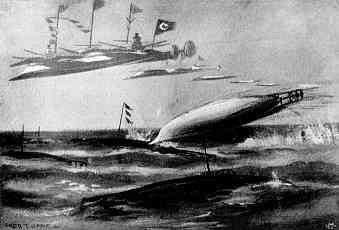 "A Great Battleship Lept Up Out Of The Nether Waters." |
The remnant of the Moslem squadron rose to the surface and signalled for instructions. Only twenty of them remained uninjured out of the hundred that had gone into the fight. Before the signals could be returned there was a loud hiss and a swirling noise as of some huge body rushing at a furious speed through the water, and a great battleship leapt up out of the nether waters, and hurled herself at a speed of nearly two hundred miles an hour into the midst of the floating squadron.
Her gleaming ram of azurine tore its way through the sides of three vessels in such swift succession that, almost before their fragments had time to sink, her huge bulk vanished under the waves again. But hardly was her work done than a second battleship charged into the paralysed squadron, sending two of its members to the bottom and crippling three more before she, too, vanished into the safe obscurity of the depths.
A third was met by a storm of shells from the air-ships, which burst round her and under her just as she came to the surface, and blew her out of the water in fragments. Heedless of this, a fourth plunged fiercely through the foaming area of the explosion, and had wrecked two more Moslem vessels before a shell smashed her propeller and laid her helpless on the water. Two of the Moslems instantly backed out and rushed at her, tearing two great ragged holes in her side and sinking her instantly, only to be sunk themselves in turn by a fifth charge from below.
Scarcely had this last foe disappeared in safety than a swarm of torpedoes, converging from all sides, encircled the remaining Moslem battleships. Some plunged beneath the waves to escape them, but these never reappeared. The remainder, torn and twisted and shattered by a series of explosions that flung the water mountains high all round them, sank like stones, and when the sea once more settled down, the grim work of death had been completed.
The fate which had so swiftly overwhelmed the expedition that had set out from Alexandria had almost simultaneously befallen four other expeditions which had started at the same hour from Tripoli, Tunis, Algiers, and Oran. The one disaster had been an almost exact reproduction of the others.
The same order, formation, and tactics had been observed in each of the five cases, and each of the five squadrons of transports and fleets of submarine battleships had been overwhelmed and completely destroyed by the same mysterious fate. Of five hundred transports and the same number of battleships which Sultan Khalid had possessed at sunrise on that fatal 16th of May not a single one remained by sundown, and of the more than three million souls who had manned the five fleets not one man survived.
Of the strength or the losses of the enemy that had wrought this appalling and unheard-of destruction within such a brief space of time nothing could, in the nature of the case, be known by those who had seen only some of its effects from the decks of the air-ships which floated almost helplessly over the waves which were engulfing their naval consorts. The work of annihilation had for the most part been done in the dim and silent depths of the sea, and all that they knew was the number of those of their own comrades who had gone to battle and never returned.
And yet to all practical intents and purposes these five stupendous blows which had simultaneously crushed the Moslem sea-power and half crippled the military strength of the Sultan had been struck by one hand. In other words, the victory of the Mediterranean was due to two inventions which had been made and perfected by Max Ernstein, who had been transferred from Kerguelen and appointed Admiral in Command of the whole Mediterranean forces of the federation.
One of these was a highly improved form of an apparatus which had just come into use on board battleships and cruisers when the War of the Terror broke out. This was an electrical contrivance which gave warning, more or less reliable, of the approach of torpedoes, by translating the aqueous vibrations set up by them into sound-waves, which increased in intensity as the hidden destroyer came nearer.
This invention had been lost sight of when all the warships of the world were sunk in the South Atlantic after the proclamation of the Universal Peace. Ernstein's was therefore a new discovery, or rediscovery, but the advantages of his position, far ahead of the scientific skill of the nineteenth century, had enabled him to produce a much more perfect instrument, and his apparatus, which was attached to all the battleships of the Federation, not only gave warning of the approach of an enemy, but indicated his direction, the number of revolutions at which his propellers were working, and his distance at any given moment.
This not only enabled the commander of a Federation battleship to detect the presence of an enemy, but it enabled him to distinguish between friend and foe. As soon as the phonetic indicator showed that another ship was approaching he stopped his own propellers, started them, and stopped them again.
The vibrations thus set up and interrupted would be conveyed to the indicator of the approaching ship, if she had one, and she would at once return the signal. If the signal was not returned it was safe to conclude that the coming vessel was an enemy and could be rammed accordingly.
When this invention replaced the tell-tale needle that had been in use a year before, an alteration in tactics became necessary, and the fighting order became more extended. A mile instead of a thousand yards was now the limit within which the Federation battleships were not permitted to approach each other, save under special circumstances. Every vessel acted as an independent unit, subject only to the general instructions.
Ernstein's second invention was of a simpler but none the less effective character. Knowing that the Moslem and Russian squadrons would be forced to trust entirely to their tell-tale magnetised needles, he had devised a plan for making these worse than useless. As soon as the phonetic indicator told him that an enemy was coming, the commander of each of his battleships dropped a thin rope of insulated wire down thirty or forty feet into the water below him.
The lower end of this cable was a powerful electro-magnet, through which a current of electricity was kept passing along the wires. The attraction of this magnet was far stronger than that of the hull of the vessel, and consequently the needles of the enemy were deflected downwards, and gave a totally erroneous idea as to the depth at which the Federation ship was floating.
Thus when the first division of the Moslem submarine squadron charged at what its commanders thought were the hulls of their enemies, their rams passed harmlessly underneath them, merely striking the magnet and knocking it aside. The moment they had passed the magnet, its attraction swung their needles back, and showed that some mysterious mistake had been committed, but before they had time to turn and seek the mark afresh the Federation ships were upon them, and their rams had rent their way into their sides.
In this manner every ship of the first division had been destroyed within three minutes after it had made its first and last charge. Then the Federationists had risen to the surface for an instant to reconnoitre by means of the arrangement of mirrors previously described, and sinking again had worked their way back towards the transports, formed in a huge circle round them, and had sent torpedo after torpedo into their midst.
As soon as the flotilla had been thrown into confusion they had converged until they could communicate with each other by means of their submarine signals, and after that they had attacked the enemy singly. Ship after ship charged into the melée, did her work, and retired, if she escaped destruction, to give place to another.
Only twenty Federation ships had been engaged in each of the five battles, and of these forty in all had been destroyed, a loss utterly disproportionate to the gigantic damage that had been done to the enemy.
Khalid the Magnificent divined intuitively that the disaster which had overwhelmed the expedition which he had commanded in person was only a portion of a result achieved by some elaborate and consummately-conceived scheme of defence which must have been simultaneously put into operation against his other expeditions. What had succeeded against his own might well have been expected to have succeeded against them.
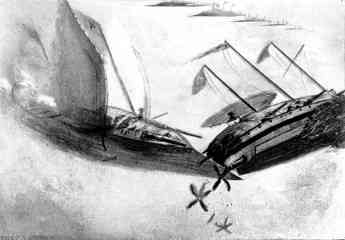 "The 'Isma' Swooped Down." |
This gave Alexis the opportunity he wanted. The instant that her stern was visible, the Isma swooped down, and rushed at her at such a speed that she looked more like a stream of blue light flashing through the sky than a solid material body. Those on board her saw this flash dart past their stern. Their ship shivered from stem to stern with some shock that came so swiftly that not until the Isma was almost out of sight did they realise the damage that had been done.
The ram of the Aerian had cut through the barrels of the two stern guns and the shafts of the three propellers as cleanly as a razor would have divided so many straws. Sustained and propelled only by her wings, she dropped from two hundred miles an hour to about twenty-five, and then the Isma reappeared in the sky above her, flying the signal, "Will you surrender?"
Her commander saw that the brilliant and almost miraculous manoeuvre of the Isma had placed him utterly at her mercy. If he refused, a single shell would send him and his ship and crew in fragments to the earth, while none of his guns could touch the Aerian, floating as she did a thousand feet above him, so he bowed to necessity and sent the white flag to his masthead. Alexis then signalled again, ordering him to unload all his guns and leave the breeches open, and when he had seen this done he sank down to a level with her, passed a steel-wire rope on board her, and towed her away in triumph to the fleet.
The brilliant achievement delighted the Aerians as much as it confounded the crew of the captured vessel, especially when it was discovered that she was the Haroun, a Moslem warship taking a message from the Sultan to the Tsarina at Moscow.
Khalid's letter, which had been despatched the night before from Algiers, informed Olga of the disaster that had overtaken the Crescent in the Mediterranean, and of his determination to avenge it by storming the bridges of Gibraltar, the Dardanelles, and the Bosphorus, and pouring his remaining troops over them into Europe as soon as he could concentrate them.
Far more important than this, however, was a notification of his intention to at once lead a fleet of two hundred and fifty air-ships to the west of Europe, and there destroy city after city on his eastward course until they joined forces and proceeded, if necessary, to devastate the rest of the Continent.
The Moslem's guns were now rendered useless, and she was left to her own devices to fall an easy prey to the first enemy that might attack her. The Aerian fleet then divided into fifty squadrons of five vessels each, and these winged their way towards the Russian frontier, ever soaring higher and higher, until their wings were beating the rarefied air at an altitude of over three miles.
Odessa, Kieff, Gomel, Vitebsk, Dünaburg, and Riga were all covered by the time the sun rose. Scores of Russian air-ships were seen by the various squadrons darting about hither and thither along the frontier at varying elevations, evidently on the look-out for an enemy.
It was not many minutes before the Aerian squadrons were discovered by these, and they instantly got away out of range, and then swerving round sought to rise to a similar altitude so as to place themselves on equal terms with the Aerians.
But long before this attempt could be made the work of death had begun, and two thousand guns were raining their projectiles, charged with inevitable destruction, upon the devoted cities. They were swarming with men who had come through the interior of Russia during the night for the invasion of Europe, but there were no troops on land to oppose them, for Alan had seen that there would be no need for these.
Within an hour the six cities were so many vast shambles, and still the relentless rain of death kept falling from the skies. Houses and public buildings crumbled into dust under the terrific impact of the explosions.
The streets were torn up as if by earthquakes, the railways running in and out were utterly wrecked, and the victims of the pitiless attack, panic-stricken and mad with fear and agony, rushed aimlessly hither and thither through the bloody, fire-scorched streets and amidst the falling ruins until inevitable death overtook them and ended their tortures of mind and body.
There was no escape even as there was no mercy. Thousands fled out into the country only to find the same rain of death falling upon the villages. It seemed as though the unclouded heavens of that May morning were raining fire and death from every point upon the devoted earth, and yet no source of destruction was to be seen.
But ere long new horrors were added to the desolation which had already befallen the cities. Terrific explosions burst out high up in the air, vast dazzling masses of flame blazed out, mocking the sunlight with their brightness, and then vanishing in an instant, and after them came showers of bits of metal and ragged fragments of human bodies, all that remained of some great cruiser of the air and her crew.
The Russian squadrons, numbering in all about three hundred warships, by flying several miles to the eastward and then doubling on a constantly ascending course had by this time gained a sufficient elevation to train their guns upon the Aerians, and as soon as they had done this the aerial battle became general along a curved line more than a thousand miles in length, extending from Odessa to Riga.
George Cosmo had been right when he said that there would be little or no land fighting, for along that line, from the Baltic to the Black Sea, there was scarcely a man left alive by midday who was not mad with fear and horror at the frightful effects of the aerial assault.
On land as well as on sea fighting was impossible. Armies and fleet could exist only in the absence of the air-ships, and they were everywhere. Cities lay utterly at their mercy, and nothing shaped by the hand of man could withstand the impact of their projectiles.
But all day long the fight went on in the skies above the Russian frontier, yet not at all after the fashion imagined by the poet of the nineteenth century, who wrote, as he thought prophetically, of
Airy navies grappling in the central blue.
The first and chief endeavour of the captain of every vessel was to avoid the shots of his opponents and to get his own home. It was brains and machinery pitted against brains and machinery, and grappling was never thought of.
The air-ship which could gain and maintain a greater elevation than her opponent infallibly destroyed her, and so, too, did the one that could fly unhurt at full speed along the line of battle and use her stern guns upon those which became relatively stationary enough for her to take aim at them.
It would have been a magnificent spectacle for an observer who could have followed the contending squadrons in their swift and complicated evolutions. He would have seen the blue and the silver hulls flashing to and fro as though apparently engaged in some harmless trial of speed, then, without the slightest warning, without a puff of smoke or the faintest sound of a report, the long, deadly guns would do their work.
The moment of vantage would come, and the silent and invisible messengers of annihilation would be sped upon their way; then, with a roar and a shock that convulsed the firmament, a mist of flame would envelop the ship that had been struck, and when it vanished she would have vanished too, falling in a rain of fragments towards the earth nearly twenty thousand feet below.
It was a battle not so much for victory as for destruction. There could be no victory save to those who survived after having annihilated their enemies, and this was the sole object of the struggle. High in air above the contending squadrons, the Avenger and the Isma swept to and fro along the line, raised by their superior soaring powers beyond the zone of battle, and from their decks the two admirals commanded the fight, and, like very Joves above the tempest, hurled their destroying bolts from their terrible guns far and wide over the scene of strife.
From morning to night both Alan and Alexis sought in vain for the blue hull of the Revenge among the Russian squadron. Unless Olga was on board one of the other ships she was either engaged in some work of destruction elsewhere or was directing the operations of her forces and learning the disasters that had overtaken them in her palace in Moscow or St. Petersburg.
It had been previously ordered that, as soon as it became too dark to take accurate aim with the guns, those vessels of the Aerian fleet which had survived the battle were to fly westward and rendezvous at midnight on the summit of the Schneekoppe, one of the peaks of the Giant Mountains to the north-east of Bohemia, whence, as soon as the amount of damage had been ascertained, the remainder of it, if strong enough, was to set out and if possible intercept the Moslem fleet before it could form a junction with the Russians.
When the last vessel had alighted on the summit of the mountain it was found that out of a fleet numbering two hundred and fifty warships only a hundred and eighty remained-- the rest were scattered in undistinguishable fragments along the Russian frontier. As for the amount of damage that had been done to the enemy as a set-off to this heavy loss, the Aerian commanders could form no even approximate estimate of it.
All they knew was that the six frontier cities, and a score or so of smaller towns and villages, were now mere heaps of ruins, vast charnel-houses choked with unnumbered corpses. The Russian army of invasion must have been practically annihilated, and certainly its remnants would be too hopelessly demoralised by the unspeakable horrors it had survived to be of the slightest use for further fighting.
As soon as the roll had been called, the fleet, in two squadrons of ninety vessels each, took the air and crossed the mountains to Gorlitz, which had been selected a year before as a convenient spot for the establishment of an arsenal and power-station, standing as it does at the angle of intersection of two great mountains which form the natural bulwarks of Bohemia.
Here the stock of motive-power and the ammunition of all the vessels were renewed, and at daybreak the squadrons were just about to take the air when a telephonic message was received from Paris that a large fleet of air-ships had appeared above the city and had begun to bombard it. This message had been sent in compliance with a system of intercommunication which Alan had instituted between all the great cities of Europe, and all the power-stations and rendezvous throughout the Continent.
The moment an enemy appeared over any town messages were to be sent to all the stations simultaneously, and detachments of warships were to be despatched to the threatened point as soon as the warning was received.
It will be seen that this system would enable a very large force to be concentrated upon any threatened point, and, in fact, before the sun was two degrees above the horizon of Paris, eight squadrons of Federation warships, including the two under the command of Alan and Alexis, were flying at full speed from all four points of the compass towards the city which for over half a century had been the acknowledged capital of the Continent.
Little more than an hour sufficed for the Avenger and the Isma to pass over the six hundred miles which separated Gorlitz from Paris. Flying at their utmost speed they left their squadrons to follow the two admirals, knowing that every captain could be implicitly trusted to do the work allotted to his ship without further orders.
The object of Alan and Alexis was to get first to the scene of action, and to avail themselves of the superior soaring powers of their two vessels to deliver an assault upon the Moslems which they could not reply to.
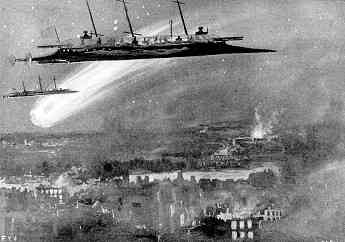 "A Fearful Scene Unfolded Itself As They Swept Up Over Paris." |
A fearful scene unfolded itself before them as they swept up out of the eastward over Paris. The vast and splendid city was surrounded by a huge circle formed of at least two hundred Moslem warships floating at an elevation of some three miles, and pouring a tempest of projectiles from hundreds of guns indiscriminately into the area crowded with stately buildings and nearly ten millions of inhabitants.
Nearly three miles above the centre of the city floated a solitary scout-ship ready to signal warning of the approach of an enemy. Fires were already raging in hundreds of places all over the city. The streets were swarming with terrified throngs of citizens who had rushed out to escape the flames and the falling buildings, only to meet the hundreds of shells that were constantly bursting among them, rending their bodies to fragments by scores at a time.
Such was the beginning of Khalid the Magnificent's revenge for the disaster of the Mediterranean-- a vengence which proved that, in his breast at least, the savage spirit of the ancient warfare was still untamed.
The Avenger and the Isma gained an altitude of four miles above the doomed city, half a dozen shells from their guns struck the scout-ship and reduced her to dust before she had time to make a signal in warning, and then the forty-four guns began to send a radiating hail of projectiles upon the Moslem fleet. Shell after shell found its mark in spite of the vast range, and ship after ship collapsed and dropped in fragments or blew up like a huge shell.
But before the fifth round had been fired a strange thing happened. A single Aerian warship rushed up at full speed out of the south, and as soon as she sighted the Avenger signalled, "Orders from the Council. Come alongside." The new-comer soared upwards as they sank to meet her, and the three ships met and stopped some three miles and a half above the earth. The stern of the Azrael, as the messenger-ship was named, was brought close up to that of the Avenger, the deck doors were opened, a gangway thrown across, and the captain boarded the flagship and placed a sealed despatch in Alan's hand.
He opened it, and to his unspeakable astonishment read--
AERIA, May 16th, 6 P.M.
All Aerians are to return at once with their ships to Aeria, and take no further part in the fighting. The Federation fleets may be left in the hands of foreign crews and commanders, to whom the power stations and batteries are to be given up. This order is to be obeyed with the least possible delay.
ALAN ARNOLD President.
To the Admirals in command of the Federation Fleets.
A MESSAGE FROM MARS.
IN order to adequately explain the origin of the peremptory recall which, although of course he obeyed it without question, seemed so incomprehensible to Alan, it will be necessary to go back to the night of the 12th of May.
While all Aeria was rejoicing over the return of the exiles and their restoration to the rights of citizenship, there was one of the inhabitants of the Valley who took little or no part in the festivities. This was Vassilis Cosmo, a man of between forty-six and forty-seven, and elder brother of the George Cosmo who had been chief engineer of the Narwhal, and was now first officer of the Avenger.
A striking distinction of personality and temperament had, ever since he had reached a thinking age, marked him as one apart from the rest of his fellow-countrymen.
He had little or none of the gaiety of disposition and social cordiality that were the salient characteristics of the Aerians as a people. He was serious almost to taciturnity, solitary and studious, and wholly engrossed in a single pursuit -- the study of astronomy in its bearing on the great problem of interplanetary communication.
After twenty years of constant labour, assisted by all the knowledge and inventive progress which had placed the Aerians so far ahead of the rest of the world, he had at length solved this problem and realised the dream of ages six years before Olga Romanoff had dropped her defiance from the skies.
As yet, however, his success had been confined to one planet, and this, as will have been learnt from the conversation between Alma and Isma on that memorable night on which Alan's letter had been received from the island, was the planet Mars.
After infinite toil and innumerable failures, he had at length succeeded in establishing an intelligible system of what may here be described as photo-telegraphy, in which the rays of light passing between the earth and Mars were made to perform the functions of the electric wires in modern telegraphy.
His alphabet, so to speak, consisted of a hundred great electric suns disposed at equal intervals on the mountain peaks round the great oval of the Valley. These were in direct communication with the observatory of Aeria, which was situated at a height of sixteen thousand feet on Mount Austral, the highest of the two snow-capped peaks which stood at the southern end of the Valley.
A single switch key enabled him, when sitting by the huge telescope which embodied all the highest optical science of Aeria, to light and extinguish these brilliant globes as he chose, and it was by lighting and extinguishing them at certain intervals that he was able to transmit his signals to the Martian astronomer, who was waiting to receive them, and to reply to them by similar means across the gulf of thirty-four million miles which separates the two planets at their nearest approach to each other.
Momentous as were the events of the last few days, they were dwarfed to utter insignificance by the irregular and apparently meaningless recurrences of a tiny point of light in the centre of a great concave mirror situated at the base of the huge barrel of the telescope, through the side aperture of which Vassilis Cosmo was looking a few minutes before midnight on that memorable 12th of May.
The point of light appeared and vanished, and reappeared again at irregular intervals, which the astronomer noted on an automatic registering instrument beside him. The moment the flash appeared he pressed a button, which he held down till it disappeared, then he released it, waited till the flash reappeared, and repeated the operation so long as the signals came.
For nearly five hours he received and registered the signals recorded by his reflector in silence, broken only by the monotonous ticking of the clockwork which, working synchronously with the movements of the two orbs, kept the image of Mars exactly in the centre of the object-glass, and by the soft whirring of the registering instrument.
Never before had human eyes read such a message as he read, sitting that night in silence and solitude in his observatory amid the snows, far above the lovely valley in which his countrymen were still holding high revel.
Well might his hands tremble and his eyes grow dim with something more than long watching when he reversed the mechanism of the register and a narrow slip of paper, divided by cross-lines into equal spaces a tenth of an inch long, issued from a slit in one end, and began to run slowly over a revolving drum.
On the tape was a series of straight black lines running longitudinally along it. They were of unequal length, and divided from each other by unequal spaces. Before the exact import of the message could be gained the length of each of these lines, and that of the space which separated it from the next, had to be accurately measured, but Vassilis knew his own code so perfectly that he had been able to read the general drift of the communication that had been sent along the light-rays from the sister world by approximately guessing the duration of the flashes and the intervals between them.
Day was beginning to dawn by the time the long tape had been unrolled and pinned down in equal lengths on a board for measuring. For more than five hours he had not uttered a syllable or even an exclamation, although he had received from another world what appeared to be tantamount, not only to his own death-sentence, but to that of the whole human race.
But when the slips were at length pinned out and he had run his practised eye deliberately over the fatal marks, his white lips parted and a deep groan broke from his chest. He was alone in the observatory, or perhaps not even this sign of emotion would have escaped him.
With his hands pressed to his temples as though his brain were reeling under the frightful intelligence that had just been conveyed to it, he stood in front of the board and gasped in short, broken sentences--
"God of mercy, can that be really true! Has the world only four months more to live? Surely I have made some mistake-- and yet everything has worked as usual. There has been no hitch. It has been a splendid night for transmission and they-- no, they had not made a mistake for a thousand years, they are past it. It must-- but no, I can do nothing more this morning. I should go mad if I did. I must think of it quietly and sleep a little if I can, and then I will transcribe it."
He left the telescope tower and went out on to a little platform at the rear of the observatory which commanded a view of the whole Valley. He looked out over the lovely landscape lying calm and silent beneath the paling stars, and involuntarily exclaimed aloud--
"Is it for this that we have conquered the earth and bridged the abysses of space-- for this that we have made ourselves as gods among men and throned ourselves here in this lovely land, lords of the world and masters of the nations?
"How shall I tell them down yonder? And yet, has not the Master told them already: 'His shape shall be that of a flaming fire.' 'Your children of the fifth generation shall behold his approach'? Yes, the two exiles we welcomed back last night are the fifth generation from the Angel, and that will truly be a flaming fire, and truly it will go hard with this world and the men of it in the hour of its passing, as the Master has said."
After a vain attempt to seek refuge from his thoughts in sleep he boarded his aerial yacht and went to the city to mingle with the merry-makers, more for appearance' sake than from inclination, but he kept his own counsel strictly, for more reasons than one. The next night, as soon as Mars was high enough in the heavens, about half-past ten, the dwellers in the Valley saw the great lights on the mountain tops flash out and darken at irregular intervals time after time and hour after hour, until all but those in the sentinel ships went to rest, saying--
"Vassilis is talking to our neighbours in Mars. He will have something to tell us to-morrow."
But when the next day came he had nothing to tell. He had spent the night repeating the message, sign for sign and word for word, and asking for confirmation lest he should have made any mistake in receiving it. Then in agonised anxiety he had waited for the reply on which he now felt the fate of mankind depended. It came with a terrible clearness and brevity, which left no room for doubt--
"Message read correctly. There is no error in our calculations. Terrestrial humanity is doomed, and must prepare to meet its fate."
So far as he was concerned he was satisfied. He knew that a mistake was impossible to the finished science of the Martian astronomers, compared with whom he was but as a little child in knowledge. But still he kept his own counsel, for there was no need for him to cast the sudden shadow of death over the rejoicings of his countrymen.
At length the fleets departed, and Aeria, armed at all points, was awaiting the possible onslaught of her foes. These she would doubtless hurl back in triumphant disdain from her bulwarks, but far, far away in the depths of space, beyond even the range of the great equatorial on Mount Austral, there was approaching an enemy whose assault men could only meet with resignation or despair, as the case might be. Resistance was as much out of the question as escape.
Early on the morning of the 16th, soon after the Avenger had struck the first blow in the world-war, Vassilis presented himself at the President's palace and asked for an interview with him.
The President received him a few minutes later in his private room. It was the first time in his life that the silent, reserved astronomer had ever asked for an official interview, and as the President entered the room he held out his hand, saying--
"Good morning, Vassilis. We have seen very little of you lately, even less than usual. Have you come to see me about the work which has kept you from joining in the general rejoicings? I'm sure it must have been very important."
"Yes, President, it was -- the most important that a terrestrial student of astronomy could be engaged upon," replied Vassilis, speaking slowly and very gravely.
The President looked curiously for a moment into his clear, thoughtful eyes, and noticed the lines of care on his pale, worn features, so different to those of the rest of his countrymen. Then he said, with an anxious ring in his voice--
"What is the matter, Vassilis? You look worn and ill, as though you had just passed through some great sorrow. Have you been keeping too long vigils with the stars? Tell me, what is it?"
Vassilis was silent for a moment as though he might have been wondering whether the President, strong as he was would have strength to bear the blow that he must strike in his next sentence. The awful news had come to him slowly, sign by sign and word by word, and so he had been in a measure prepared for it when its full meaning became clear. But upon Alan Arnold it must fall at a single stroke. Still the words had to be spoken, and after a good minute's pause he said--
"President, I bring you the most terrible news that one man can bring to another. The Master's prophecy is about to be fulfilled. Three nights ago I received through the photo-telegraph what I believe to be the death-sentence of humanity upon earth. Here is the transcript of the message."
Save for a sudden pallor and a quick uplifting of the eyelids, Alan Arnold betrayed no more emotion as he took the roll of paper which Vassilis handed to him, than he had done when he received his son's letter from the island.
"It does not come to me unexpected," he said in his firm quiet tones. "Your children and mine, Vassilis, are of the fifth generation, and it was foretold that they should see the sign in the sky. And so the threatened doom is not to pass us by?"
"No," replied Vassilis "Not unless some miracle happens, and there are no miracles in the astronomy or the mathematics of Mars. The Martians are long past the age of miracles or mistakes. These are the data and the calculations upon which the conclusion is based. I have repeated them back to Mars and received confirmation of them.
"I have also verified the times and distances and velocities myself, and have been unable to find the slightest error. As far as I can see, there is not the remotest chance of escape. The human race has only four months, five days, and twenty-three hours to live from midnight to-night."
"It is the will of God!" said the President solemnly, slightly bending his head as he spoke. "It is not for us to question the designs of Eternal Wisdom, save in so far as we may strive to understand them. Death has always been inevitable to all of us, and this will only be dying together instead of alone. Do you wish anything done with these calculations?"
"Yes," said Vassilis. "I would suggest that you appoint a committee of our best mathematicians and astronomers to examine and verify them once more, detail by detail, so that assurance may, if possible, be made surer. I shall receive another message from Mars to-night, and it will be well for the committee to be with me in the observatory. With the public aspect of the question I have, of course, nothing to do, that lies in the hands of yourself and the Council."
"Very well," said the President, "what you wish shall be done at once, and the Council will meet this morning to consider what public steps are to be taken."
Within half an hour after the conclusion of the momentous interview the Council had met, and the most immediate result of its deliberations on the tremendous tidings that had come from the sister world was the issue of the order for the instant return of all Aerians who were abroad which had been delivered to Alan on the deck of the Avenger on the morning of the 18th.
Immediately on receiving his father's letter, Alan signalled, "Cease firing and follow," to the Isma, and the three Aerian vessels started southward towards Gibraltar, leaving Paris to its fate. At Gibraltar, which was reached in two hours and a half, he found that, in accordance with the orders of the Council, messages had already been sent out to all the stations within the European area of the Federation for all Aerians to rendezvous at the Rock as soon as possible.
The same orders had been transmitted along the telephonic cables which connected the marine stations of the Mediterranean for all the battleships on service to go into their respective harbours, so that their crews might land and be picked up by air-ships which had already been despatched for them.
Before the evening Aerian vessels had begun to come in from all parts of Europe, where they had been stationed, and their crews brought terrible descriptions of the scenes of carnage and destruction they had left to obey the summons. The Federation leaders were in despair at their apparent desertion by their potent allies, while their enemies were already rejoicing at the disappearance of the Aerian warships from all points of the scene of war.
By midnight the last Aerian vessel had come in, and, after the command of the Rock, the last station of which the Aerians retained command, had been handed over to the British forces, the flotilla, numbering nearly four hundred warships, rose into the air just as two large Moslem squadrons, one fresh from the destruction of Paris, and the other from Alexandria and the east of Europe, converged upon the Rock, and, without warning, opened a furious fire of shells upon it. The great guns from the batteries replied, and the fleets, under the command of Alan and Alexis, after sending a rapid hail of shells among the Moslem vessels as a parting salute, soared into the upper regions of the air and headed southward for home, leaving a fiery chaos of death and destruction behind them.
Two hours after daybreak on the 19th the fleet crossed the Northern Ridge, and sank to earth on the sloping plateau behind the city. Alan at once disembarked, and went to his father's palace to report himself.
The sudden and unexpected return of the fleet, which had left to do battle for the empire of the world but three days and a half before, filled all the inhabitants of the Valley with amazement, for no one outside the Council and the committee appointed to verify the message received from Mars yet knew of the doom that was menacing the world.
Alan was received at the door of his palace by his father, who, after their greetings had been exchanged, took him at once to the room in which the Council were already assembled, and there in the presence of his colleagues made him acquainted with the reason for his recall.
Inured as he was to the unsparing warfare in which human life had to be counted as almost a negligible quantity, a warfare in which there was no middle course between life and death, Alan, after the first shock of surprise and horror had passed, faced the tremendous crisis with a calmness and resignation worthy of the traditions of his family and his race.
For years he had carried his life in his hands, and now that the end of all things seemed near he was prepared to look inevitable death calmly in the face. He heard the reading of the message in silence, and then, when he saw that they were waiting for him to speak, he said quietly--
"What is to be must be! We cannot argue with the workings of the universe." Then he paused for a moment, and went on-- "I have come back with my comrades in obedience to orders. May I now ask why, if death is coming to the whole human race, we were not permitted to die in battle for the right against the wrong rather than to wait here in inaction and suspense until we are burnt to death on the funeral pyre of the world?"
He spoke the last words almost hotly, for the first thought that had risen in his mind after hearing the doom that was about to overtake humanity was that the debt he owed to Olga Romanoff must now for ever remain unpaid at his hands. This thought was so unbearable to him that before any reply could be made to his question he broke out again, this time speaking rapidly and almost angrily--
"If, as you tell me, the world has only a few weeks to live, why should I wait here for death when I have work to do elsewhere? What does it matter whether I die scorched to a cinder in the fire-mist or am blown to pieces by a Russian shell? I have a debt to pay, a stain upon my honour and my manhood to wipe out before I die.
"And so, too, has Alexis. Will you not give us an air-ship and let us find a crew of volunteers that we may go back to the war and hunt our enemy, and the enemy of humanity, down, and either destroy her or find an honourable death in the attempt to do so?"
As he ended his impassioned appeal his father rose from his seat, and laid his hand upon his shoulder and said gravely, and yet not without a note of admiration in his voice--
"My son, those are brave and honourable words, and they prove that you are no unworthy son of the race you belong to. But they are still the words of passion rather than reason. Remember that in the presence of the universal doom that now overhangs the human race not only private vengeance but even the strife of nations sinks into utter insignificance. A heavier hand than yours will punish the sin for which she who has wronged you will soon have to answer at the bar of Eternal Justice. Remember how it was said of old, 'Vengeance is mine, saith the Lord. I will repay.'"
"That is true, father," replied Alan, now speaking in his habitual tone of respect. "But why should not the instrument of that vengeance be the hand of him whom she has so bitterly wronged? You know what I mean, and so do all in this room.
"Has she not so polluted my manhood and stained my honour that I must meet, apart from Alma, the fate that I could have shared with her with no more regret than that we had to die instead of live together? Is it not better that she should know I died in the attempt to wipe that stain away than see me waiting for death with it still upon me?"
"That is for Alma as well as for you to decide," said Francis Tremayne, rising from his seat as he spoke. "How do you know that she is unwilling to meet her end hand-in-hand with you?"
"I have looked into her eyes and seen no love in them," replied Alan, flushing to his temples with shame and anger. "Her old love for me is dead, as it may well be. How could I expect her purity to mate with my"--
"Stop, Alan!" exclaimed his father before he had time to utter the shameful word that was on his lips. "Those are no words for you to speak or for me to hear, especially at such a time as this. If any stain ever rested upon you you have more than purged it already. The man who is found worthy the confidence of the rulers of Aeria is worthy the respect, if not the love, of any woman in the State. Whether Alma loves you still or not is a question for her own heart to answer, but you must not call yourself unworthy in my hearing."
"Nor yet in mine," said Alma's father warmly. "If the shadow of death had not fallen across all our life-ways as it has done, there is no man who wears the Golden Wings that I would so willingly see Alma join hands with as yourself. If I, her father, hold you worthy to live with her, surely you cannot hold yourself unworthy to die with her."
As he spoke he held out his hand to Alan, and he, unable to find words to answer him, grasped it in silence, broken only by a murmur of approval from the assembled members of the Council.
"Thank you, my friend, for saying that!" said the President to Tremayne. "Alan can ask no better assurance unless he has it from Alma's own lips. But now I have something more to say, something that will give the true reason for my recall of all the Aerians who were beyond our borders. Let the words you are now going to hear be heard with all respect, for they are not mine but those of the Master himself."
Amidst an expectant silence he now resumed his place at the head of the Council table, and bidding Alan and the Vice-President to be seated, took a long parchment envelope brown with age from the breast of his tunic and said--
"This contains the last words of him who prophesied the doom with humanity now stands confronted, and who thus speaks to us from the past, and gives us good counsel and comfort in the hour of our perplexity and sorrow. It has been handed down with its seal unbroken from father to son for four generations, and now it has fallen to me to break the seal and read what no eyes but those of Natas and my own have ever seen. This is the endorsement upon the cover--
'To the son or daughter of my line who shall be the head of the House of Arnold in the fifth generation from me:-- When the world is threatened with the final ruin that I have foreshadowed, open this and read my words to all who are then dwelling in Aeria.NATAS.'"
The President paused, and everyone waited with most anxious expectation as he opened the envelope and took from it four square sheets of parchment. He unfolded them and went on--
"When Vassilis Cosmo brought me the transcription of the message from Mars I saw that the time had come to obey the injunction endorsed on this envelope. I opened it, and this is what I read:--
'The interpretation of the prophecy concerning the possible destruction of the world in the fifth generation from now, written by me in the twenty-fifth year of the Peace, and commanded to be read every fifth year in the ears of the descendants of those now dwelling in Aeria.
'When the War of the Terror was over, and there was peace on earth, I devoted the declining years of my life to the study of that noblest of all sciences which teaches the lore of the stars and the constitution of the universe. In the fifteenth year of the Peace, that is to say, in the year of the Christian Era 1920, a new star appeared towards the constellation of Andromeda, which shone with great brilliancy for thirty-five nights, and then faded gradually away into the abysses of space.
'Seeking into the causes of this phenomenon, I found that it was due to the collision of two opaque bodies beyond the bounds of the solar system, which doubtless had been travelling towards each other for centuries through space. So enormous was the heat evolved by the conversion of the motion of the two bodies, that their materials were resolved into their component elements, and what had been two bodies as solid as the earth, though immensely larger, now became an enormous fire-mist, a chaos of blazing storms and burning billows of incandescent matter.
'I observed it closely from the time of its first appearance until the most powerful telescope at my command could no longer detect it. I found that vastly remote as it was, the course which it pursued until it was lost to view proved that it was still within the sphere of the sun's attraction, and that therefore a time must come when it would reach its point of greatest distance, and return.
'Such calculations as I was able to make during the brief period of my observation, showed that it would re-enter the confines of the solar system in one hundred and twelve years from then, and, travelling with constantly accelerated motion, would become visible to the inhabitants of the earth five years later. I learnt, too, that unless it should be deflected from its path by the attraction of bodies unknown to terrestrial astronomers it would cross the orbit of the earth in the month of September in the year 2037, that is to say, in the fifth generation of men from my own day.
'If my calculations are correct, the earth will during that month pass through an ocean of fire that will destroy all living things upon its surface, both plants and animals.
'For the space of ten hours, or, it may well be, more, while the planet is passing through the fire-mist, there will be no water upon the face of the earth but the whole globe will be surrounded with a vast nebulous mantle of steam. At the end of this time it will emerge from the fiery sea, the steam-cloud will be recondensed and fall in a deluge upon the land, and the world, with a changed face, with new oceans and new continents, will pursue her impassive way lifeless, through space.
'But even in the face of so tremendous a cataclysm as this, it is not for human genius to despair or human faith to be confounded. The new earth may be repeopled, and you may be the parents of the new humanity. Though innumerable millions shall die, yet the chosen few will be saved if the Master of Destiny shall permit, and from among you the chosen few shall come.
'The caverns of Mount Austral are deep and cool, and enclosed by walls of living rock, deep rooted in the foundations of the world. In those days, if you shall have made good use of the heritage we leave you, you shall be almost as gods in skill and knowledge, and you shall find a means to make this a fortress whose strength shall defy the convulsions of the elements and preserve a remnant of human life upon the earth.
'When you have done this, you that remain shall prepare to meet the inevitable end, for only a few among your many thousands can be saved. Yet, if you have grown in wisdom and faith as well as in knowledge and skill, you shall not disquiet yourselves about this, for sooner or later death is certain to all and you will but pass together through the shadows instead of singly.
'When the final hour comes, and the breath of the blazing firmament is hot upon your brows, may He in whose Hand the fate of worlds and races lies, give you strength and wisdom to compose yourselves for death as men who know that it is but the dreamless sleep that parts to-morrow from to-day.'
"Those are the words of the Master," said the President, reverently laying, down the parchment sheets on the table before him. "And it is for us to hear and obey. You will now see why it was necessary for all our sons that had gone forth to battle to be recalled, for among them there are many who can justly lay claim to be of the flower of Aerian manhood.
"To-morrow I will read the message from Mars and the commands of the Master, in the temple, to a
congregation of all the fathers and mothers in Aeria, and then it shall be their task to prepare their children for the
doom which awaits them in common with the rest of humanity. The remainder of to-day we will devote to the task of
considering how the commands of the Master may be best obeyed."
SENTENCE OF DEATH. AT ten o'clock on the following morning the great temple of Aeria was filled by a congregation of men and matrons
who had been summoned together to hear what may, without exaggeration, be described as the death-sentence of
the world and the funeral oration of the human race.
As had been previously decided by the President and Council, only the heads of families were present. Of
these, some had but just welcomed their first-born into the world, while others, standing almost on the brink of the
grave, could see their children of the fourth generation growing up from infancy to youth.
When the President commenced his address by reading in solemnly impressive tones the prophecy of Natas,
those present knew instinctively what they had been called together to hear. The possibility of the world being
overwhelmed by some tremendous catastrophe in the fifth generation from the year of the Peace was no new or
unawaited prospect to the Aerians.
Therefore there was no panic, no sudden outburst of sorrow or dismay, among the grave, earnest congregation
assembled in the temple when the President, having read the prophecy, went on to say--
"It is now my solemn duty as Chief Magistrate of Aeria to tell you, the heads of the families of our race, that, in
the mysterious workings of destiny, which we can only accept with reverence and resignation, the time has come for
us to prepare to meet, with the fortitude worthy of our position among the races of mankind, the doom which is as
inevitable as it is universal. The confirmation of the prophecy of Natas has come to us across the abysses of space
from one of those sister worlds which, as the Master said, should see with fear and trembling the passing of the
messenger of Fate.
"On the night of Tuesday last, Vassilis Cosmo received from the planet Mars a photogrammic message, the
transcription of which into our language reads thus--
'A cometary body, primarily formed by the meeting of two extinguished astral spheres at 'At this hour the earth will arrive at the point of intersection, and will pass obliquely through the central portion or
nucleus of the body. This portion is composed of incandescent metallic gases interspersed with semi-fluid masses
which on contact with the earth's atmosphere will probably be vaporised.
'The constituents of the incandescent nucleus are iron, gold, tellurium, chromium, oxygen, nitrogen, and carbon
with smaller quantities of many other substances which spectrum analysis will disclose to you on the appearance of
the comet which will become visible from Aeria at "With these calculations," continued the President, "this is neither the time nor the place to deal, for I know that
all here will be satisfied when I say that for the last three days they have been submitted to the critical examination
of our best astronomers and mathematicians, and that not the slightest flaw has been found in them.
"This being so, the only course left open to us as reasonable beings is to prepare to look the inevitable in the
face, and to play our part in the closing scene of the life-drama of humanity as men and women who believe that
the life we are living here is but a stage on our journey through infinity, and that the fiery sign which will soon
appear in the heavens will be to us but a beacon light on the ultimate shore of Time casting a guiding ray over the
ocean of Eternity."
He paused for a moment and looked down upon the hushed throng at his feet. The instantaneous silence was
broken by a long, low, inarticulate murmur. Thousands of pale faces were upturned towards him, from thousands of
eyes there came one appealing upward glance, and then every head in the great assembly was bowed in silence
and resignation.
The death-sentence had been passed. There was no appeal from it, and there was no rebellion against it. The
voice of Fate had spoken, and it was not for such men as the Aerians to sacrifice their reason or their dignity by
cavilling at it.
The President bent his head with the rest, and for several moments there was silence throughout the vast area
of the temple. Then he took up from the desk in front of the rostrum the four sheets of parchment which contained
the last message and commands of Natas, and read them out to the assembly.
The perusal was listened to in breathless silence. It was like his voice speaking across the generations from the
urn containing his ashes and standing there in their midst. When the President had finished, he laid the sheets
down again and said--
"Thus the eye of the Master, looking across the years which separated his day from ours, has seen one gleam
of light, one ray of hope piercing the black pall of desolation which is about to fall upon the world, and it is for us to
follow where he has pointed the way.
"I have now discharged the first part of the solemn and terrible duty which has devolved upon me. It is now for
you to communicate the tidings you have heard to your families, a task which, however awful it may be for loving
parents to be charged with, you will yet find strength to perform, even as your children shall find strength to hear
their inevitable doom from those lips which will best know how to soften the tidings of death to them.
"When you have done this we will set about making the choice of those who, if it shall please the Master
of Destiny, shall be the Children of Deliverance and the parents of
the new race that shall repeople the earth when cosmos once more succeeds to chaos.
"If that shall be permitted, then we, who shall never see the new world, may yet go down to the grave knowing
that we shall live again in our children, for these will be the children, not only of a few families among us, but sons
and daughters of Aeria, the most perfect flower of our race, and in them, if we choose them wisely, the world,
purged by fire of the dross of human wickedness, will find a new destiny, and the Golden Age shall return to earth
once more."
As the President finished speaking, he held up his hands as though in blessing, and once more every head was
bent. Then the great doors of the temple swung open, the assembly divided into four streams, and passed silently
as a congregation of shadows out of the building.
That night the story of the world's approaching doom was told in every home in Aeria. Children on the threshold
of youth learnt that for them youth would never come; youths and maidens on the verge of manhood and
womanhood learnt that the bright promise of their lives could now never be fulfilled; and lovers just about to join
hands for life saw the grave opening at their feet, and parting them in their earthly personalities for ever. That they
would meet again upon a higher plane of existence was the first and most firmly held article of their faith, but so far
as the affairs of this world were concerned the end was in sight.
In a less highly developed, a less perfectly organised, state of society, the almost immediate result would have
been the end of all control, and the dissolution of all but the most elementary bonds of interest or affection that exist
between men and men.
But in Aeria this was not possible. The firm belief, ingrained into the very being of all who had reached the age
of thought, that where men left off here, whether in good or evil, they would begin their lives again hereafter,
precluded even the thought of such a lapse into social anarchy and individual sin.
For, happily for them, the union of true religion with true philosophy had now been accomplished in a national
faith, and the result was that even the terrors of the universal end which was so near failed to shake the fortitude
that was founded on a basis firmer than that of the world itself.
Though every home in the valley had its tragedy that night, a tragedy too sacred in its unspeakable solemnity
for any mere words to describe it, when the next morning came the first bitterness of death had already passed.
Saving only the little children, who, too young to understand, laughed and played and sang in the sunlight as
usual, in happy unconsciousness of their coming fate, the dwellers in Aeria rose with the next sunrise from their
sleepless couches and went about their daily associations much as they had done the day before.
They did so rather as a matter of routine and discipline than of necessity, for now nothing more was necessary
on earth. They had ample supplies of food to last them beyond the time when they would have no more need of it. It
was of no use to dress the gardens and vineyards, or to till the fields that would be blasted into wildernesses before
the harvest could be reaped.
There was no need to pursue further the triumphs of creative art and science which had transfigured Aeria into
a paradise and a fairyland, for in a few weeks all these would be crumbled to dust with their own sepulchres-- and
yet they took up the work that lay nearest to their hands and went on with it as though they believed that there were
still ages of life before humanity, and that the empire of Aeria was to endure for ever.
They knew that in work only lay the refuge from the torment of apprehension which might in the end drive even
their highly disciplined minds into the delirium of despair and transform their orderly paradise into a pandemonium
of anarchy and terror.
As soon as the first shock of inevitable horror had passed, as it did during that first terrible night when the death-sentence
went from lip to lip throughout the land, their proud spirits rose superior to their physical fears and
conquered them, and they resolved that, until the fatal hour came, nothing short of the dissolution of the world
should put an end to social order in Aeria.
They were the royal race of earth, and when death came they would meet it crowned and sceptred in the gates
of their palaces, and die as men who had solved the secret of life and death and so had no fear.
With the war that was raging beyond their borders they had now no personal concern. The quarrels of men and
nations were as the bickerings of children in the presence of the fate that would so soon involve the world in ruin.
And yet the rulers of Aeria were not willing that this fate should overtake their fellow-men in the delirium of blood-drunkenness.
They recognised that their duty to the nations bade them send the warning of the world's approaching fate far
and wide through the earth and call for the cessation of strife, so that humanity might set its house in order and
prepare to meet its end.
Whether the warning would be received or not was another matter. It was possible that both the Tsarina and the
Sultan would laugh it to scorn, and pursue their path of now certain conquest through carnage and devastation to
the end. That, however, was their concern.
As soon as the Council decided to despatch an envoy to summon the warring nations to cease their strife for
the now more than ever worthless prizes of earthly empire, and to prepare for the cataclysm which would so soon
dissolve all empires and kingdoms to nothing in the fiery crucible of the coming chaos, Alan at once renewed his
petition and asked to be allowed to man the Avenger with a crew of volunteers and convey the warning to the Sultan
and the Tsarina.
Since his second return to Aeria no word of love had passed between him and Alma. He was still too proud to
become a suitor even to her, knowing as he did that she had looked upon him as polluted by his involuntary
relations with Olga. As before, they had met as friends whose friendship was warmed by the memory of an early
but bygone love.
They had talked calmly and dispassionately of the coming end of earthly things, but neither of them had let fall
any hint of a desire to meet it hand and hand with the other. His lips were sealed by the pride and anger of
humiliation and hers by a spiritual exaltation which in the presence of approaching death raised her above the
consideration of earthly love to the contemplation of even more solemn and holier things.
Then there happened an entirely unexpected event, which completely changed their relationship in an instant.
On the third day after the delivery of the message in the temple a company composed of twenty old men, the heads
of the noblest families in Aeria, presented to the President in Council, a petition, signed by every father and mother
in the nation, praying that all in whose veins flowed the blood of Natas Richard Arnold, and Alan Tremayne should,
irrespective of all other considerations, be included among those who were destined to seek in the caverns of
Mount Austral the one chance of escape from the universal doom.
So obvious and so weighty were the reasons advanced in support of the petition that when, like all other matters
of State, it was put to the vote of the Council, the only dissentient voices were those of the President and the Vice-
President.
The immediate effect of this decision-- from which, by the laws of Aeria, there was no appeal-- was that Alma,
Isma, and Alan were exempted from the ordeal of selection and numbered beforehand among the Children of
Deliverance.
The President took upon himself the duty of communicating this decision to those whom it so deeply
concerned. He told Alan first, and this was the half-expected reply that he received--
"No, father, I have never disobeyed you or the Council, as you know, but I tell you now frankly that I will not
take advantage of what is after all only the accident of birth to save my life in such a crisis as this.
"Not only are there thousands of others in Aeria as good as I am, but I have already told you that, save under
one condition, which you know as well as I do can never be realised, I have not the slightest desire to survive the
ruin of the world. You may call this disobedience, rebellion, if you will, but it is my last resolve, and in such a time
as this one does not make resolves lightly."
Alan said this standing facing his father in his private study. The President looked at him for a moment or two
with eyes which, though grave, were neither reproving nor reproachful. Then he said with the shadow of a smile
upon his lips--
"It is both disobedience and rebellion, my son, but though the Chief Magistrate must condemn it, your father
cannot. I know, too, that not even the Council of Aeria can now enforce its commands. After all, the last penalty is
but death, and that is a mockery now.
"I fully understand, too, the spirit in which you refuse the reprieve from the general doom, and prefer instead a
mission which can scarcely end save in honourable death. It is the most noble one that you can choose, and you of
all other men are the man to perform it.
"You have shown our enemies that you can strike hard in battle, so if they believe anyone they will believe you
when you go to them with a message of peace enforced by such a solemn warning as you will take."
"Thank you, father," replied Alan simply, "not for what you say of me, but for the consent that your words imply.
But what about the air-ship and her crew? I can do nothing without them, yet I cannot have them without the
consent of the Council. Can you get that for me?"
"I believe so," said the President. "And if I can I will, since you are resolved to go, and since the honour of our
name compels me to consent. But I must tell you that I feel sure that it will only be given conditionally."
"And what will the condition be?"
"That if you survive your mission you will return to Aeria before the end comes. They will have a right to
demand that, for it is no part of your duty to deprive your companions of the chance of life, slender though it may
be, that will remain for those who may be among the chosen."
"That is true," replied Alan, bending his head in acquiescence. "If we escape with our lives they shall return,
though I shall not"--
"You will not return, Alan? Why, where are you going? Surely you are not going to leave Aeria again, and at
such a time as this; you, who are already one of the chosen, a firstborn son of the Master's line!"
It was Alan's mother who spoke. She had entered the room just as he had uttered the last sentence, and the
ominous words struck a sudden chill to her heart. She came towards him with her eyes full of tears of apprehension
and her hands stretched out pleadingly towards him.
Now that the first terror of the crisis was past, and there was one definite, however slender, hope of safety, she
clung to it passionately for Alan's sake with a faith that made light of all the fearful difficulties which lay in the way of
its realisation. In the sublime egotism of her mother-love the fate of a world shrank into insignificance in comparison
with the one chance of safety for her only son.
"Yes, mother," replied Alan, taking her hands in his and bending down until his lips touched her upturned brow.
"I am going to leave Aeria again to proclaim the Truce of God against the hour of His judgment, and I have just told
my father that I shall not return"--
"No, no, my boy, you must not say that. You must not rob us of the one ray of light in this awful darkness that is
falling upon us-- of our one hope in all the world's despair!" cried his mother, letting go his hands and laying her
own upon his shoulders as she looked up into his face with eyes that were now overflowing with tears.
"You will not leave us now, surely, for if we lost you we
could not even take the chance of life ourselves, for it would not be worth having."
"Nor would it be worth having, my mother, either to you or to me," he replied, gently laying his hand on hers, "if
I lived and left untried the attempt that it is my plain duty to make. You would see me a lonely and unmated man
among the parents of the new race, a man with a shadow upon his name, and the memory of an unfulfilled duty
behind him.
"Remember that it is I who have brought the guilt of blood back again upon earth. Would you have me outlive all
the millions of my fellow-creatures with the knowledge that I had not made one effort to bring back that peace on
earth which was lost through me before the last summons comes to all humanity?"
"Alan is right, wife," interrupted the President, before she could make any reply to her son's appeal. "It is his
duty to save, if he can, his fellow-creatures from being overwhelmed in the midst of their madness and their sin.
Remember that according to our faith, as all these millions, who are now drunk with battle and slaughter, and mad
with the rage of conquest and revenge, end this life, so they must begin the next.
"There is time for him to speak and for them to hear, but whether they hear him or not, if he has spoken he has
done his duty. Is it not better that if needs be he should die doing it than live and leave it undone?"
The weighty words, spoken as they were in a tone of blended affection and authority, found a fitting echo in his
wife's breast. She stood for a moment between her husband and her son, looking from the one to the other. Then
she dried her tears, and replied in a tone of gentle dignity and resignation--
"Yes, I see. You are right and I was wrong. It is his duty to go, and he must go. But," she continued, turning to
Alan with the sudden light of a new hope in her eyes, "if I bid you 'God-speed,' my son, you will promise one thing,
won't you?"
"Yes, mother, I will-- whatever it is."
"Then promise me that if it shall be proved possible for you to live in happiness as well as in honour, you will
come back."
"Yes," he replied, smiling gravely as he once more took her outstretched hands. "I will promise that as gladly
as I would promise to enter Heaven if I saw the gates open before me."
"Then you shall go, and God go with you and bring you back in safety to us!" she said. Then, turning abruptly,
she went out of the room, leaving them both wondering at her words.
This took place early on the morning of the 21st of May. An hour later the President had applied in Alan's name
for the permission of the Council for him to select a crew of twenty volunteers and to take the Avenger to Europe on
his mission to the warring peoples and to proclaim peace on earth and breathing space for humanity to prepare for
its end. But then a new difficulty presented itself. Alexis, in spite of all Alan's remonstrances to the contrary,
declared that he should never leave Aeria without him.
"I have shared in your exile and your return," he said, in answer to all arguments, "and, by the honour of the
Golden Wings, I swear that I will either go with you now or you shall see me fall dead the moment that you leave the
earth!"
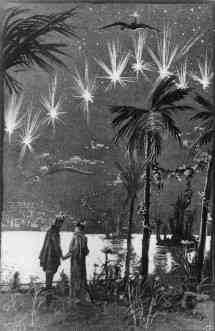 "Only You Can Bid Me Live, Alma." |
"Then it will be for you-- under Heaven-- to speak the words of life or death, for only you can bid me live, Alma."
As he spoke the great lights on the mountain tops suddenly blazed out, shone for a few moments, and were extinguished again. It was the answering signal to one from Mars; but it joined two souls as well as two worlds, for by its light Alan saw on Alma's face and in her eyes the one reprieve from death that honour would permit him to accept.
Without waiting for the words that her now smiling lips were opening to utter, he took her unresisting in his arms. Then her proudly carried, wing-crowned head drooped at last in sweet submission, and rested on his heart; and as he turned her face up to his to take his kiss of re-betrothal, he said--
"That tells me that I may live. Now we are immortal, you and I, for this kiss is our eternity!"
Then their lips met, and for the instant Time had no more beginning or end. The impending ruin of the world
was forgotten; for Love had spoken, and the very voice of Doom itself was silent amidst the happiness of their
heedless souls.
THE SIGN IN THE SKY. WHEN the news of what had happened at midnight in the palm grove was published the next morning far and wide
through the valley of Aeria it would have been impossible to imagine that an irrevocable sentence of death was
overhanging the land and all its inhabitants, save those who were to be selected to take the one chance that
remained of surviving the chaos that was to come.
There was no one in the valley to whom Alan's story was not familiar in all its details, there was not a single
heart that had not in the midst of its own happiness sympathised with him and Alma in their sorrow, and so, when
that sorrow was at last turned into joy, everyone forgot for the moment the fate whose approach was so near and so
certain, and rejoiced with them in the happiness that was great enough to raise them above the gloom that was
already stealing over the world.
But in the midst of the general rejoicing came the decision of the Council upon the request which Alan had
submitted to his father, and this, though he was forced to confess it wise and just, was by no means what, in his
enthusiasm, he could have wished. The rulers of Aeria absolutely refused to permit any of the air-ships to leave the
valley for at least two months to come.
They recognised with perfect approval the nobility of the resolve which Alan had taken to carry the message of
the world's approaching end to those nations which he had been partially at least, responsible for plunging into the
horrors of war, but they insisted that the concerns of Aeria must, in their eyes, take precedence of those of the
outside world.
There was much to do, and the time for doing it was short. What was perhaps the greatest engineering task in
the history of the world had to be conceived and completed within the next four months, and as Alan and Alexis
were admittedly the two most skilful practical engineers in the State, the Council declined to allow them to run the
almost certain risk of death at the hands of their enemies when their knowledge and skill ought to be devoted to the
work of ensuring, as far as possible, the preservation of that remnant of the human race who should be destined to
seek safety in the caverns of Mount Austral.
When the completion of that work was made certain, then permission would be freely given to them and their
companions to go forth and proclaim their warning to the world, subject only to the condition that they were to take
every precaution consistent with the honour of their race to return while there was yet time for them to take their
places among the Children of Deliverance should the selection fall upon them.
Meanwhile, telephonic messages were to be sent to all those portions of the world with which Aeria was still in
communication, conveying the exact terms of the warning that had been received from Mars, and calling upon the
astronomers in all the observatories on the globe to verify the calculations for themselves, and publish their
conclusions to their respective nations as quickly as possible.
With these terms Alan was of necessity obliged to be content. Indeed, when he came to review them in sober
thought, he saw that, while nothing was to be lost, much was to be gained by submission to them.
Though he still refused, even in spite of the knowledge that he would share with Alma the future if there was to
be one, to obey the order of the Council which exempted him from the ordeal of selection, he thought and worked
with just as much ardour as though the safety of the whole of the dwellers in Aeria, as well as his own, hung upon
his efforts.
The caverns of Mount Austral, like those of other limestone formations in various parts of the world, had been
formed in some remote geological period by the solvent action of water charged with carbonic gas upon the
limestone rocks.
The entrance to them, discovered very soon after the valley had been colonised by the Terrorists in the first
decade of the twentieth century, was situated on the inner slopes of the mountain about eight hundred feet above
the level of the lake, which occupied the central portion of the valley.
This lake, although fed by hundreds of streams from the surrounding mountains, always preserved the same
level, in spite of the fact that it had no visible outlet. Those who first explored the caverns found the explanation of
this phenomenon.
Below the floors of the vast chambers which penetrated the heart of the mountain for a distance of nearly three
miles there ran a deep chasm, through which rushed in a black, swift, silent stream the surplus waters of the lake.
This stream was nearly a thousand feet below the entrance to the caverns and half that distance below the floor of
the lowest chambers and galleries.
The scheme conceived by Alan and Alexis and their fellow-workers was in fact nothing less than the damming
of this subterranean stream by a mighty sluice-gate composed of one huge sheet of metal which, running down into
grooves cut in the solid rock and metal-sheathed, should completely close the inner mouth of the tunnel by which
the waters entered the caverns.
This, once successfully fixed in its place, would deprive the lake of its only known outlet. The streams would go
on flowing from the mountains and the waters of the lake would rise. The upper entrance would, when the fatal
moment came, also be closed, not by one such door, but by three that would slide down one behind the other in the
upper tunnel, which, with a diameter of about thirty feet and a height of almost fifty, ran for nearly a quarter
of a mile from the side of the mountain to the first of the chambers.
The spaces between these doors would be filled with ice artificially frozen, and shafts to allow for expansion
should the ice melt and the water boil would run from them vertically, piercing the mountain-side. When the waters
rose to the level of the entrance the doors would be lowered and the space filled with water and frozen. Then the
waters would go on rising, the entrance would be submerged, and the defences of the fortress in which the remnant
of humanity was to make its last stand for life would be complete.
But in addition to these outer defences there was an enormous amount of work to be done in fitting the interior
of the caverns to receive those for whom they were to form an asylum.
They were already lighted by myriads of electric lamps, but the source of light was outside, and this had to be
replaced by power-stations inside. Provision had to be made for keeping the air pure and vital, for supplying food
and drink for an almost indefinite time, and for storing up a sufficiency of seeds and roots and treasures of art and
creative skill, so that the new world might be clothed again with verdure and nothing essential of the splendid
civilisation of Aeria be lost.
Such, in the briefest outline, was the momentous task to which the Aerians devoted all their splendid genius and
unconquerable energies, and day by day and week by week they toiled at it, while the fatal hour which was to
witness the last agony of man upon earth swiftly drew nearer and nearer.
The messages to the outside world had been sent and replied to. Those to the astronomers and to the
governments of the Federation had been acknowledged in formal terms which thinly concealed the incredulity with
which they had been received.
Olga had treated the message with the silent disdain of a conquering autocrat-- such, as in sober truth, she now
was. The Sultan had replied to it in a despatch in which the dignity of a victorious despot and the fatalism of the
religious fanatic were characteristically blended. Then one by one the telephonic communications with the various
parts of the world ceased; messages were sent out and repeated, but no answer came back.
First Europe, then Britain, then South Africa, America, and Australia, ceased to respond to the signals; and by
the beginning of July Aeria was completely isolated from the rest of the world-- probably the only stronghold that
now remained unsubdued by the conquering fleets of the Sultan and the Tsarina.
Still the sentinel ships, hanging high in air over the valley, and constantly patrolling the outer slopes of the
mountains, saw no sign of hostile approach. The last messages that had been received from the great cities of the
Federation had told brief but fearful stories of the desolation that was following in the path of Moslem and Russian
conquest.
The bridges of Gibraltar and the Bosphorus had been forced, and thousands after thousands of Moslem troops
had been poured into Europe. Frenzied by fanaticism and the new-born lust of battle and conquest, the hordes of
Asiatic tribesmen who had escaped the one terrific onslaught of the fleet under the command of Alexis had, now
that the guardian ships were withdrawn, been hurried through Russia, and hurled upon the wealthy and almost
defenceless cities of Western Europe.
The Federation was on the point of utter collapse, divided in its counsels, confused in its plans of defence, its
armies undisciplined, and its fleets disorganised and daily diminishing in number and effectiveness.
In America, Australia, and Southern Africa there was anarchy on earth and terror in the air. Cities had been
terrorised into capitulation by aerial squadrons, and then looted and burnt, and their ruins given up to be the
miserable prey of the revolutionaries who now, as ever, had taken advantage of the universal panic to revolt against
all government, and deny all rights but that which they claimed to prey upon the helpless, all liberty that was not
license, and all property that was not plunder.
The last tidings of all that came from Europe were received from Britain, and, after recounting the destruction of
London and the collapse of the Government, concluded with the news that Olga had publicly embraced the faith of
Islam, and, in conjunction with the Sultan, whom she was to marry as soon as the conquest of Europe was finally
complete, was forcibly converting her Russian subjects to the creed of the Koran.
So the affairs of the world stood when the sun went down on the 15th of July. On the meridian of Aeria it set at
nine minutes to eight; at thirteen minutes past eight, according to the calculations made by the Martian and verified
by the Aerian astronomers, the herald of Fate would approach within the range of terrestrial vision.
Before the brief period of tropical twilight had passed every telescope in the valley was turned to that spot in the
constellation of Andromeda at which it was predicted to become visible. As the revolving earth swept Aeria into the
shadow of night every light was extinguished, for it was known that the astronomers of Mars would be anxiously
watching for a signal that would announce the correctness or the error of their calculations.
Vassilis Cosmo, seated at the eye-piece of the great equatorial telescope on Mount Austral, with his hand on
the switch which controlled the electric currents that were waiting to do his bidding, watched the fields of space
darken, and the stars of Andromeda shine out. Just a little below the line which joins the Square of Pegasus with the
constellation of Cassiopeia, he saw, as usual, the oval, luminous cloud of the great nebula in Andromeda.
Four degrees towards the zenith, above the centre of the star-cloud, a tiny fan-shaped spray, faint and pale as
a dissolving puff of white smoke, was floating in the black abyss of space. Precisely at the thirteenth minute of the
hour he turned the switch, and the great suns on the mountain-tops blazed out and flashed the signal to the sister-world
to tell its inhabitants that their prediction had been fulfilled to the second.
THE TRUCE OF GOD. BY the 30th of July the work in the caverns was so far advanced that the Council was able to authorise the
departure of Alan and his companions for the outside world. The great vertical sluice-door, a huge sheet of steel
forty feet long, twenty wide, and eighteen inches thick, and footed with a great indiarubber pad, was in its place,
suspended at the top of the steel-lined grooves, which had been sunk three feet into each of the rock walls of the
chasm into which the water-tunnel from the lake opened.
On the morning of the 30th it was sent down into its final position. The momentous experiment proved
completely successful. The huge mass of metal descended slowly over the mouth of the tunnel into the black, swift
stream at the bottom of the chasm. As its enormous weight crushed the indiarubber pad down into all the
inequalities of the floor the outrush of the waters instantly stopped, and the channel ran dry save for the fierce jets
of water which spouted out over the top of the plate.
The crevices through which these came were easily plugged, and when this was done it was found that the
waters of the lake were rising at the rate of three feet an hour. This proved that, whether the lake had another outlet
or not, the damming of the subterranean channels would be quite sufficient to flood the whole valley.
The gate was then raised again, and the waters permitted to flow as before. The triple doors at the entrance to
the cavern were already in position when this was done, as the task of placing them had necessarily been much
easier than the construction of the water-gate. Nothing but details now remained to be completed, and there was
therefore no reason for any further postponement of Alan's mission.
Alexis had also succeeded in carrying his point, and getting permission to accompany Alan in the Isma. He had
had no difficulty in satisfying the Council that the risk would be enormously diminished by sending two air-ships
instead of one, for while Alan descended to the earth to convey his message to a hostile city, he would be able to
remain in the air, dominating it with his guns, and ready to lay it in ruins if the flag of truce were not respected.
But the two friends had gained even more than this, for in answer to their earnest pleadings, in which it may be
suspected they were not altogether unsupported by those as vitally concerned as themselves, a joint family council
had decided that, under the unparalleled circumstances of the case, there was no valid reason for refusing consent
to their immediate union with the two faithful brides who had waited so long and so patiently for their lords.
Therefore, on the morning of the 31st, it came to pass that they stood upon the spot sanctified by the ashes of
their great ancestors, and took each other for man and wife, for life or death, as the hazard of the world's fate
might decide, in the presence of a vast congregation of those who stood with feet already touching the brink of the
valley of the shadow of death.
No bridal so strange or solemn had ever been celebrated in the world before. It was human love and hope and
genius, serene and confident in the presence of the most awful catastrophe that had ever befallen humanity,
defying the fate that was about to overwhelm a world in destruction.
That evening, as the sun was touching the tops of the western mountains, the last preparations for the voyage
were completed, the last farewells exchanged, and the Isma and the Avenger, now renamed the Alma by the hands
of her name-mother, rose into the air amid salvoes of aerial artillery, and winged their way northward over the
Ridge.
As they sped out over the plains of Northern Africa the sun sank, and out of the north-western heavens shone
the luminous haze of the Fire-Cloud, which had now grown in visible magnitude until the two fan-like wings which
spread out from its central nucleus spanned an arc of twenty degrees in the heavens.
As the two air-ships sped on their northward course towards Alexandria, where Alan had decided to make his
first attempt to stay the progress of the world-war, the two pairs of new-wedded lovers watched with anxious eyes
from the decks of their flying craft the terrible portent in the skies whose meaning they above all others on earth
were so well qualified to read.
There could be no doubt now, even apart from all the elaborate calculations which had been made, that the
prediction of the Martian astronomers was far more likely to be fulfilled than contradicted by the event.
Yet, so great was the happiness they found in this strange fulfilment of the faint hopes of years of almost
hopeless waiting that, even as they journeyed on through the night with this threatening sign of approaching ruin
pouring its angry light out of the skies, their talk was still rather of love and life and hope than of the death and
desolation which they knew to be overhanging their race with such remorseless certainty.
They had lived and loved, and their love had found fruition. What more could they have asked of Fate than this,
even if they could have prolonged their lives indefinitely by a mere effort of will? As Alan had said to Alma at the
moment of their re-betrothal in the palm-grove, they were immortal now, and for them the death of a world was but
an accident on the onward progress of an evolution in which such souls as theirs, veritable sparks of the divine fire
itself, were the dominating factors.
As the Fire-Cloud paled in the West, and the eastern heavens brightened with the fore-glow of the coming
dawn, the captains of the two vessels were roused by the signals from the conning-towers which told them that
Alexandria was in sight.
As soon as he got on deck Alan signalled to the Isma to come close alongside. As she did so and the morning
greetings were exchanged, Alma appeared on deck, and suggested that Alexis and Isma should come and have
breakfast on board the flagship, so that the two captains could discuss their final plans before descending to the
city.
The invitation was of course accepted, and an hour later the Alma commenced her descent towards the Sultan's
palace, above which, from a lofty flagstaff, the banner of Islam was floating lazily in the early morning breeze. She
flew no other ensign save a broad white flag of truce that streamed out from the signal-mast at her stern.
The whole city seemed asleep, secure in the conquests that had already been won. A single air-ship floated two
thousand feet above the palace, and as he approached her Alan, keeping her well under his guns, flew from his
mainmast the signal-- "We come in peace. Will you respect the flag?"
The Moslem captain saw at a glance that a single shell would annihilate his vessel, and that the Alma was
perfectly protected by her consort, circling two thousand feet above him, so he signalled, "Yes, come alongside."
The Alma descended and swung round until she came on a level with the Moslem vessel, then she ran alongside
within speaking distance, the doors of the deck-chambers were opened, and Alan, after exchanging salutes, asked
her captain whether the Sultan was in his capital.
"Yes," replied the Moslem. "He is down yonder in his palace awaiting the coming of the Tsarina, for they are to
join hands to-day and reign lord and mistress of the world they have conquered."
"Is the world, then, conquered?" asked Alan, with a smile on his lips and a note of scornful pity in his voice.
"Yes," said the Moslem. "East and west, north and south, the world is ours, saving only your own little land, and
for that, I suppose, you have come to make terms of peace."
"I have not come to make terms of peace for Aeria, but for the world," replied Alan gravely. "But of that I must
speak with your master. When will he be able to give me an audience?"
"That I cannot say," was the reply, "or even that he will hear you at all. But, pardon! I did not know that the
angels of Paradise accompanied the Aerians on their voyages. Descend in peace, my master will receive you."
As he was speaking Alma, crowned with her crystal wings, and radiant with a beauty which, to the Moslem's
eyes, seemed something superhuman, had come from the after part of the vessel to Alan's side. It was the first time
that he had ever seen a woman of Aeria; and, with the innate chivalry of his race, he paid his involuntary homage to
her as he would have done to an incarnation of one of the poetic dreams of his faith.
Then salutes were exchanged again between the two captains and the Alma sank swiftly downwards until she
hovered twenty feet above the terrace on which Alan had first spoken with the Sultan on the night that he captured
the Vindaya.
The approach of the Aerian warship had already summoned a party of guards to the roof, and after a brief
parley a message was carried to the Sultan from Alan. A few minutes later Khalid stepped out of the doorway
leading from the interior of the palace, magnificently attired as though for some great ceremonial.
He looked up and saw Alan standing with Alma by his side on the after-deck of his ship. He saw, too, that the
flag of truce was flying from the stern and that the guns were laid alongside instead of being pointed down upon the
city. He raised his hand in salute and said--
"I see you come in the guise of peace. If that is so you are welcome."
"It is peace if your Majesty will have it so," replied Alan,
returning his salute, and at the same time making a sign for the Alma to descend to the roof of the palace. As her
keels touched the floor of the terrace, the steps fell from the after doorway, and he came down, leaving Alma
standing on deck by the open door.
"Will not your companion honour my palace by touching its roof with her foot?" said Khalid, looking up at Alma
as he exchanged greetings with Alan.
"My companion, Sultan, is the wife of the man whom you turned your back upon on this very spot as a liar, a
traitor, and a murderer," said Alan, looking him straight in the eyes. "How, then, could she honour your palace by
setting foot on its roof?"
For a moment the Sultan was abashed into silence by the directness of the rebuke, and then his Oriental
subtlety and quickness of thought came to his aid, and, bending his head with royal dignity, he said--
"The angels do not mate with such men as that. The Tsarina must have been misled by appearances, perhaps,
indeed, carried away by her hereditary hatred of your people. It is impossible that any but a true man could have
won the love of such a woman. You tell me that you come as friends and not as enemies, so, for the hour, let there
be peace, not war, between us. While you are my guests my city is yours, and all that it contains. I pledge my
honour for your safety, so let the Daughter of the Air descend that I may hear from her lips the music of her voice."
Turning aside, half to hide a smile at the Oriental metaphor of the Sultan's speech, Alan went to the foot of the
steps and held out his hand to Alma. As she alighted on the terrace he led her towards him, saying--
"This is my wife. Yesterday morning she was Alma Tremayne, a daughter in the fifth generation of the first
President of the Federation. Her ancestor and yours made terms of peace after the War of the Terror. It is,
therefore, more fitting that you should hear from her lips than from mine the message that we bring."
"My ears are waiting," said Khalid, bending low over the hand that Alma held out to him as Alan spoke. "It would
be a strange message that would not be welcome from such lips."
From one whom she could have looked upon as an equal such language as this would have jarred sorely upon
Alma, accustomed as she was to the frank directness of her own people's speech. But from Khalid she tolerated it
as she would have tolerated the extravagance of a child, and as he raised his head again she looked at him with
eyes that dazzled him afresh, intoxicated as he already was with her, to him, strange and almost unearthly beauty,
and said in a voice such as he had never heard before--
"Thank you, Sultan, for your welcome, but surely there is little need for me to tell you what message we bring.
Last night you saw it written in letters of fire across the heavens. Has not the voice of God spoken bidding you and
your people to cease the cruel warfare that you are waging upon the world and to prepare for the end of which that
is a sign?"
As she spoke she raised her hand and pointed to where the shape of the Fire-Cloud now hung in the sky like a
white mist paling before the light of the rising sun.
"You rejected our first warning, as perhaps was natural, but now that you have seen the confirmation of it
shining among the stars, surely you will no longer reject it."
The last words were spoken in a gentle, pleading tone, which no man could have heard without being moved by
them.
"Daughter of the Air," replied the Sultan, following her hand with his eyes, "I have seen, and in a measure I
believe, your message, though my interpretation of it may be other than yours. If the end of the world is at hand,
the Commander of the Faithful will know how to meet it as a true believer should. It is not impossible that there may
be peace between us yet in the last hours of earthly life, for I would not willingly make war on a people that has
daughters such as you."
"Not for our sake, Sultan, but for the sake of all who have
survived this terrible warfare of yours we are come to plead with you for peace," said Alma. "This is no time for hate
and strife and bloodshed. There will be horrors enough upon earth before long without any made by the fury of
man. It is in your power to give peace to the world and breathing space to meet its end. Why will you not give?"
"You forget it is not I alone who can give peace," replied Khalid. "If that were so"--
Before he could speak another word a salvo of aerial artillery shook the air above the city. All looked up towards
the northern sky, whence the sound proceeded, and saw a squadron of twenty silvery-hulled air-ships flying the
Moslem and Russian flags, and escorting in two divisions a warship, from whose flagstaff flew the imperial standard
of Russia, and whose shining hull of azurine proclaimed her the lost Ithuriel.
Alan grasped the perilous situation in an instant, and was just about to tell Alma to go back on board their own
ship when the Sultan, divining his intention, took a step forward and said--
"Do you think that Khalid cannot protect his guests or that his ally will not respect the hospitality of his house?
You are safe. If a hair of your head were harmed the Tsarina and I would be enemies and she would come to her
death instead of her bridal, for that is what brings her here. There is truce between us for this day at least, and she
shall not break it."
As he ceased speaking the twenty air-ships opened out into a long line and remained suspended five hundred
feet above the palace, while the Revenge continued her downward flight and alighted at the farther end of the
terrace from where they were standing,
The after door of the deck-chamber opened as she touched the marble pavement, the steps dropped down, and
Olga descended, attired as usual in a plain robe of royal purple, over which hung a travelling mantle of pearl-grey
cloth as fine and soft as silk and lined with the then almost priceless fur of the silver fox.
Her head was uncovered save for a plain golden fillet, from which rose a pair of slender silver wings so thickly
encrusted with diamonds that they seemed entirely fashioned of the flashing gems. The golden fillet shone out
brightly yellow against the lustrous black of her thickly-coiled hair, and the diamond wings blazed and scintillated in
the sunlight with every movement of her head.
As she descended the steps she was followed by Orloff Lossenski and a guard of honour of twelve of her
officers, splendidly dressed and armed to the teeth, who, as soon as they landed, drew their swords, which were
now only used as ornamental insignia of rank, and ranged themselves in two lines, one on either side of her.
Before the Revenge had alighted the Sultan had made a sign to one of the sentries, who blew a long, clear blast
on a silver bugle, which was instantly answered by a hundred others from various parts of the city. At the sound the
Moslem metropolis seemed to wake from sleep into universal activity.
Thousands of soldiers in brilliant uniforms poured into the empty streets, the Moslem and Russian flags ran up
to a thousand flagstaffs, squadron after squadron of aerial cruisers soared up from the earth and saluted with
salvoes of artillery, which shook the very firmament and brought Alexis down to within three thousand feet of the
palace roof in the belief that Alan and Alma had fallen victims to some treachery, and that the time had come for
him to avenge them by laying the city in ruins, as he had promised to do in such an event.
A single glance through his field-glasses showed him the true state of affairs, so he contented himself with
keeping his crew at quarters with every gun trained on a Russian or a Moslem air-ship and ready to spread death
and ruin far and wide should any harm happen to the Alma or her crew.
While this was taking place the Sultan's bodyguard had filed out on to the terrace resplendent with gorgeous
uniforms and glittering weapons, and between the two long lines that they formed Khalid advanced to meet his bride, leaving
Alan and Alma interested and not unanxious spectators of the strange and unexpected scene.
They met half-way down the double line, and as Olga held out the hand over which Khalid bowed low as he
raised it to his lips, she said, with a glance of undisguised hate towards Alan and Alma and a mocking smile on her
lips--
"Your Majesty's generosity is unbounded! I see that you have invited to our wedding-feast the only enemies with
whom we have yet to measure swords!"
"They have not come as enemies, Tsarina," replied Khalid, as he raised his head and looked with but half-restrained
ardour on the beauty that was so soon to be his. "Nor yet have they come at my invitation. Alan Arnold
and his wife"--
"His what!" interrupted Olga, her cheeks burning and her eyes flashing with a sudden blaze of uncontrollable anger.
"His wife, Tsarina," replied Khalid, somewhat coldly. "The son of Natasha and Richard Arnold has mated with
the daughter of Alan Tremayne, and they have come in the fifth generation to warn you, the daughter of the House
of Romanoff, and me, the son of the line of Mohammed Reshad, to cease our warfare upon the nations and
prepare for the universal end which, they tell us, is at hand."
Khalid spoke, as Olga thought, half in jest and half in earnest, so she continued in the same mocking tone in
which she had first spoken--
"Then if that is so, if all human enmities are soon to be purged by the all-destroying fires, we may as well meet
in peace for the moment. Will your Majesty honour me by presenting me to your uninvited guests?"
"Uninvited, but still my guests, Tsarina," replied Khalid gravely, "and therefore I need not ask you"--
"No, Sultan," said Olga, interrupting him, "you need ask me nothing. You need not fear that I shall not respect
the hospitality of your house, even when extended to them."
As she spoke she gave him her hand again and he led her between the silent, rigid ranks of his guards to
where Alan and Alma were standing.
Since men and women had learned to love and hate there had been no such strange meeting between two
women as that which now took place between Alma and Olga. It was the first time that Olga had ever seen a woman
of the race to which Alan belonged, and Alma, for the first time confronted with a daughter of the "earth-folk," saw
in Olga Romanoff at once the most beautiful woman outside the confines of Aeria and the incarnation of everything
that she had been trained to look upon as evil.
While the Sultan was speaking the words of presentation their eyes met, and Alma thought of that sentence in
Alan's letter to his father, "She is as beautiful as an angel and as merciless as a fiend," while Olga looked back to
the time when she first heard Alma's name and hated her for the sake of him who now stood beside her, her lover
and her husband-- the man she had held in bondage for years without winning one voluntary caress from him.
Alma's first emotion was one of wonder. Hitherto, she had seen nothing beautiful that was not at the same time
good, for in Aeria the conceptions of beauty and goodness were inseparable. But here was a woman of almost
perfect physical loveliness, after her own type, who was beyond all doubt guilty of the most colossal crime that a
human soul had conceived or a human hand had carried out since men first learned to sin.
The world, which ten years before had been a paradise of peace, prosperity, and enlightened progress, was
now a wilderness of misery and an inferno of strife, fast lapsing back into barbarism-- and all this was her doing.
As this thought came to Alma's mind, standing out distinct among all the others that were forcing themselves
upon her, wonder gave place to unspeakable horror, and as Olga
approached, with the light of hate still burning in her eyes and the same mocking smile upon her lips, she
instinctively shrank back as though to avoid contact with some unclean thing. As she did so her hand slipped
through Alan's arm and a visible shudder ran through her form.
Marvellous as Olga's power of self-control and dissimulation was, she failed entirely to restrain the passion
which such a reception aroused within her. It was the first time in her life that she had ever stood in the presence of
a woman untainted by a spot of sin or shame, and this woman recoiled from her in visible loathing, beautiful and
mighty as she was, at the very zenith of her conquering career and on the morning of her promised union with the
man who, as she believed, would before many days share the empire of the world with her.
Hardened as she was, the mute rebuke cut her to the quick. The flush on her cheeks died out and left her so
pale for the moment that her face looked almost ghastly with its grey lips and black burning eyes. This daughter of a
higher race had at a single glance pierced the splendid mask which covered the fearful deformity of her true
nature. She thought of the night long ago in the bedroom at St. Petersburg when by the light of the unearthly flame
hovering above her poison-still she had seen her image in the mirror.
Then pride and anger came to her rescue. The blood returned to her cheeks and lips, she drew herself up to
the full height of her queenly stature, and as the Sultan spoke the words of presentation she slightly inclined her
head, and then raising it again said, in low, even tones, whose wonderful music sent a chill to Alma's heart--
"This is a pleasant surprise, Alan Arnold. I little thought that after our last parting we should meet again, save in
battle, much less did I think that you would honour my bridal by bringing your own bride to it. Still, as the Sultan tells
me, there is truce for to-day, and, so far as to my enemy, you are welcome."
"We have not come as guests to your bridal, Tsarina," said Alan coldly and gravely, "nor have we come to
make truce as between mortal enemies. The enmities of men and nations are but as child's-play now. We have
come to proclaim the Truce of God against the hour of His final judgment."
THE SHADOW OF DEATH. "AH, I see," said Olga. "You have come to tell us this wonderful story about the comet, and the message you say you have received from Mars, over again. You are not the first who have prophesied the end of the world by such means, nor will you be the last to be discredited by the event.
"Once for all, then, let me save misunderstanding by telling you that I don't believe a word of it, and therefore
nothing that you can say will have any effect on the course of action that I have determined upon. You are of
course at liberty to preach your truce elsewhere and at your own risk, though I fear it will be but the voice of one
crying in the wilderness."
"Yes, truly in the wilderness," said Alma before Alan could reply, "but a wilderness that you have made with
your own hand, Tsarina. You who have been the evil genius of the world, have you not done harm enough, now that
the world has only a few more weeks to live?"
"According to the idle tale you bring us," interrupted Olga, repressing with a barely successful effort the anger
aroused afresh within her by the serene tone in which Alma spoke. It sounded rather like the voice of an angel
speaking to a mortal than of one woman addressing another, and even to herself Olga was forced to admit that
there could be no question of equality between this daughter of the air and herself.
"It is no idle tale," replied Alma, almost in the same tone which she might have used in reproving a wayward
child, "it is not even a prophecy, it is a mathematical certainty, and if you understood you would believe."
"You are wasting time and your own breath," said Olga scornfully. "You are not my guests but the Sultan's, yet
he may allow me to say that we have other demands upon our attention more important than listening to such
sentimentalism as this."
Before Alma could answer, Alan turned to the Sultan as though not deigning to reply to Olga's insulting speech.
"Your Majesty, I see that this is no time to perform the mission upon which I came. We did not expect the
presence of the Tsarina here. Had we done so we should not have come, for I know how vain it would be to reason
with her. I came prepared to satisfy the most skilful astronomers in your kingdom that what I say is absolutely true,
and I ventured to hope that you, if satisfied by their assurances, would give peace to the world for the remnant of its
days.
"But even so it is not for us to interrupt or even to introduce an unpleasant element into the doings of to-day, so,
with your Majesty's permission, I will leave the calculations with your minister and relieve you and the Tsarina of our
unwelcome presence."
All this time the Grand Vizier, Musa al Ghazi, had been standing a little to the rear of the group stroking his
beard nervously and looking anxiously from one to the other. He seemed about to speak, when Khalid said to Alan
with a courtesy which contrasted strongly with Olga's contemptuous demeanour--
"I thank you, Prince of the Air. As matters stand I think that will be the most reasonable as well as the most
convenient course. Though I am far from convinced that you are not mistaken, yet I can assure you that the best
skill in my domains shall examine what you leave us. Musa!"
The old man turned pale as his master pronounced his name, and stepped forward with a visible agitation,
which was by no means accounted for by the circumstances of the strange situation. Instead of waiting for Khalid's
commands he said as he made his obeisance before him--
"Commander of the Faithful, I am here; but before your Majesty bids me take these papers from the hands of
Alan Arnold I would ask permission to say a word that must be said in private."
"In private, Musa?" said Khalid, frowning slightly and passing his hand down his beard. "This is hardly a time
for State secrets."
"It is but my duty to my master that bids me speak," replied the old man, again bending before him. "A moment
will suffice for the speaking of what I have to say."
Musa's tone was so earnest and his anxiety so palpable that Khalid without more ado made his excuses to the
Tsarina and his unexpected guests and stepped aside out of earshot with his Vizier.
"Well, Musa, what is it that is so pressing and yet so private?" he asked, a trifle impatiently.
"My master," replied the old minister, in a voice that now trembled with emotion, "there is no need to examine
the calculations from Aeria. An hour before daybreak Hakem ben Amru, your chief astronomer at the observatory
of Memphis, came to me and told me that he had completed his own calculations of the curve and period of the
comet and that, allowing for difference in longitude between our meridian and that of Aeria, the prediction from
Mars will be fulfilled beyond all doubt at midnight on the 23rd of September."
This was testimony which it was impossible for Khalid to question. Musa's sincerity was beyond all question and
Hakem ben Amru was the most renowned astronomer in the world outside Aeria. Khalid recoiled a pace as though
he had been struck, and said in a voice hoarse with sudden emotion--
"Why did you not tell me this before, Musa?"
"Because I would not mar my master's happiness for this day at least," replied Musa. "If it be true that the end
of earthly things is at hand a day is of but small account. To tell you would neither hasten nor delay the end. But
Alan Arnold's words forced me to speak, for I knew that Hakem would speak if I did not."
Khalid laid his hand upon the old man's shoulder and said gravely but kindly--
"It was well thought, Musa, and I thank you for your consideration, evil as your news is. It is Kismet, and the will
of Allah must be done!"
So saying he turned away and walked with slow steps and downcast eyes to where Olga was standing talking to
Orloff Lossenski with her back turned in open contempt upon Alma and Alan. A single glance at his face told her
that Musa had had no pleasant tidings to impart.
"Your Majesty looks grave," she said. "Has Musa given you news of some disaster to our forces?"
"More than that, Tsarina," replied Khalid. "He has brought me confirmation that I cannot doubt of the truth of the
message from Aeria."
"What!" exclaimed Olga in a quick passionate tone that all standing near could hear. "The confirmation of that
thrice-told tale with which these people are trying to impose on our fears! Surely your Majesty is jesting now?"
"No, Tsarina, it is no subject for jesting but only for earnest and solemn thought," answered Khalid seriously.
"I neither can nor will believe it!" cried Olga passionately, her long-restrained anger completely overcoming her
prudence and her whole soul rising in ungovernable revolt. "Believe or not as you will, I will not. It cannot be
possible; it is too monstrous for all credence!
"Why, one would think the very Fates themselves were fighting against us if that were true, and were bringing
the world to an end just as we have conquered it for our own!
"As for these Aerians," she continued, turning upon Alan and Alma and taking a couple of steps towards them,
"they have come here with this wild story to cover an attempt to make terms with us before it is too late. It is a trick
to deceive you, but it shall not succeed in my presence. Do you not remember how, upon this very spot little more
than a year ago, I showed you this same Alan Arnold, who now comes preaching about his Truce of God, as the
shameless liar and traitor that he is."
She had thrown off all disguise and all restraint now. Hatred was shining out of her eyes and open scorn was
upon her lips. She waved her hand with a contemptuous gesture towards them and went on--
"If you have come to ask for terms of peace, be honest and say so. You need not fear to speak, for there may
be conditions on which we will let you live."
Khalid was about to utter some reproof, and Alan's hand had gone instinctively to the hilt of his rapier, when
Alma stepped forward and faced Olga, her own eyes now burning dark with anger and her cheeks flushed with the
hot blood which Olga's insult had called to them.
"Make terms with you!" she said, looking down upon her from the height of her splendid stature. "With you, who
have laid the earth waste and made the habitations of men desolate --with you, whom I could strike dead at my feet
without staining my hand by laying it upon you! It is for you to make terms, if you can, not with us but with the
Heaven whose justice you have outraged and whose patience you have scorned!
"Cease this idle talk of battle and conquest, this impious defiance of the decrees of Fate! Can you make terms
with God? If so, then when you see His sign blazing in the heavens to-night cause it to change its path and pass
aside from the earth. If not kneel down and pray, not for your life, for that would be useless, but for strength to meet
your end in the midst of the desolation that you have created!"
Olga heard her in silence to the end, her whole being shaken with the tempest of passion that Alma's words set
raging in her breast. For a moment she stood speechless, white to the lips, and trembling in every limb from very
rage. Then she suddenly stepped back a pace, and cried in a voice more like the cry of a wild animal in pain than
human speech--
"Whether the world lives or not you shall not, whatever comes!" and as she spoke she snatched a pistol out of
her girdle and levelled it at Alma's heart. Before she could spring the lock Alan had snatched Alma up in his arms
and Khalid, with a cry of horror and anger, had sprung forward and grasped Olga's wrist.
The bullet flew high, cutting one of the wings off Alan's coronet in its flight. Half a dozen strides took him
alongside his ship, and in another instant he was standing on her deck, his left arm round Alma's waist holding her
behind him and his right hand grasping one of his pistols.
He raised his arm and the pistol flashed. At the same moment he stamped on the deck and the Alma leapt a
thousand feet obliquely into the air. The second before the pistol flashed Olga turned her head as though she were
going to fire again, and the motion saved her life, for Alan's bullet, instead of piercing her brain, as it was meant to
do, cut a straight red gash across her forehead from temple to temple and buried itself in the breast of Orloff
Lossenski as he sprang forward to snatch his mistress out of the line of fire.
He pitched forward and dropped, and Khalid, forgetting everything else in the horror of the moment, caught
Olga in his arms as a rain of blood streamed down over her face and a shrill scream of pain and rage burst from
her lips.
Although there were nearly three hundred warships floating in the air above Alexandria, and though the rapidly-enacted
tragedy on the roof of the palace could be distinctly seen from their decks, the Alma escaped scathless,
for the simple reason that, so terrible was the energy developed by the projectiles in use, that had one struck her as
she left the terrace the palace itself would have been wrecked, and every living being within
a radius of two hundred yards from the focus of the explosion would have been instantly killed.
Consequently, the captains of the Russian and Moslem ships had to look on in angry impotence as she leapt
out of range, joined her consort, and with her soared away westward until a height of fifteen thousand feet was
reached, and so vanished from the sight of their discomfited enemies.
From Alexandria they crossed the Mediterranean and Europe to Britain by way of Italy, the Valley of the Rhone,
and Paris, at a height of some five thousand feet from the land. What they saw more than justified the reports which
had reached Aeria. The fairest countries of Europe were now only blackened deserts and wasted wildernesses.
They flew all day over deserted fields and towns and cities that were little better than heaps of blackened ruins,
and when night fell and the Fire-Cloud blazed out of the sky, its glare was answered by flames rising from the earth,
and huge patches of mingled smoke and flame which marked the sites of other towns which were only now falling
victims to the destroyers.
Society had practically come to an end. People who a few weeks before had been wealthy watched almost with
apathy the plunder of their homes and the burning of their palaces by the armed bands of robbers which sprang up
everywhere. There was no longer any protection for life and property. If anarchists on the earth did not burn and
slay and plunder their enemies in the air would, and even if they did not, what did it matter if friends and foes,
plunderers and plundered were to be consumed together in the fire that was about to fall from heaven?
Amidst the universal terror Alma, with her almost unearthly beauty, the calm dignity of her bearing, and the
sweetness and gentleness of her loving counsels, passed through the devastated lands rather like an angel of
mercy than a woman of the same flesh and blood as the distracted panic-stricken crowds through which she moved
by Alan's side, speaking her message in a voice that seemed to be an echo from some other world.
When the Alma and the Isma reached London ten days after leaving Alexandria, they found the vast and once
splendid metropolis of the world a wide waste of broken, blackened, and in some places still smoking ruins. Of its
fifteen millions of inhabitants barely three millions remained to people its fragments. All the rest had either fled soon
after the first assault, or had fallen in the pitiless carnage that had been let loose upon them.
They remained three days amidst the ruins of London, listening to the most heartrending tales of suffering and
cruelty, and giving in return such consolation as they could. Then they took the air again, and journeyed on
westward over the once fair and smiling English land that was now a wilderness amidst which plague and famine,
anarchy and destruction, stalked triumphant, while the few who listened to their message waited in despairing terror
for the fate that could hardly be worse than what they had passed through since the fatal 16th of May.
From England they crossed the Atlantic to America, and from America they sped over the Pacific to Australia,
finding everywhere the same desolation upon the face of the earth, and the same terror and despair in the minds of
men. But for the awful reality before their eyes, it would have been impossible for them to believe that the civilisation
which had seemed so strong and splendid four months before, could have collapsed as it had done into such utter
chaos.
In those four short months the whole tragedy of human life on earth seemed to have been re-enacted. The
frenzy and panic of war had degenerated into a universal delirium. Men, women, and children had gone mad by
millions. Religious fanatics, impostors, and enthusiasts, if possible more insane than their hearers, preached the
wildest and most blasphemous doctrines, and uttered the most hideous prophecies, not only as to the approaching
end of the world, but of the imaginary eternal horrors that were to follow it.
The art and science and culture of five hundred years had been forgotten in those few weeks of madness, and
mankind had sunk back wholesale into the grossest superstitions of the Dark Ages. Every night, when the flaming
shape of the Fire-Cloud blazed out the stars, millions fell down on their knees and greeted it with prayers and invocations, as savages
had once been wont to worship their fetishes.
By the end of August, when the fiery arc overarched more than two-thirds of the heavens and rivalled the
sunlight itself in brightness, the degeneration of humanity had advanced to such a fearful stage of intellectual and
moral depravity, that even human sacrifices were offered to appease the wrath of the deity who was believed to
have taken the shape of the Fire-Cloud. Under the influence of delirium the human mind had gone back through
twenty-five centuries, and the worship of Baal and Moloch had returned upon earth.
Only a small minority of men and women preserved their senses amidst the universal madness. These greeted
the Aerians as friends, and heard their message, and promised to remain steadfast to the end, but as day after day
went by and the terror grew and the nations plunged deeper and deeper into the saturnalia of frenzy and despair,
the task undertaken by Alan and Alma grew more and more hopeless, and when the last day of August came, they
at length confessed to themselves that it was useless to pursue it any further.
This, too, was the day on which the term of absence granted by the Council expired, and so at nightfall, after
having carried their message round the whole world and passed it, by the mouths of those who were willing to listen,
through many lands, they at length reluctantly turned their prows homeward, and, with hearts sickened by all the
unspeakable horrors they had witnessed, soared upward into the luridly-lighted heavens, leaving the world to the
fate which in twenty-three days more would overwhelm the conquerors and the conquered, the few sane and the
many mad, in universal and inevitable destruction.
Alan timed his arrival so that the Alma and her consort crossed the Ridge a few minutes after sunrise on the 1st
of September. As they alighted in the central square of the city and disembarked to greet the group of friends and
kindred who were waiting to receive them, a strange stillness struck their ears and sent a mysterious chill to their
hearts.
The splendid capital of Aeria seemed like a city of the dead. Its broad white streets and squares were empty,
there were no boats on the lake, and no aerial yachts in the air as there were wont to be at sunrise. The gardens
were deserted and silent, even the songs of birds which had welled up from them in a chorus of greeting to the
coming sun were now hushed, and the birds themselves were flying restlessly from branch to branch, twittering and
calling to each other, frightened sharers in the universal fear. It was not long before Alan learnt from his father the
explanation of this strange and mournful change in the life of the valley. A few days after their departure a
mysterious epidemic had appeared among the people of Aeria. First the old, then the middle-aged, and then the
young had been silently and swiftly stricken down, first in hundreds and then in thousands.
There was no sign of physical disease, no apparent source of physical infection, and none of the horrors which
characterised the plagues that were decimating the outside world. Those attacked by it went to bed in apparently
robust health, and in the morning they were found dead with an expression of perfect peace upon their features
and no marks of disease upon their bodies.
That was all that was publicly known. There had been, and, as the President told his son, there would be no
inquiry into the cause or origin of the epidemic. Whether those who died died voluntarily, or whether the visitation
was a merciful release from the torment and terror of the general doom, it was not for those who survived to ask.
It was enough for them that the Shadow of Death had begun to steal silently and swiftly over the land of the
royal race who had raised the dignity of humanity to a height untouched before in the story of man. They were
content to know that their friends and kindred were permitted to die in painless peace rather than forced to writhe
out their last hours in torture amidst the conflagration of the world.
All day and all night for nearly a month the fires of a hundred crematoria had burned, and day and night the
funeral processions had never ceased passing through their gates. The population of Aeria, which had been over a
million at the end of July, was now little more than a hundred thousand, and these were hourly dwindling under the
mysterious epidemic.
Those who had returned in the Alma and the Isma accepted all without question and applied themselves with all
their energy to the performance of the solemn duties that remained to them.
The work in the caverns of Mount Austral was now almost completed, and the minute calculations which had
been made had shown that it would be possible for two hundred and fifty souls to find a refuge in them for ten days
if necessary.
Sufficient supplies of food had been already stored, the machinery for lighting the caverns was complete, and
solid oxygen had been enclosed in steel reservoirs to supply what would be consumed by respiration, while
provision had also been made for continually abstracting the carbonic acid and other injurious constituents from the
respired air.
Everything that human genius and skill at their best could do to ensure the preservation of this remnant of
humanity, had been done, and by the 15th of September the caverns were finally ready for occupation. Only one
more task now remained to be completed, and this was the selection of those who were to survive, provided that the
precautions taken proved adequate. Unspeakably pathetic as this work of selection was, it was performed with a
calm and apparently passionless precision worthy of the unparalleled solemnity of the occasion and the splendid
traditions of those who accomplished it.
The field of selection was first narrowed by confining it to those who had been regularly betrothed when the first
message was received from Mars. From these first the physically perfect were chosen, then the strongest and the
fairest of these, and finally those who to their physical perfections added the highest intellectual and moral qualities.
The work was performed by the Ruling Council assisted by a council of an equal number of matrons who had
what had once been accounted the misfortune to be childless. Neither joy nor sorrow was shown, at least in public,
either by those who were chosen or by those upon whom the joint Council was forced to pronounce sentence of
death by rejecting them.
The natural joy of the chosen was lost in the universal sorrow of the now inevitable parting, and those who were
destined not to survive, satisfied with the perfect justice with which the selection had been made, consoled each
other with the knowledge that they would die hand in hand and be spared the sorrow of surviving all who were
nearest and dearest to them.
On the morning of the 18th, the temple of Aeria witnessed the last ceremony that would ever take place within its
walls. This was the marriage of those who, unless their last refuge shared in the destruction that was about to bring
chaos upon earth, were to be the parents of the new race that was to repeople the world.
The survivors of the whole nation now barely filled the vast interior of the temple. The solemn words which
bound youth and maid together as man and wife to face side by side the last ordeal that humanity would ever have
to pass through were spoken in the midst of a silence which reigned not only in the temple but now throughout the
whole valley.
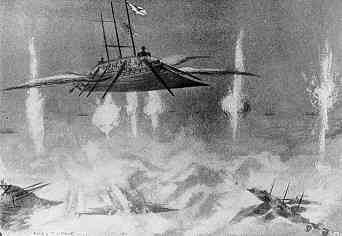 "Still The Fight Went On At Long Ranges." |
Morning came, the flaming arch of the Fire-Cloud sank lower and lower in the heavens until it stretched a broad band of lurid light round the western horizon, and an unclouded sun brought the last dawn but one that the terror-maddened myriads of earth would ever see. Still the fight went on at long ranges; still ship after ship of the hostile fleet made its desperate effort to cross the invisible barrier which was drawn all round Aeria by the range of its protecting guns, only to be overturned and hurled to the earth by the shock of an exploding projectile or to be fairly struck and dissolved to dust.
No matter how high they attempted to soar, the Alma and the Isma were still above them, and if the shells from the land batteries failed to do their work the guns of the air-ships did it for them and the result was the same-- annihilation.
The night of the 22nd was spent in incessant attack and defence. The crews of the Aerian ships, grown desperate in their supreme despair, now left the mountains and sallied forth into the open, engaging the enemy ship for ship and gun for gun in a last determined effort to destroy them, or be destroyed, and far out from the still untouched battlements of Aeria the fight raged fast and furious.
There now was no thought of safety in the hearts of the Aerians. They had come forth to kill and be killed. The rules of aerial tactics were utterly neglected. They laid their guns alongside and, rushing through the air at their utmost speed, they hurled themselves with the ram upon every Moslem or Russian vessel that they could meet or overtake, crashing into her with irresistible force and going with her into annihilation as their two cargoes of shells exploded under the shock.
The last sun rose and saw the fight still going on. What had begun as the greatest battle in the history of war had now dwindled down to a series of single combats. At length the end came. It was a few minutes after midday that the last blow in the battle was struck. Ten Russian and Moslem air-ships, all that remained of the great fleet that Olga had brought against Aeria, formed in line ten miles from the Ridge and made a last attempt to break through the defences.
Flying through a storm of shells from the land batteries, seven of them were torn to pieces and the other three, just as they reached the Ridge, were met obliquely by the five remaining vessels of the Aerian fleet. The same moment the Alma's broadside was discharged upon them, friend and foe vanished together in a mist of flame-- and so ended the assault and defence of Aeria.
"We can go down now!" said Alan in a broken voice to Alma, who was standing white and speechless with horror at his side in the bows of the air-ship. "It is all over! God rest their gallant souls, for they left the world like brave men and true Aerians!"
"Amen!" sighed Alma. Then, after a brief pause, she said-- "I wonder whether Olga Romanoff is alive or dead?"
The two air-ships now sank together and alighted close to the entrance to the caverns.
There the splendid fabrics were reluctantly abandoned, their crews disembarked, taking with them everything they wished to preserve, and a minute inspection was made for the last time of the triple doors and the machinery for lowering them and filling the spaces between them with water to be frozen as soon as they were in their places.
This occupied the time until the evening, and then all went once more into the open air to take what might be their last look at the sun. The waters of the lake were now within a few feet of the entrance, creeping more and more slowly upwards, and across the vast expanse of water, lying unruffled by the lightest breeze, fell the mingled rays of the sinking sun and the brightening Fire-Cloud.
There was not a cloud in the heavens and no breath of wind relieved the almost suffocating heat of the inert and sultry air. It seemed as though all terrestrial nature lay paralysed in a stupor of terror, waiting for the fire-blast that would wither it into death and ruin.
As the sun sank down behind the veil of flame his disc loomed redly and dully through it. Long streams of fire, blue and green and orange, darted across the disc and leapt and played round its circumference until it sank finally out of sight. The little group on the shore of the lake gazed at each other in silence as it disappeared.
Their faces looked wan and ghastly in the awful light that now reigned supreme in the heavens. Most of them turned away in grief and horror too deep for words, and with one last look at earth and sky, crept into the caverns, unable any longer to support the terror of the scene.
But a few remained, determined to see the fearful drama played out to the end, if they could, and among these were Alan and Alexis, whose duty kept them by the doors, the President and Francis Tremayne, and Alma and lsma, whom nothing could persuade to leave their husbands' sides.
No human eyes had ever beheld so magnificent or so awful a display of celestial splendours as they beheld during the three hours that they stood in the doorway after sunset. The Fire-Cloud now covered almost the whole heavens, and its enormous nucleus blazed like a gigantic sun down out of the zenith with a heat and radiance that were almost insupportable.
Huge masses of flame leapt out continuously, as though hurled from its fiery heart, and were projected far beyond its circumference, while the incandescent cloud-mass which surrounded it was torn and convulsed by internal commotions which spread out and out in enormous waves of many-coloured fires until they disappeared below the horizon.
Still there was neither sound nor breath of wind upon earth, only the awful stillness in which the world waited for the hour of its doom to strike. At last, towards ten o'clock, the water began to lap the threshold of the entrance, and Alan, pointing to it, said--
"Come, we must take our last look at the world. It is time to lower the doors."
The words were scarcely out of his mouth before a low dull booming sound came echoing down the gorges of Mount Austral. They looked up and saw huge masses of snow and ice loosened from its upper heights gliding, at first slowly and then more and more swiftly, down towards the valley beneath, a mighty avalanche which in a few minutes more would carry irresistible ruin in its path.
"In with you all!" cried Alan. "Quick! That is the beginning of the end; the snows are melting and the waters will be over us in another hour."
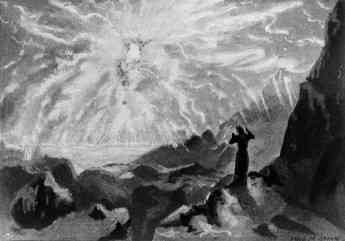 "The Blazing Sky Was Literally Raining Fire Over Sea And Land." |
Huge masses of many-coloured flame were falling from it in all directions on the devoted earth, and as each of these entered the atmosphere it burst into myriads of fragments which fell in swarms until the blazing sky was literally raining fire over sea and land.
The Fire-Cloud had at last invaded the outer confines of the earth's atmosphere.
All this while there had been no change in the Antarctic cold of the air, but soon after the first storm of explosions roared out Olga felt a puff of warm tainted air blow across her face. Then came another and another, and then she heard what had never been heard before on the slopes of Mount Terror-- the sound of running water. The snows were melting, and soon there would come avalanche and deluge.
She hurried back into the council chamber, convinced that it was no longer safe to remain in the open air. She made the great bronze doors fast and covered them with layer after layer of thick heavy curtains. Every other opening into the chamber she closed up as tightly as possible. In the nature of the case they were compelled to trust to the supply of air already in it to last them through the ordeal.
Then she went and sat down on the divan by Khalid's side, and, taking his hand in hers, bent over him and kissed him on the lips, saying--
"Now we must wait for life or death together!"
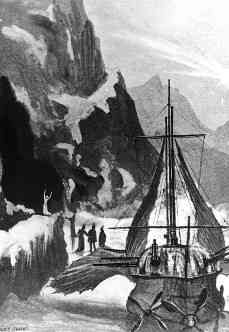 "Olga Romanoff Had Survived The Doom Of The World." |
Olga Romanoff had survived the doom of the world, but the hand of a just vengeance had fallen heavily upon her. Her once splendid form was shrunken as though three score years had passed over her in as many hours. Her left side was half paralysed and her shaking limbs hung loosely as she tottered along.
Her golden fillet and jewelled wings had been cast away, leaving bare the great livid scar that crossed her forehead; her white, drawn face was seamed with deep lines marked by agony and terror, and the thick masses of the once glorious hair that hung about her head and shoulders were streaked with grey and clotted with blood.
The fire had died out of her eyes and the red from her shrivelled lips, and the weak broken voice in which she answered Alma's greeting quavered like that of an old woman in her dotage.
"I have been expecting you," she said as Alma took her trembling hands in hers. "I thought you would come. You have come for Alan, haven't you? He is yonder, but he is dead. I kept him alive as long as I could but he was wounded, and when the world was changed to hell for my sins the fire choked him.
"I tried to die too, but it wouldn't kill me. There was air enough for me and I wanted to give it to him to breathe but he wouldn't take it. I suppose you have been dead and are an angel now like those others behind you. Come, I will take you to him. It is dark but I know the way."
The moment she began to speak Alma saw the awful calamity that had befallen her. The haughty daring spirit that had essayed and almost achieved the conquest of the world was dissolved in the bitter waters of the Marah of Madness. The soul that had quailed before no human fear had collapsed into imbecility under the superhuman terrors which she alone had witnessed and survived. Without a word she suffered her to lead her into the gloom, beckoning to the others to follow. They turned on the electric lamps they had brought with them and entered the chasm.
They reached the black ash-strewn floor of the gloomy subterranean lake in the heart of the mountain, and Alan, pausing for a moment, flashed the light of his lamp round the vast chamber that had once been so terribly familiar to him. The walls were burnt and blackened, and here and there masses of rock and boulders had been calcined to dust as though the long pent-up lava that had once flowed in fiery torrents over them had again been let loose.
Then the light fell upon something that was not rock and which gave back a dull metallic sheen. He took a few strides towards it and soon recognised it as all that was left of the once shapely and beautiful Ithuriel, the old flagship of the Aerian fleet with which he had lost the mastery of his own manhood and his people the empire of the air.
The crystal dome of the roof was gone and lay in patches of congealed glass about the blackened and shrivelled-up deck. The wings were burnt away and the transverse ribs of azurine stood out bare and twisted like the bones of a skeleton, and in the fore part of the hull a great gap showed where her magazine had taken fire and burnt with such terrific heat that it had melted even the azurine plates of which she was built.
"The poor old Ithuriel has flown her last flight!" he said to himself with a sigh as he turned away and followed the others, thinking sadly of all that had come to pass since he had last trodden her deck.
Olga, holding Alma by the hand, led the way from the lower gallery to the council chamber. As she pulled the curtain aside from the doorway a puff of foul air that seemed to bear a faint smell of blood was wafted in their faces. Alan called Alma back, fearing that she would faint in the sickening atmosphere, and at the sound of his voice Olga stopped short and looked back with a reawakened gleam in her eyes.
"Who is that?" she cried, pressing her hand to her brow. "Why, it is Alan! But no, Alan is here-- here. He has been with me all the time since Khalid shot him. My God, can he have come to life again?"
Her voice rose to a shrill wavering scream as she said this. She dropped Alma's hand and ran with faltering, stumbling steps towards a divan on which lay the form of a man whose black beard and moustache were thickly clotted with blood. She stopped and bent over it for a moment, then she raised herself and faced them with her hands locked in her hair and the light of frenzied insanity blazing in her eyes.
"No! No!" she cried in a voice, half a scream and half a wail, that rang weirdly through the great chamber. "He is dead still and that is only his ghost. Oh, Alan, my love, Alan! Why could I not die with you? Curse the hand that wounded you. Curse"--
In the one syllable her voice died away from a scream to a whisper, and at the same instant the paralysis, which had already smitten her once, laid its swift icy hand on her heart and brain. She swayed to and fro for a moment and then fell forward across the corpse of the man whose love for her had plunged the world into madness on the eve of its doom.
"What an awful end!" gasped Alma, shuddering in the close embrace she had sought in Alan's arms. "And yet,
Alan, she loved you to the end through all. That love for you was the one true thing in her life, and for its sake I will
say God forgive her! Come, let us go!"
THE END.